
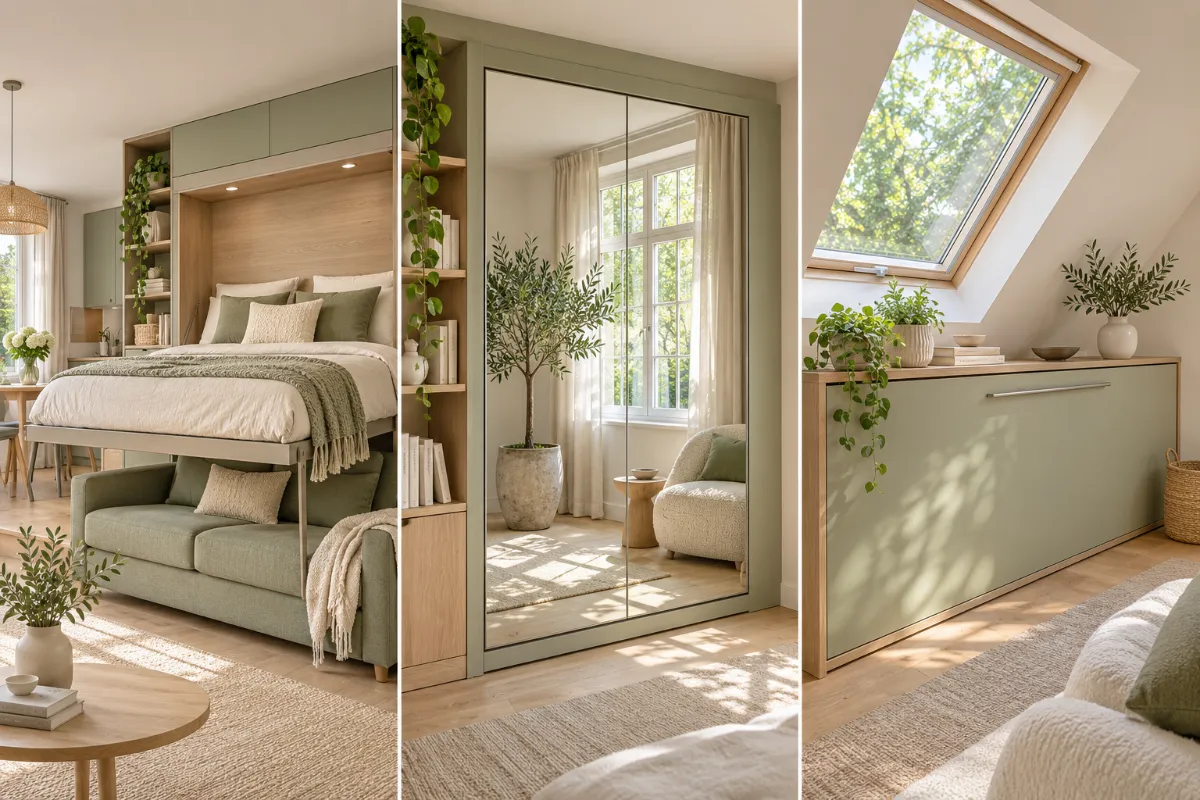
Most studio apartments make you choose. You can have a bed that takes up half the room, or a living room where you sleep on the couch and pretend that’s fine.
A wall bed gets you out of that choice. It folds up in the morning, and suddenly there’s floor for a yoga mat or a friend’s chair. You can walk across the room without hitting your shin on a bed frame. At night it comes down, and you’re sleeping on a real mattress again.
The catch is that not every setup suits every apartment. A sofa-front bed needs depth. A horizontal one needs a long wall. Renters have to think about drilling into studs, and anyone with kids has to think about safety first.
So these murphy bed ideas for a small apartment start from real rooms: low ceilings, shared kids’ rooms, closets nobody uses, and leases that say no holes. Each one tells you what the setup needs and who it works best for.
1. The Sofa-Front Murphy Bed That Turns a Studio Into a Real Living Room
Friends come over, and the first thing they see is your bed. That’s the studio problem in one sentence.
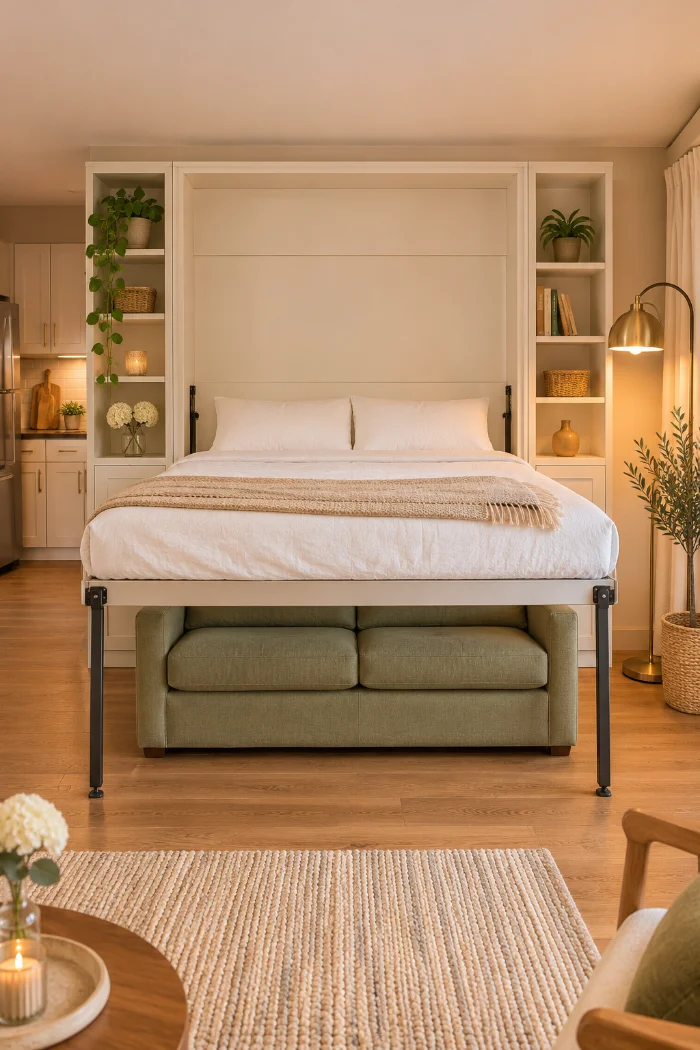
A sofa-front wall bed fixes it by putting a real couch in front of the folded bed. During the day, the cabinet reads as a wall unit with a sofa. At night, the bed swings down over the sofa. On many designs the sofa stays where it is, so you aren’t moving cushions or dragging furniture around.
Before you order one, check two things:
- The full depth on the spec sheet, since the sofa adds to how far the unit sticks out
- The sofa fabric, because you’ll sit on it every single day
It works best in studios where one wall faces the main seating area.
The bed stays down all day. Guests perch on the edge of your duvet, laundry piles up on it, and every video call shows your pillows.
By day you get a couch facing the room, open floor in front of it, and a backdrop that looks like shelving. The bed only shows up when you need it.
2. A Desk-Front Wall Bed for a Room That’s Both an Office and a Guest Room
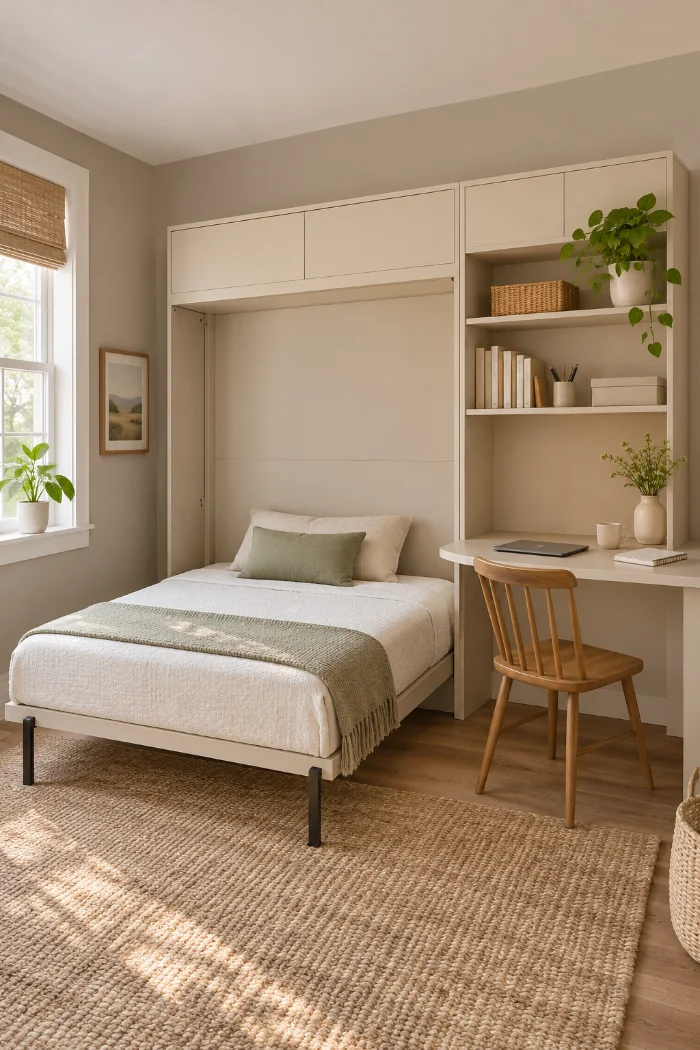
A sofa-front bed and a desk-front bed solve two different problems. The sofa version is for living rooms. The desk version is for the spare room that’s an office five days a week and a guest room a few nights a year.
The clever part is the desk. On many models it stays level as the bed comes down, so your mug and notebook can stay where they are. That matters, because having to clear a desk every time someone visits is how spare rooms end up with an air mattress instead.
Pick desk-front if:
- You work from home in that room
- Guests visit now and then, not every week
One honest limit: these desks tend to be shallow. If you use two big monitors, measure before you buy.
| Desk-Front | Sofa-Front | |
|---|---|---|
| Best room | Spare room or home office | Studio or living room |
| Daytime job | A place to work | A place to sit and host |
| Bedtime prep | Tuck in the chair, lower the bed | Pull off throw pillows, lower the bed |
| Watch out for | A shallow work surface | Extra depth out into the room |
3. A Horizontal Wall Bed That Fits Under a Window or a Low Ceiling
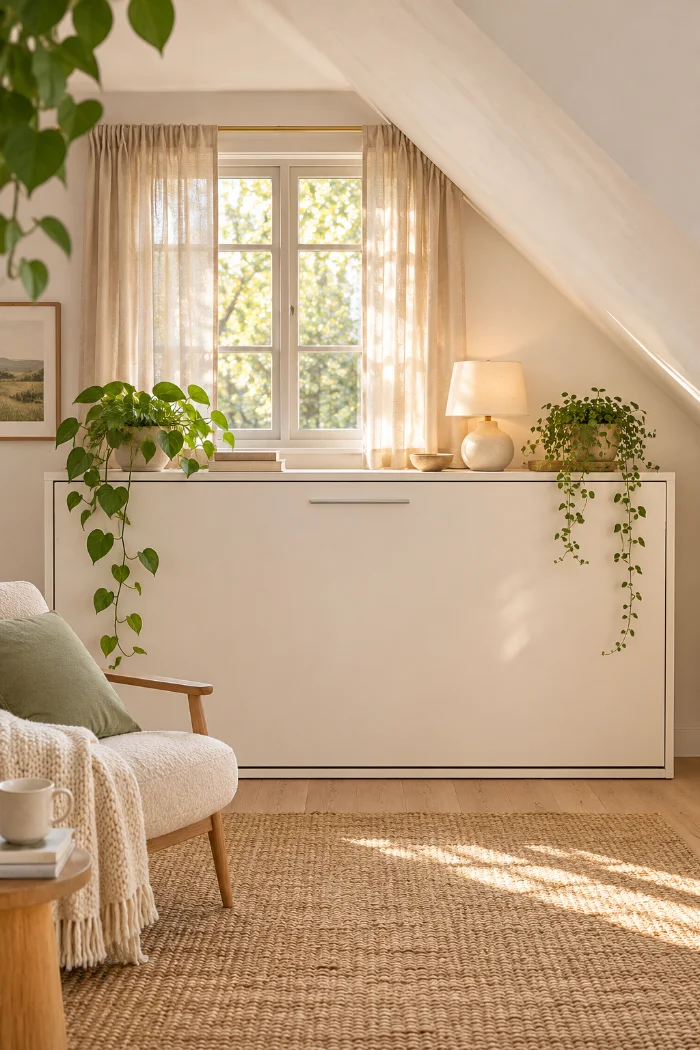
A lot of people rule out a wall bed because their ceiling is low or their only free wall has a window in it. A horizontal bed gets around both.
It folds up along its long side, so the cabinet is wide and low instead of tall. That leaves space above it for a window, a shelf, or a sloped attic ceiling.
Where it fits best:
- Under a window you don’t want to block
- Attic rooms with a slanted ceiling
- Narrow rooms, where a bed opening lengthwise would block the door
The payoff is a bed that disappears into a room you thought was too awkward for one.
4. Tuck the Bed Into a Closet or Alcove So It Gets Its Own Nook
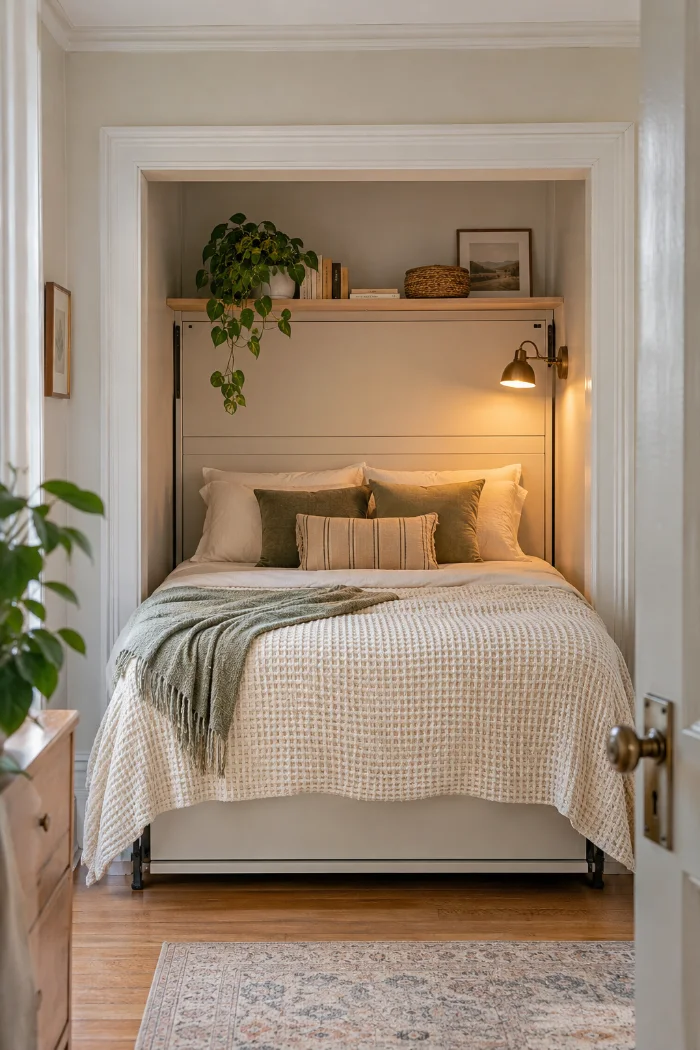
Almost every older building has one closet that doesn’t earn its keep. It holds a vacuum, a stack of shopping bags, and a box you haven’t opened since you moved in.
That space can hold a wall bed. With the doors off, the cabinet sits inside the opening, so it doesn’t stick out from the wall when it’s folded up. The side walls hide the cabinet edges, and the whole thing looks built in.
The measuring matters more here than anywhere else, because old closets are rarely square. Follow the steps below before you buy anything.
Renter tip: label the closet doors and hinges and store them under the bed or with a friend. You’ll want them back on move-out day.
Measure the width at the top, middle, and bottom of the opening. Use the smallest number.
Measure the height from the floor to the bottom of the door frame, not to the ceiling inside the closet.
Compare the closet depth with the cabinet depth on the spec sheet, and leave room for baseboards.
Use a stud finder on the back wall. If there are no studs where the bed needs anchoring, choose a different spot.
5. A No-Drill Cabinet Bed for Renters Who Can’t Anchor Anything
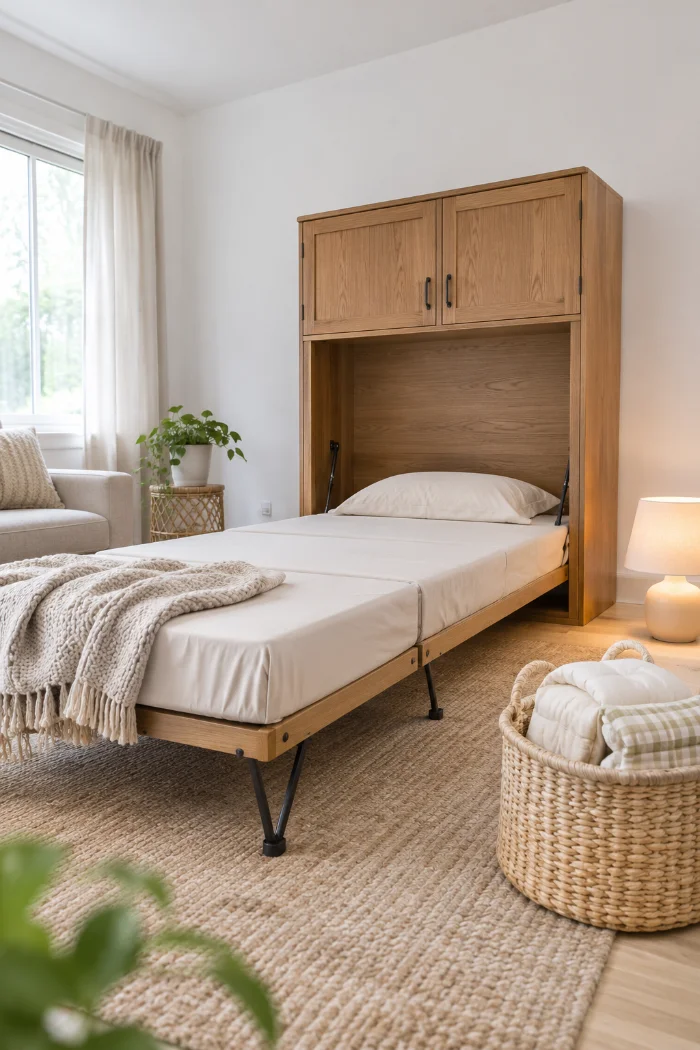
Here’s a simple rule: if your lease bans holes in the walls, a traditional murphy bed isn’t your bed. Most of them have to be anchored into wall studs to be safe.
A cabinet bed avoids that problem. Closed, it looks like a wide chest or console. Open the top, unfold the front, and a mattress rolls out on its own legs. Nothing is fixed to the wall.
A few things to know first:
- The mattress usually folds in sections, so you may feel the seams. A thin topper helps.
- Check the open length against your room, just like any other bed.
- Some models have a drawer for bedding. If yours doesn’t, keep a lidded basket nearby.
It’s a smart choice for a first apartment you already know you’ll leave.
6. Frame the Wall Bed With Floor-to-Ceiling Shelves on Both Sides
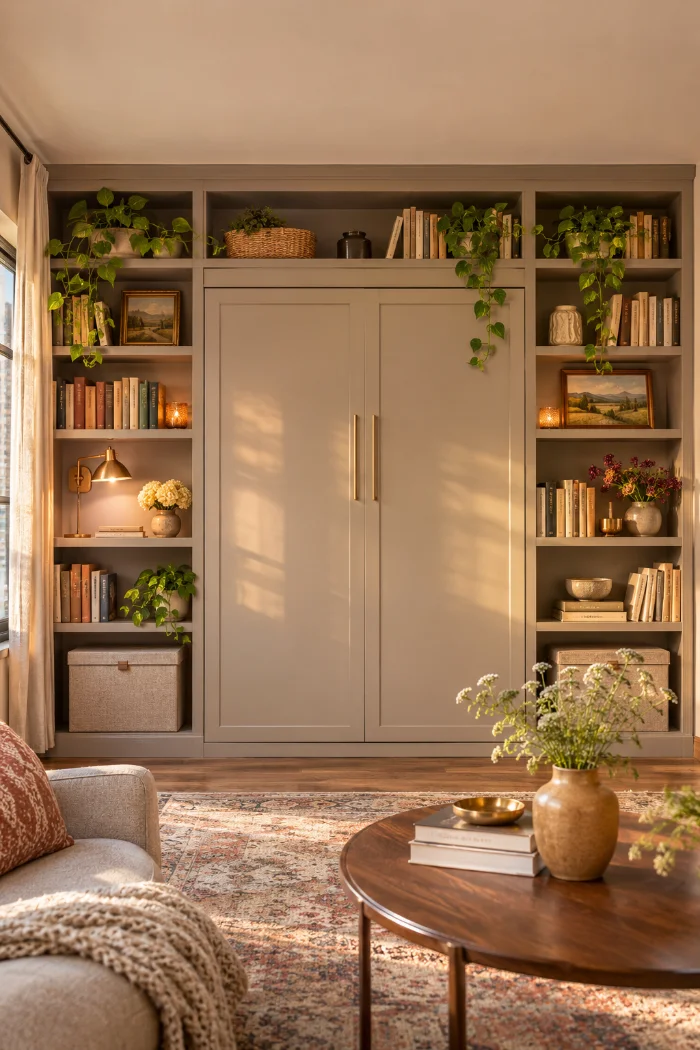
A murphy cabinet alone on a bare wall looks like what it is: a big box. Put tall shelves on either side and your eye reads the whole wall as one built-in piece of furniture.
The shelves also fill a gap most people don’t think about until the first night. A wall bed has no nightstand, so the shelf closest to your pillow has to become one.
Two ways to get the matched look:
- Buy the side units the bed’s maker sells
- Use plain bookcases close in depth and color, then paint them all the same shade
Renter note: tall bookcases need anti-tip straps, and those usually take one small screw. Check your lease or ask your landlord first.
What belongs on the side shelves
7. Side-Tilt Bunk Wall Beds for a Shared Kids’ Room
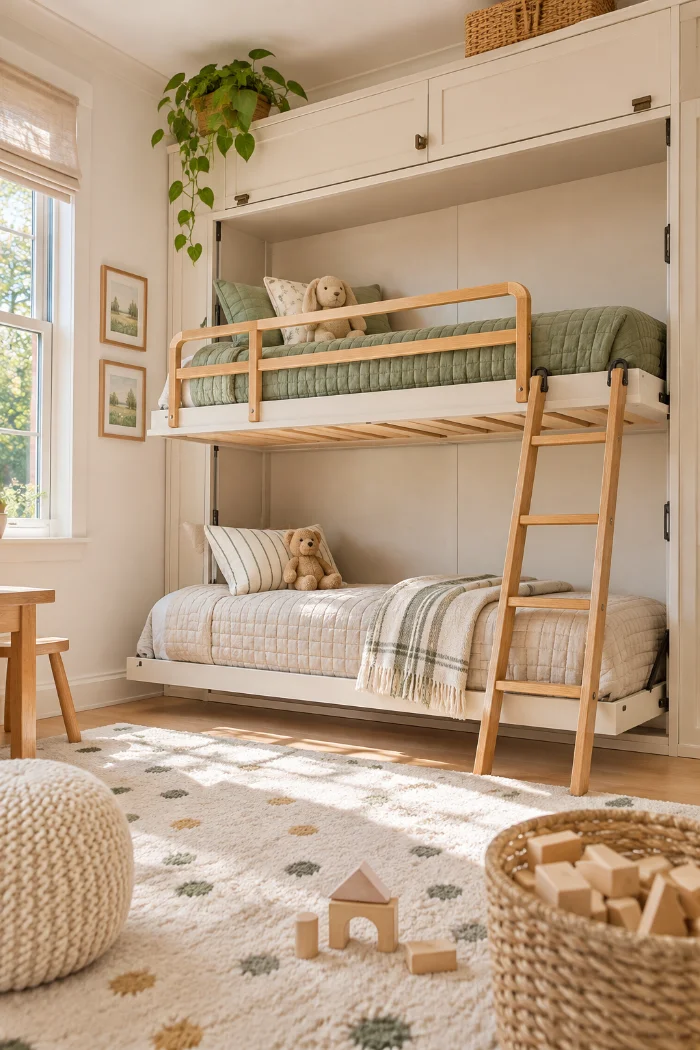
Two kids, one small bedroom, and once both beds are made there’s nowhere left to build a block tower. That’s the room bunk wall beds were made for.
Both bunks fold up into one wall cabinet, often sideways, so the room opens up for play during the day. At night they come down stacked, like regular bunk beds.
Before you choose a model, check:
- The ceiling height listed for the top bunk, so an older kid can sit up without hitting their head
- That a guard rail and ladder come with it
- Where the ladder goes when the beds fold up
This setup suits families who plan to stay in a small place for a while, since it’s a bigger install than a single bed.
Treat a wall bed like a heavy appliance. Anchor it into the studs exactly as the instructions say, make raising and lowering it an adult’s job, and teach kids that the frame is not for climbing or hanging.
8. A Mirror-Front Murphy Bed That Makes the Room Feel Bigger
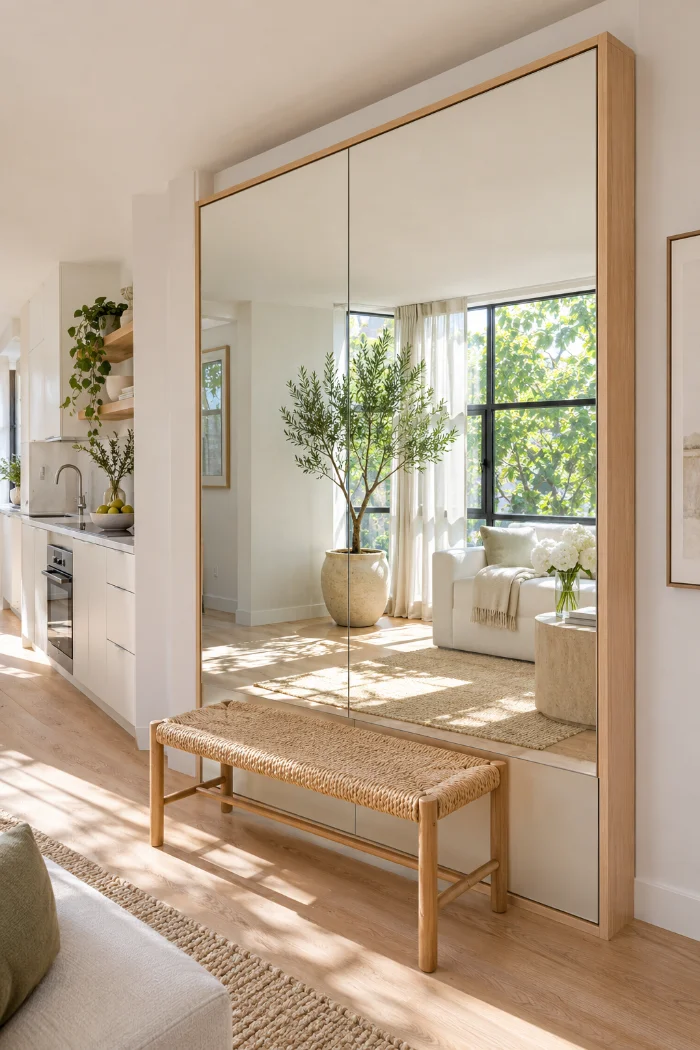
A mirror is one of the easiest ways to make a small room feel deeper. A mirror-front wall bed gives you a full-length one without giving up another wall.
When the bed is up, the whole cabinet reflects the room back, and the bed vanishes. When it’s down, nobody needs the mirror anyway.
It does three jobs at once:
- A dressing mirror for checking your outfit before you leave
- A light bouncer when it’s beside or across from a window
- A disguise, since most guests never guess there’s a bed in there
Mirror panels are heavy, though. Choose a bed built to carry them, and don’t glue mirrors onto a standard front.
💡 Quick Tip
Before you commit to the wall, stand where the bed will go and look at what sits opposite. A mirror doubles whatever it faces, so a window or a plant is great. The dish rack or the shoe pile, not so much.
9. A Ceiling Curtain Track That Gives Your Murphy Bed Privacy in a Small Apartment

The most common mistake is a tension rod stretched across the room. It sags in the middle, the curtain drags, and eventually the whole thing drops at 2 a.m.
A ceiling-mounted track works much better in a studio. When a guest stays over, or one person is up late on the laptop, you pull the curtain and the sleeping area becomes its own little room. In the morning it slides back and stacks neatly against the wall.
Look for a track that can bend around a corner if your bed sits in one. Pick fabric close to your wall color, so the stacked curtain fades into the background during the day.
Small screws in the ceiling are usually needed, so check with your landlord first.
Hang the curtain long enough to just touch the floor so it blocks light from below.
Mount the track a little past the open bed’s edge so the curtain clears the mattress.
Choose a medium-weight fabric that blocks light but still slides easily.
Tension rods across a wide room. They are meant for short spans like windows.
Curtains that stop above the floor. They look temporary and let in light.
Fabric so heavy that it strains the track or takes two hands to pull.
10. A Rolling Coffee Table and Rug Plan for the Floor Where the Bed Lands
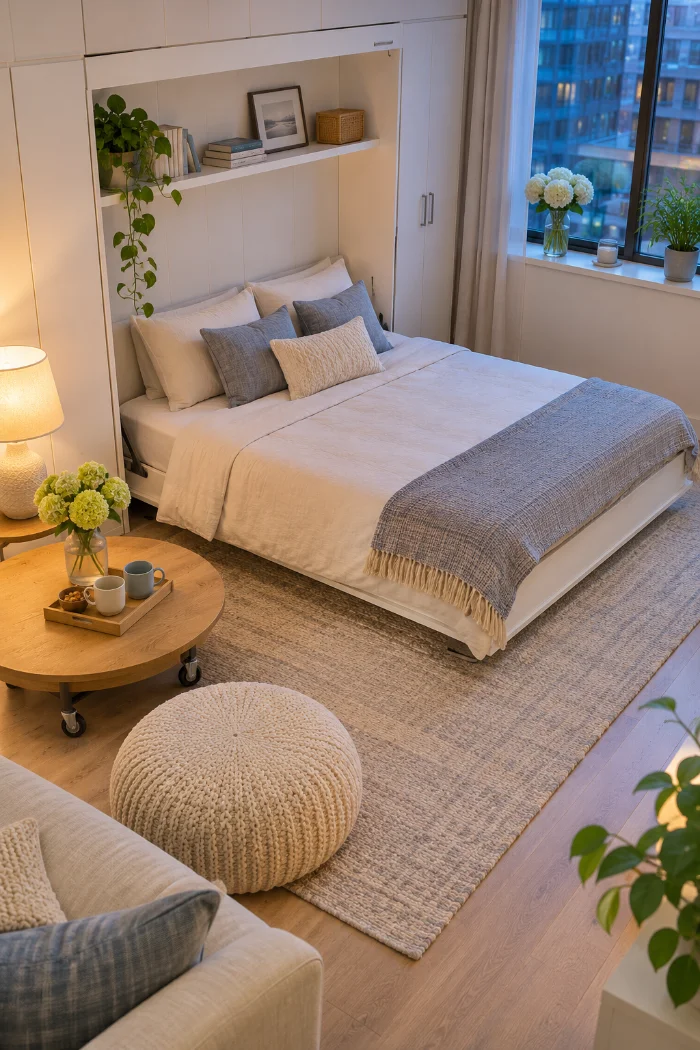
Start with the floor, not the bed. Lower the bed once, then mark the outline of the mattress with painter’s tape. That taped zone is the floor the bed claims every night.
Everything inside that zone needs to move fast:
- Put the coffee table on locking casters so it rolls to the side in seconds.
- Choose a flat, low-pile rug. A thick, fluffy one can make the bed’s legs sit unevenly.
- Keep floor cushions or a pouf in place of a heavy armchair.
Once the table rolls away in one push, making the bed takes a minute instead of a chore you put off. That’s what makes you actually use it every night.
⚠️ Watch Out
The mattress blocks your view of the floor as it comes down. Make a habit of a quick look first for toys, a sleeping pet, or a charging cable in the landing zone, and lower the bed slowly with both hands.
Making a Wall Bed Work in Your Space
A wall bed needs a little planning up front. Measure the wall, check your lease, and work out where the bed will land before you buy anything. Get those right, and the bed becomes the easiest part of the room.
The best setup is the one that matches how you actually live. If guests come twice a year, a desk-front bed or a cabinet bed is enough. If you sleep in your living room every night, a sofa-front bed is worth the bigger install.
Keep these murphy bed ideas for a small apartment close by. Save this list to your small space board for the day you finally measure that empty wall.
Before you buy any wall bed