

Small apartments are rarely short on space. They’re short on places to put things.
The gap under your bed, the back of every closet door, the four inches beside the fridge, the wall above the toilet. That space already exists in your home right now, and most of it is holding nothing at all.
Once you start seeing it, a cramped apartment starts feeling a lot bigger without a single thing being thrown out.
These 30 small apartment storage ideas cover every room, from the entryway you drop your keys in to the balcony you use twice a year. Some are weekend projects, like drawers built into a bench base or a pegboard painted to match your kitchen.
Plenty need nothing more than ten minutes and no holes in the wall, which matters when your lease says so.
You’ll find shoes tucked under a staircase, a desk that folds flat when you’re done with it, a cart that slides into a gap you thought was useless, and bedding compressed down to a quarter of its size. Start with the room that frustrates you most and work from there.
If floor space is the real problem, start with my 15 vertical storage ideas, then come back for room-by-room fixes.
1. Slide Pull-Out Shoe Drawers Into the Wedge Under Your Stairs
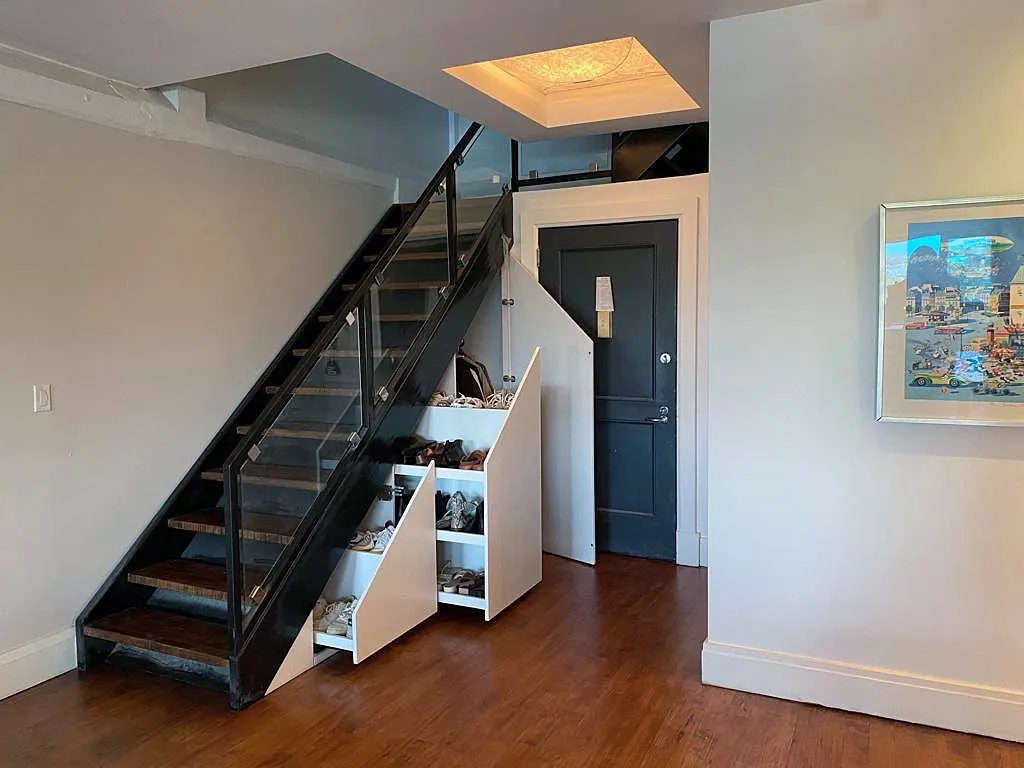
The staircase in this entry does double duty. Each white unit is cut to follow the slope of the steps, so the tallest sits at the back and the shortest tucks in near the floor. They roll straight out into the room, which means you reach the back row of shoes without crouching or digging.
Worth copying:
- Angled tops that waste zero height under the stringer
- Open shelves inside, so nothing disappears into a deep bin
- Flat white fronts that read as wall instead of furniture
Renting? A row of low rolling bins pushed under the same slope gets you most of the way without cutting into anything.
2. Park Soft Canvas Cases in the Gap Under a Leggy Bed
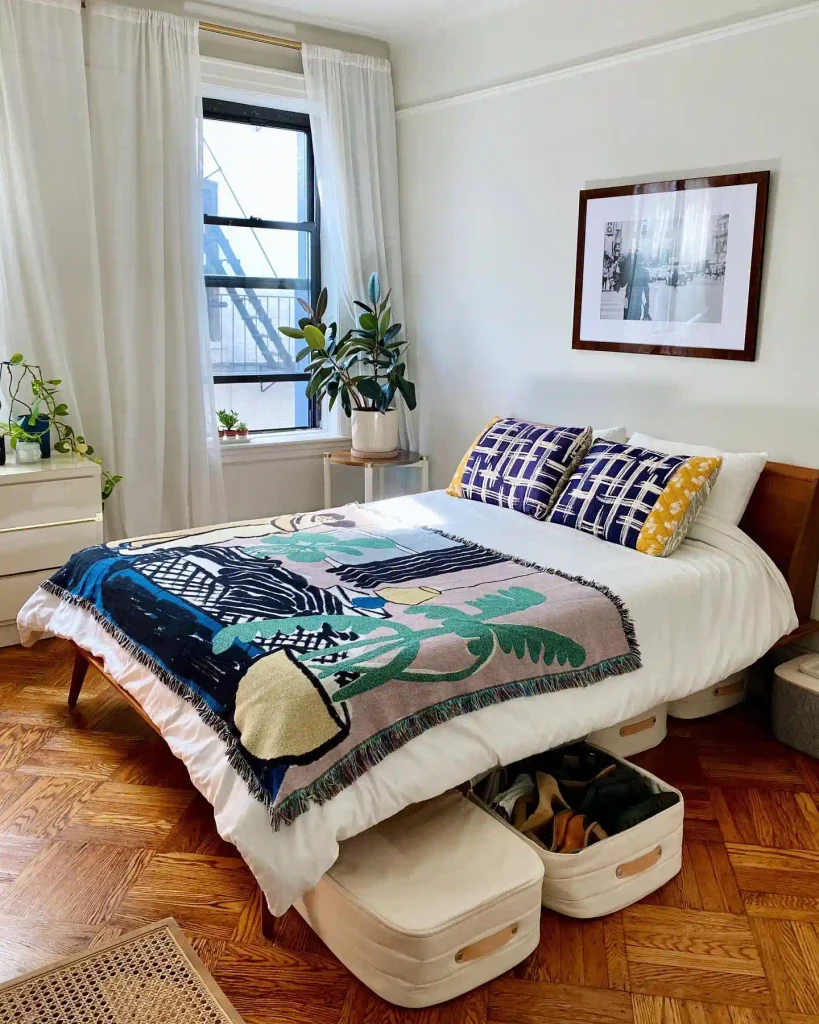
Notice how high the bed sits. Those slim wooden legs buy roughly a suitcase of clearance, and the room uses every inch of it with matching canvas cases that slide out by a leather tab. One sits open with heels and boots inside, which is the smart move: shoes take up closet floor space that hanging clothes can’t reach anyway.
Soft cases beat hard plastic bins here for two reasons. They squash slightly to fit a tight gap, and in cream fabric they read as part of the bedding instead of storage.
Keep the lids closed between grabs, or you will be dusting shoes every week.
Shoes you wear in rotation, sorted one case per type.
Off season sweaters and spare bedding, folded flat.
Gift wrap, tote bags, anything long and thin.
Paperwork and photos, since floor level is the first place a leak reaches.
Daily items you need in a hurry while half awake.
Anything taller than your leg gap, which forces the case to sit crooked.
3. Run a Tension Pole Rack Up the Wall Above the Toilet

Bathrooms hide their best real estate overhead. Above the tank there’s usually four feet of blank wall doing nothing, and a tension pole unit claims all of it without a single hole.
How it goes in:
Stand the poles just wider than the tank, clear of the lid so you can still lift it.
Twist each pole tight until the ceiling caps sit flush and the frame stops wobbling.
Set the shelves so the heaviest load sits low, and spread weight across the board instead of piling it at one end.
Leave the top shelf for light backstock, since that height is hard to reach safely.
Ten to twenty minutes start to finish, and it leaves no marks when you move out. Go for stainless or powder coated metal, because raw finishes spot in a steamy bathroom. The styling trick worth stealing: stacked towels and a lidded basket up top, small bottles and a plant lower down, so the rack looks arranged rather than stockpiled.
If there’s no cabinet in your bathroom at all, here’s my full plan for bathroom storage with no cabinet.
4. Let an Open Shelf Unit Carry Your Desk and Your Clutter at Once
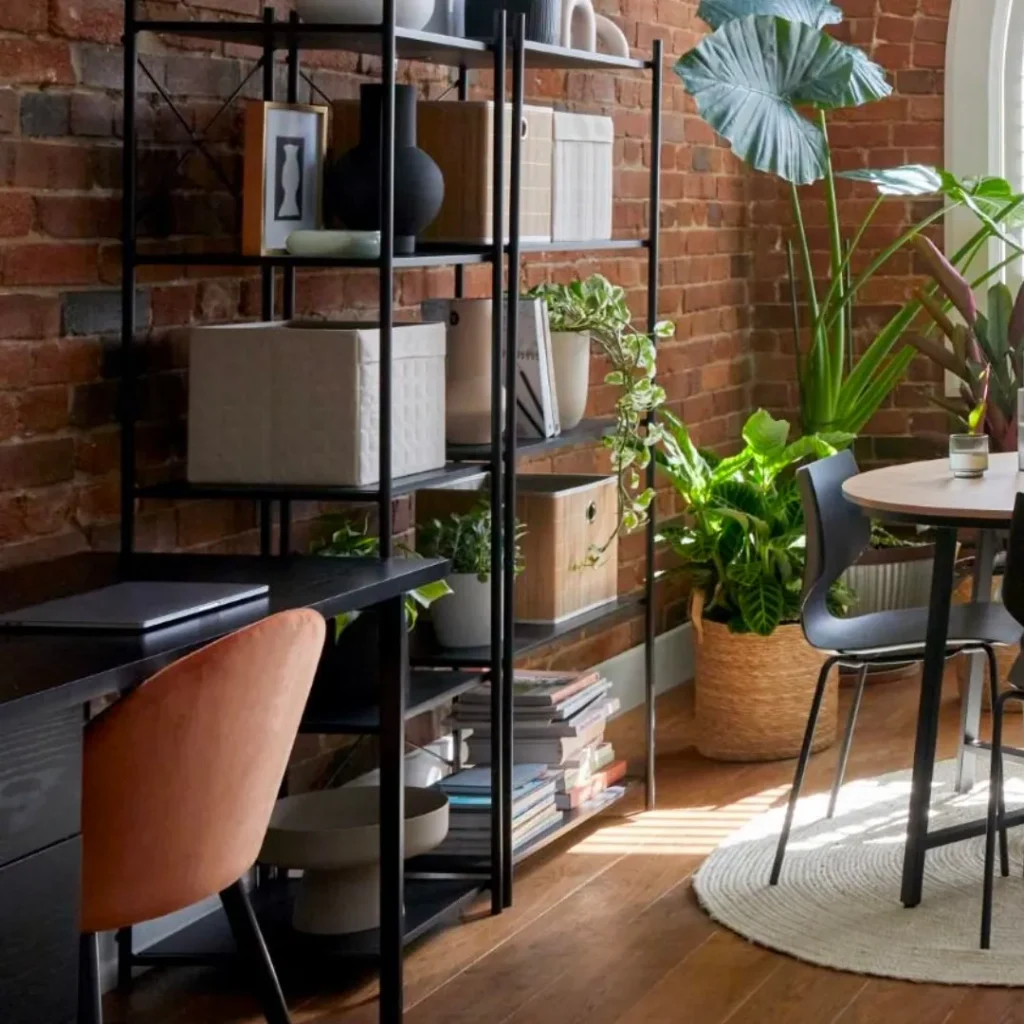
Look at where the desktop meets the frame. The work surface bolts straight into the same black uprights that hold the shelves, so one footprint covers a home office and a full wall of storage. In a studio that saves you from buying two separate pieces that each eat floor space.
The storage itself is mixed on purpose:
- ▸Lidded fabric and woven boxes swallow the ugly stuff, cables, chargers, paperwork.
- ▸Book stacks lie flat on the lower shelves, which is steadier than upright rows and reads calmer.
- ▸Plants and a couple of ceramics break up the boxes so the whole thing doesn’t look like a stockroom.
The open back matters too. Against exposed brick the shelf shows the wall through it, which keeps a tall unit from feeling like a solid block in the middle of the room. Lightest and prettiest things go up high, heavy and boring things go down low.
5. Hang a Labeled Pocket Organizer on the Back of the Closet Door
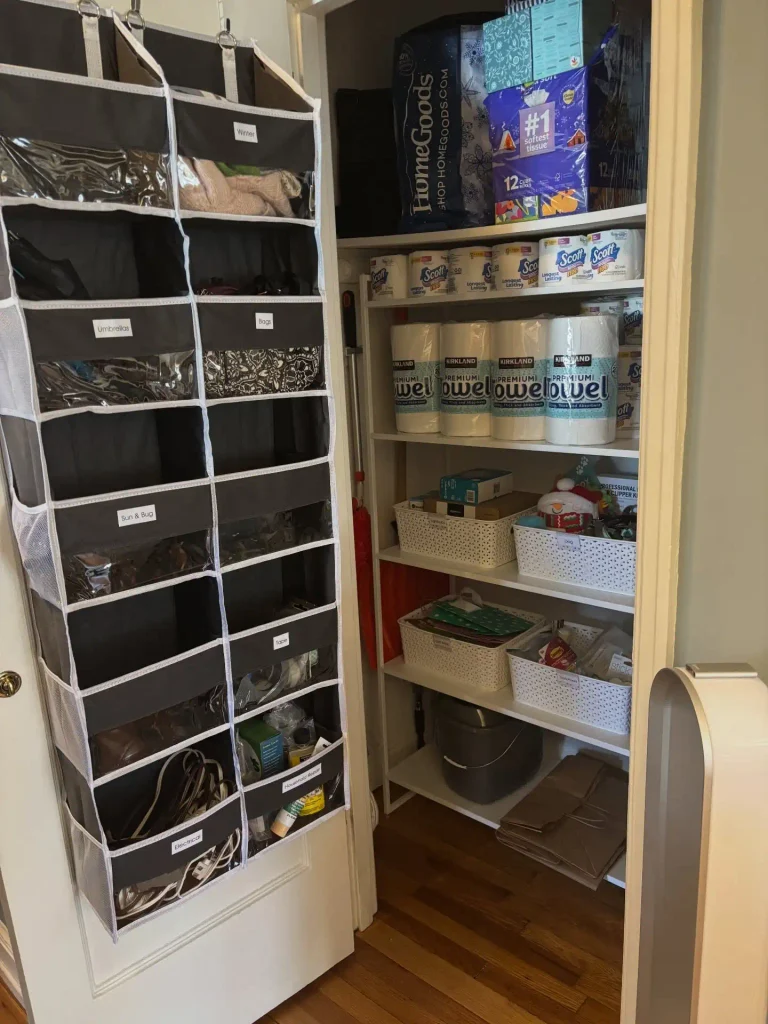
Every closet door in your apartment has a free vertical panel on the inside. This one carries two columns of clear pockets on over-the-door hooks, and the labels are what make it work: Winter, Umbrellas, Bags, Sun & Bug, Tape, Electrical, Household Repair.
💡 Quick Tip
Sort by when you reach for something, not by what it is. Sunscreen, bug spray, and a hat live together because you grab them on the same kind of day, even though a store would shelve them in three aisles.
Clear fronts do the heavy lifting. You see the tangle of charging cables without pulling the pocket open, so the cable drawer problem quietly disappears. Deeper pockets sit low where weight is easier on the hooks, lighter seasonal stuff rides up top.
The closet behind it follows the same logic, with shelves for bulk paper goods and labeled white baskets for small odds and ends. Total spend stays low because the shelf unit is plain and the organization does the work.
6. Fill the Dead Air Under Short Hanging Clothes

Shirts and shorts stop about halfway down a closet. Below that hangs roughly two feet of wasted vertical space in almost every apartment closet, and this one fills it with a low four-tier rack that slides in under the rod.
Three zones stacked in one closet:
Three hooks screwed into the blank wall beside the rod matter more than they look. Caps and a drawstring bag hang flat against a surface that would otherwise hold nothing at all.
One habit keeps it working: measure your shortest hanging item first, then buy a rack an inch or two under that height. Guess wrong and the clothes drape over the top shelf every time you reach in.
7. Hang Bulky Gear Flat Against the Back of the Front Door
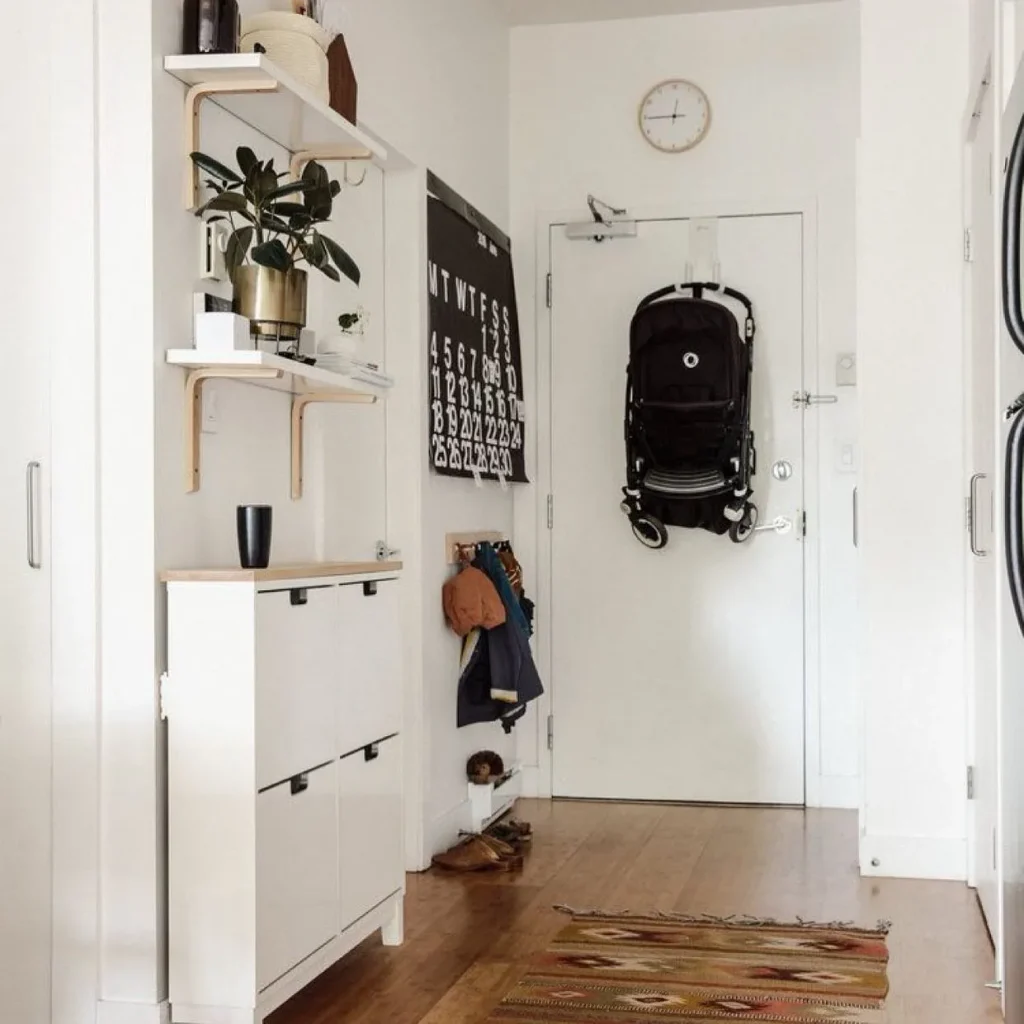
Strollers, folding chairs, drying racks, a bike helmet. Big awkward items that never fit a closet usually end up parked in a walkway. Here a folded stroller hangs off a bracket mounted high on the front door, sitting flush and clearing the whole floor beneath it.
Bulky things eat floor space by lying down. Stand them up on a wall and a hallway stays a hallway.
Two things make it safe rather than annoying. The bracket sits above head height so nobody walks into it, and the item hangs on the hinge side edge where the door swings without catching the frame. Check your door swings fully open before you mount anything, since a few inches of extra depth can stop it hitting the wall.
The rest of the hall follows the same thinking. A slim tilt-out cabinet takes shoes in a depth of just a few inches, a hook rail handles coats, and floating shelves run up the wall above it. Everything stays pressed against a vertical surface.
Hollow doors need the right anchors, or use an over-the-door bracket that hooks on the top edge and needs no hardware at all.
8. Build Drawers Into the Base of a Built-In Bench

Seating normally donates its underside to nothing. This banquette wraps the corner and the whole plinth underneath is filled: a stack of three white drawers with black knobs at the end nearest the walkway, and more drawer fronts continuing along the side facing the room.
Legs, a gap underneath that collects dust, and storage you have to crawl for. Pulls away from the wall and wastes the corner.
Solid base full of drawers, seating tight to the wall, and a corner turn that adds seats without adding footprint.
Drawers beat a lift-up seat lid here. You open one without moving cushions or asking someone to stand up, which means the storage actually gets used on a normal Tuesday.
The kitchen behind it stacks two levels of cabinets up to the ceiling, with open cubbies at eye height for mugs and everyday plates and closed doors above for everything you’d rather not look at. Even the ceiling works, with two plants hanging beside the skylight instead of taking counter space.
Worth knowing: a bench like this is a build, not a purchase. Renters can get close with a low storage cube unit pushed against the wall and a long cushion on top.
9. Paint a Pegboard and Hang Your Pans on the Wall Beside the Fridge

Pans are the worst thing to stack in a small kitchen. They nest badly, they scratch, and reaching the bottom one means unloading the other five. This wall solves it by moving them out of the cabinet entirely.
The board is painted deep green so it reads as a design choice instead of garage hardware. Copper pans and black cast iron sit against it like art, with a dowel across the bottom holding two rolling pins.
Set yours up right
Arrangement matters more than people expect. The pans here are spaced with gaps between them and sizes mixed rather than lined up in rows, which keeps a full board from looking cluttered.
Only put this over a stretch of wall you never lean against. A pan handle at shoulder height gets old fast.
10. Roll a Slim Cart Into the Gap Between Your Washer and the Sink
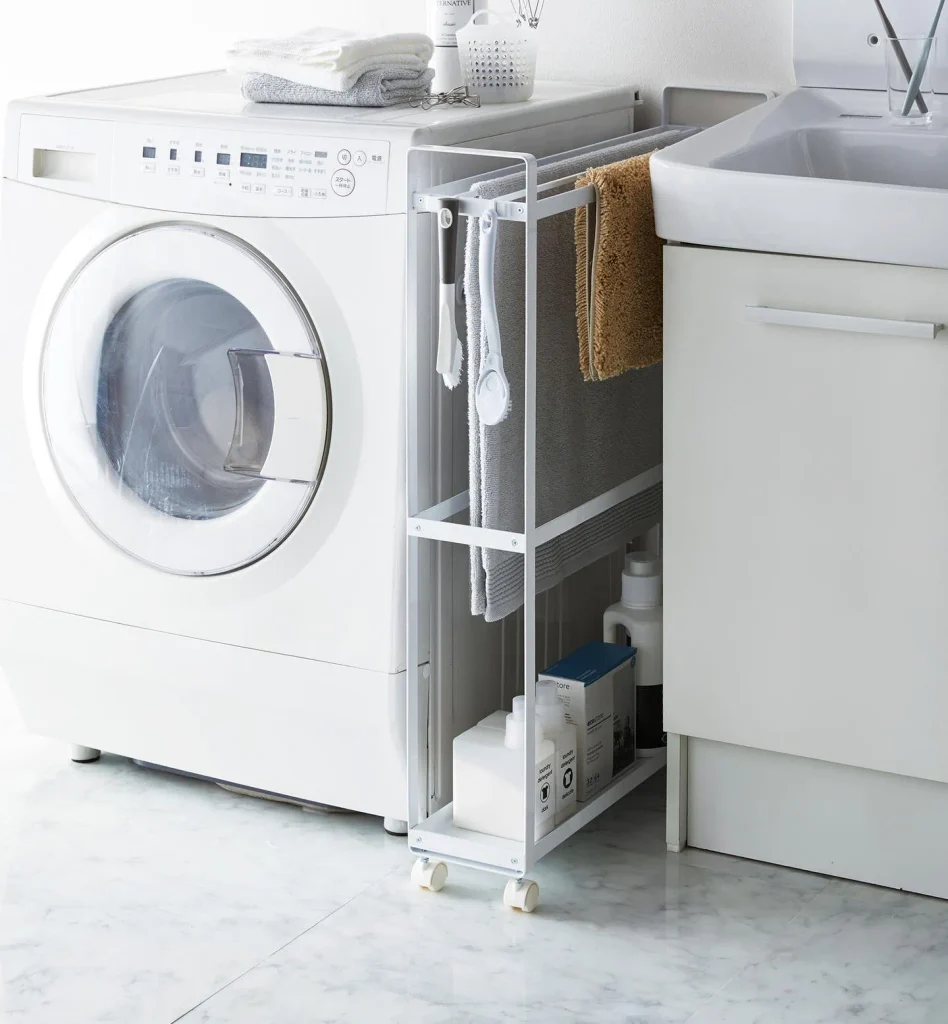
The space beside a washing machine is usually five or six inches of nothing. A narrow wheeled cart fits right in and pulls straight out when you need it.
Every surface on this one earns its place. The top rail hangs a bath mat and a hand towel to dry. A hook on the side frame holds cleaning brushes by their handles. The lower shelf takes tall detergent bottles standing up, so they stop crowding the floor under the sink.
Measure the gap at its tightest point before buying, usually where a pipe or a plug bulges out, not at the open front. Then take an inch off that number.
No laundry room? The same cart shape works beside a fridge, next to a toilet, or in the sliver between a bed and the wall.
11. Mount Slim Glass Shelves Inside the Shower, With a Rail on the Front
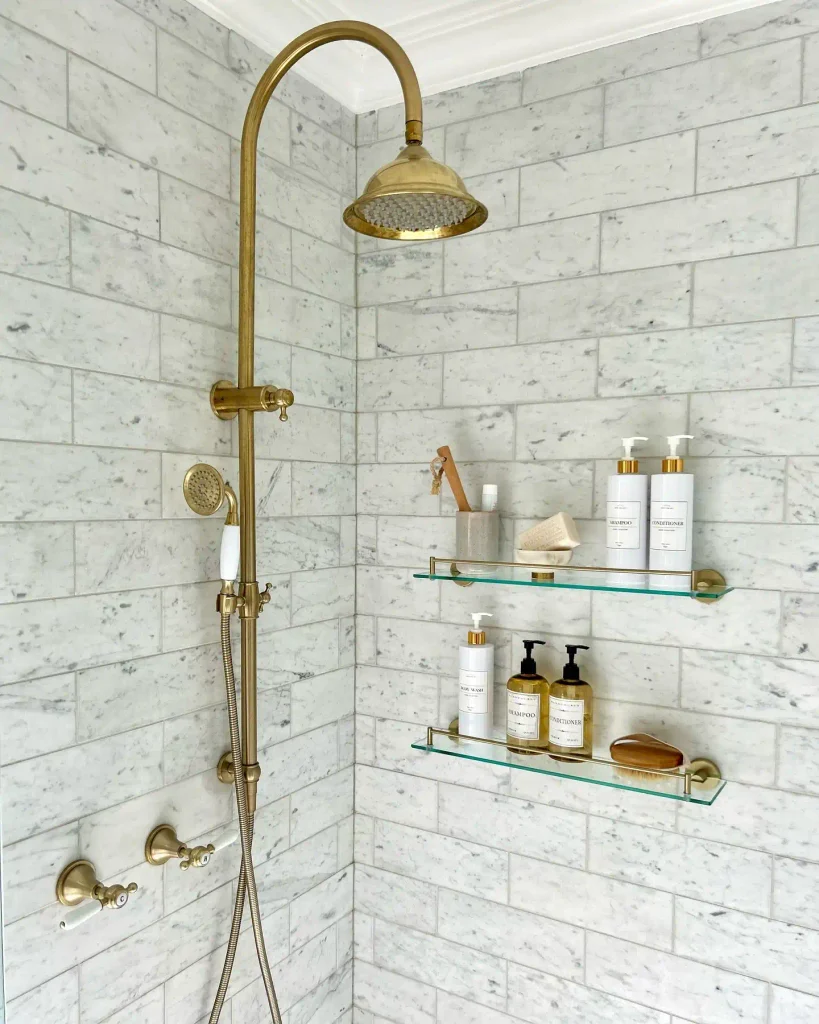
Bottles crowded around the tub edge are the default in most apartments. Two shallow glass shelves on the back wall clear all of it, and the brass rail running along each front edge is what stops a slippery bottle sliding off when you knock it.
Low shelves hold what you reach for wet, tall pump bottles and a body brush. The upper one takes smaller things, a soap dish, a cup with a razor, a scrub brush hanging by its cord.
📌 Good To Know
Glass and metal shed water fast, so nothing sits in a puddle. Solid plastic trays and wire baskets with flat bottoms trap it and go slimy underneath within a month.
Depth is the number that matters. These are barely wider than a shampoo bottle, which keeps them out of your elbows in a narrow stall while still holding everything.
Refill bottles do a lot of quiet work here. Matching white and amber pumps look calm where six different supermarket brands would look like a shelf in a shop.
Renting and can’t drill tile? Strong adhesive shelves in the same slim shape get close, as long as you stick them to tile rather than grout lines and let the glue cure a full day before loading them.
Need more for the shower and vanity? I have 15 bathroom storage ideas under three square feet.
12. Slide a Narrow Console Down the Side of Your Sofa

The strip between a sofa arm and the wall is maybe six inches wide. This table is built to that exact measurement: a long wood top on a slim white frame, tall enough to sit level with the sofa back.
Built into the frame under the top is a power strip with two outlets and a USB port, so a phone charges right where you sit instead of running a cable across the room to the nearest wall socket.
What the surface actually solves:
- ▸Remotes stop disappearing into the cushions.
- ▸A drink has somewhere to go that isn’t the floor.
- ▸A lamp moves off the coffee table and frees the middle of the room.
- ▸The lower shelf takes a book stack or a small basket.
One thing to check before you buy: the height. Match it to your sofa back, not to a standard side table, or the top sits below the cushions and you can’t reach anything on it.
A plain shelf board on two brackets does something similar if you’d rather mount it to the wall and skip the legs entirely.
13. Lift the Bed High and Slot a Cube Unit Underneath
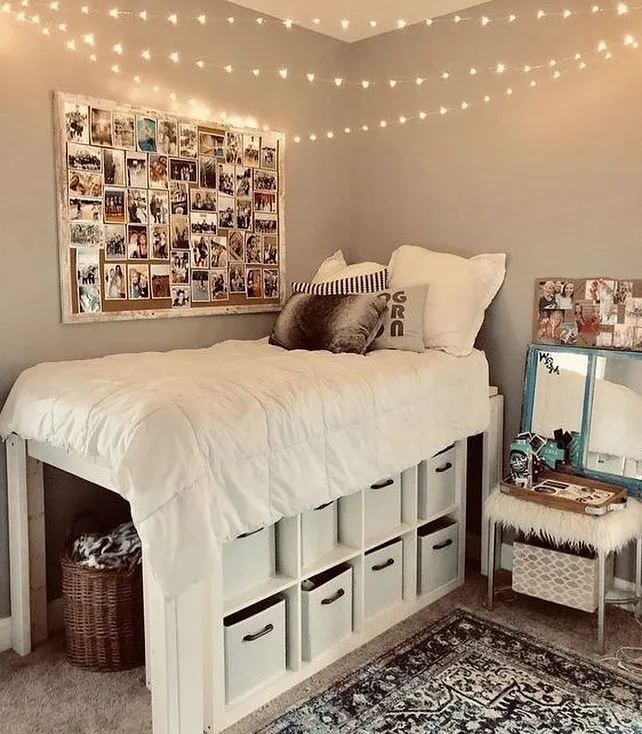
Raising a bed by a foot or two changes what fits below it. Instead of a few inches for flat bags, you get a wall of cubbies. Here an eight-cube shelf runs along the open side, most of them holding matching fabric bins with metal label holders on the front.
Eight inches of clearance. Flat bags only, and you crouch on the floor to reach anything.
A cube unit plus open floor for a laundry basket, all reachable while standing up.
Not every cube gets a bin, and that’s deliberate. A few open squares break up the wall of boxes so it looks built in rather than like a stack of storage in a bedroom. The corner nearest the head of the bed stays empty for a tall woven basket of blankets.
Two ways to get the height. Bed risers under the legs are the cheap renter version. A loft or captain’s frame built for it is sturdier and doesn’t wobble when you sit down hard.
Just be honest about ceiling height first. Lift a bed too far in a low-ceilinged apartment and sitting up in the morning gets uncomfortable.
14. Pick an Entry Bench With a Drawer Instead of a Lift-Up Lid

Storage benches usually hide everything under a hinged seat. This one pulls out from the front instead, a deep upholstered drawer sitting beneath a fixed green cushion.
That difference matters more than it sounds. You can open a drawer while someone is sitting on the bench tying their shoes. A lid means asking them to stand up first, which is why lid benches quietly turn into places where nobody looks inside for months.
Sit on your dining chair and measure from the floor to the seat. That’s a comfortable height, and most storage benches come in shorter than it.
Check the depth next. Too shallow and you perch on the edge instead of sitting properly.
Measure the drawer’s pull-out clearance against your hallway width, so it opens fully without hitting the opposite wall.
Inside, a flat tray keeps small stuff from sliding to the back of the drawer, holding keys, a charging cable, and loose paperwork in one grab-able spot.
The rest of the nook stacks upward. A hook rail at coat height, a floating shelf above it for a dish, and a plant filling the corner that furniture couldn’t use anyway.
15. Fold a Whole Desk Flat Against the Wall When You’re Done

The front panel drops down on two gas struts and becomes the work surface. Close it and the entire thing is a shallow white box on the wall, about as deep as a kitchen cabinet.
Behind the panel is where the storage hides. Two small plywood shelves sit at different heights, a metal rail runs across the back for pens and small tools, and a strip light along the top edge lights the whole cavity. A phone props upright on one shelf while it charges.
A desk only needs to exist while you are working. The rest of the day it can be four inches of wall.
The struts are worth paying for. A cheap hinge lets the panel drop hard and slam, while struts lower it slowly and hold it level under a laptop’s weight.
Mount it so the open surface lands at normal desk height, then push a chair you already own underneath. Studio dwellers get a real workspace without giving a whole corner to a desk that sits empty all evening.
16. Screw Slim Racks to the Inside of Your Kitchen Cabinet Doors
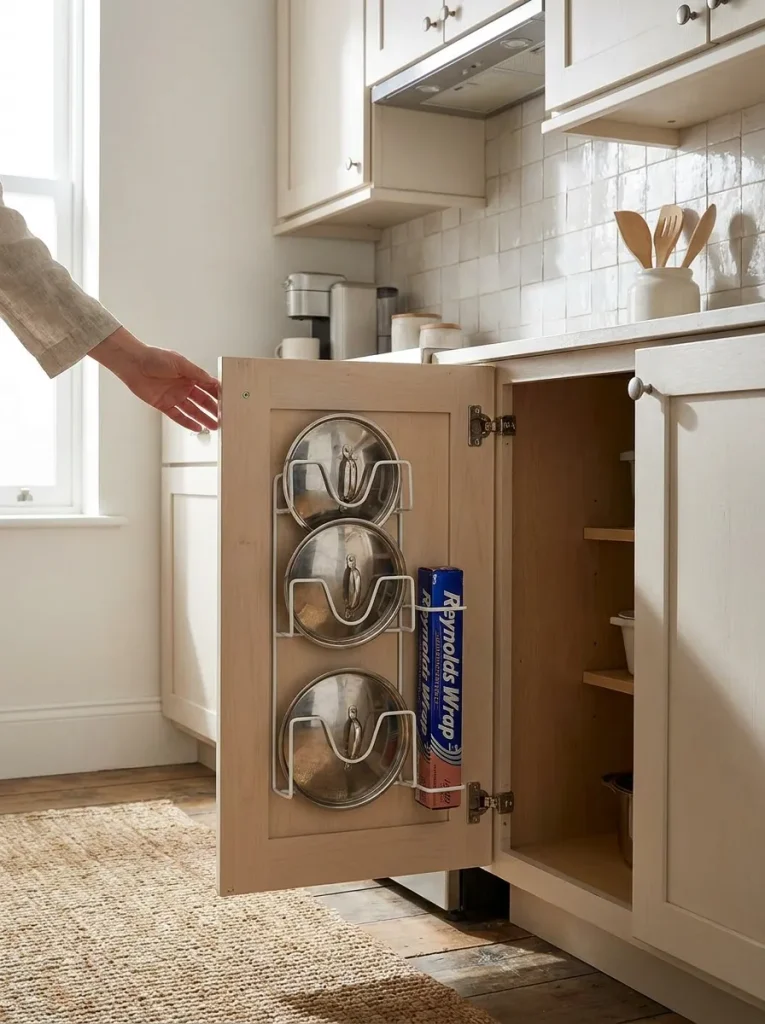
Cabinet doors have a flat inner face that holds nothing by default. A shallow wire or wooden rack turns each one into a second shelf for the awkward flat items that never stack well.
Best candidates for a door rack:
- ▸Pot lids standing on edge, which frees a whole shelf inside.
- ▸Foil, cling film, and parchment boxes lined up in a row.
- ▸Cutting boards slid in vertically.
- ▸Spice jars, if the shelf inside is deep enough to clear them when the door shuts.
The clearance check comes first. Shut the door gently with the rack held in place and see whether it collides with the shelf edges inside. Most kitchens have an inch or two spare, some have none.
Screws into the door panel beat adhesive for anything holding weight, since a door that swings gets shaken a hundred times a week.
Racks inside the doors free up shelves, and that frees up counter space in a small kitchen too.
17. Build Storage Around the Pipes Under Your Bathroom Sink
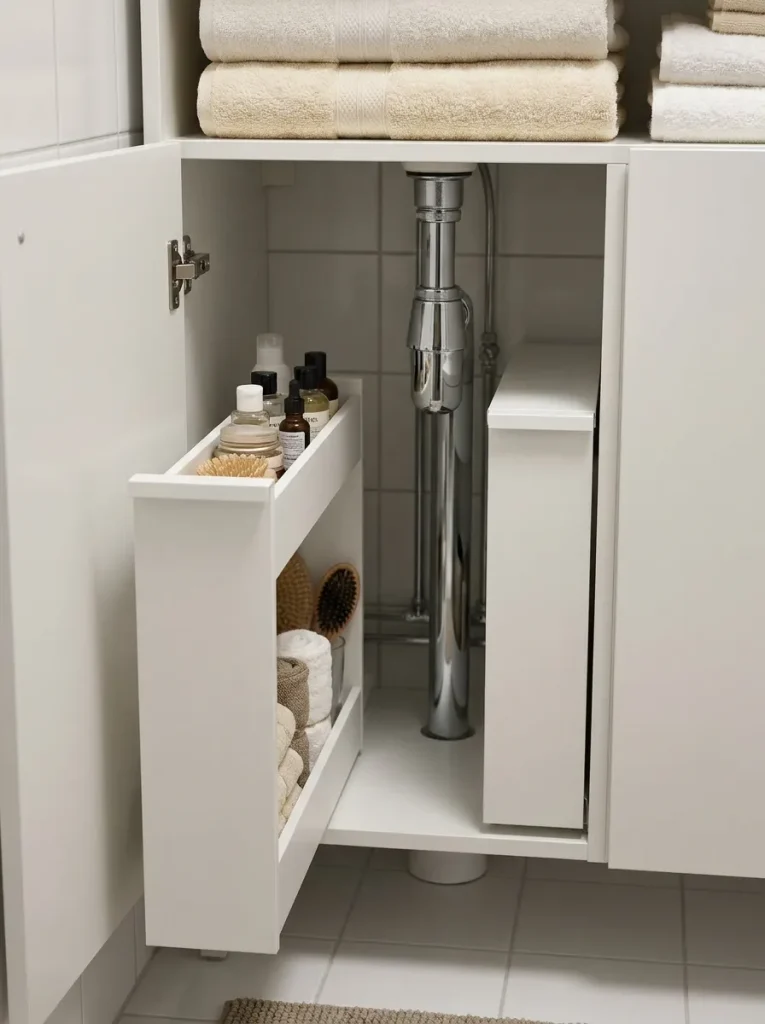
Under-sink cabinets waste most of their volume because the drain pipe sits right in the middle. Anything flat-bottomed has to squeeze around it, so the corners fill with junk and the middle stays empty.
💡 Quick Tip
Buy two narrow pull-out drawers instead of one wide bin. One slides in on each side of the pipe, and the dead center becomes the only space you lose.
Stack a second tier above them if your cabinet is tall. An expandable two-level shelf steps over the pipe entirely and puts backstock at eye level where you can see it.
Keep the front row for daily things and push refills to the back, since a drawer that pulls all the way out makes the back row reachable for once.
One rule that saves a headache later: nothing heavy or precious directly under the trap. If a joint ever weeps, that’s where the water lands.
For the full step-by-step, including checking for leaks first, here’s my guide to organizing under the bathroom sink.
18. Turn a Balcony Bench Into a Weatherproof Storage Box
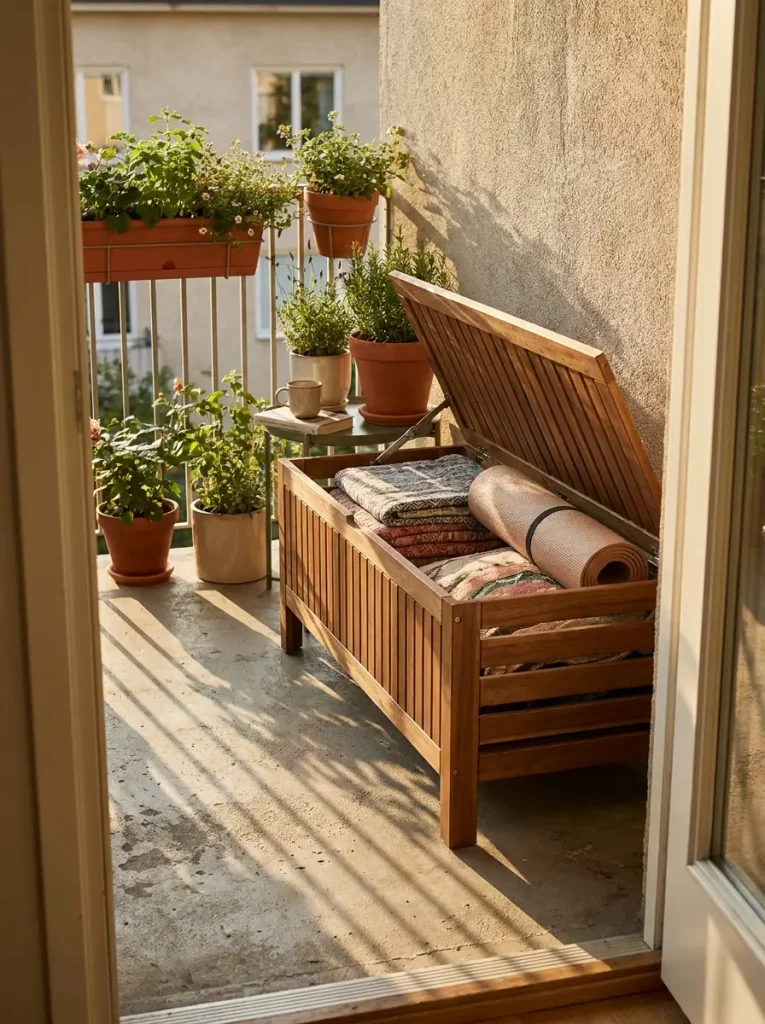
Outdoor space in an apartment is usually four square feet of concrete. A bench with a lift-up seat gives you somewhere to sit and somewhere to hide the things that have no indoor home.
Push it against the building wall rather than the railing. You get shelter from rain running off the edge, and the walkway stays clear.
Line the inside with a cheap plastic tub if the lid isn’t sealed. Most benches at this price resist rain rather than block it.
Cushions, a folding chair, gardening bits, and a rolled mat all live in there, which frees an indoor closet shelf you’d otherwise give up.
19. Swap Your Dining Table for a Drop-Leaf Against the Wall
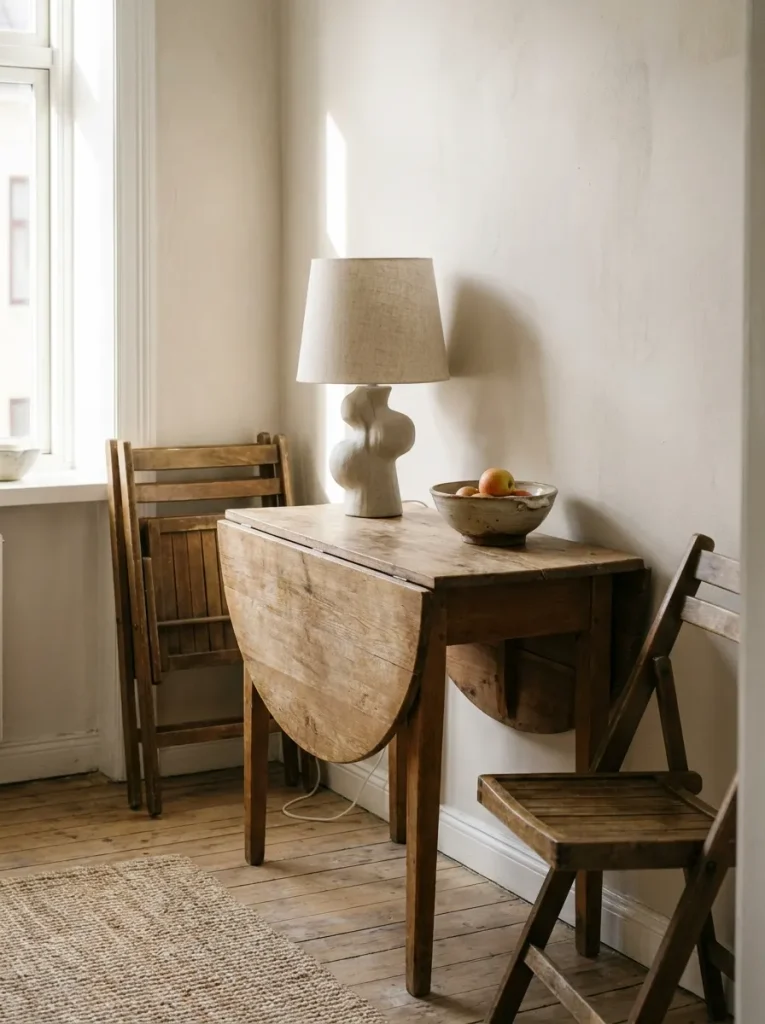
Most apartment dining tables sit at full size all week for a meal that happens twice. A drop-leaf table folds one or both sides down and parks flat against a wall, taking the footprint of a console.
How the day actually goes:
Folded flat on a normal morning, holding a lamp and a bowl for keys.
One leaf up for dinner alone or a laptop, still tight to the wall.
Both leaves up and pulled out when four people come over.
Look for one with a drawer or a shelf in the base. That turns it into real storage in its folded state instead of just a narrow surface.
Chairs are the other half of the problem. Two folding or stacking ones hung on a wall hook or slid behind a door keep the room clear the rest of the week.
20. Compress Bulky Bedding Into Vacuum Bags for the Top Shelf
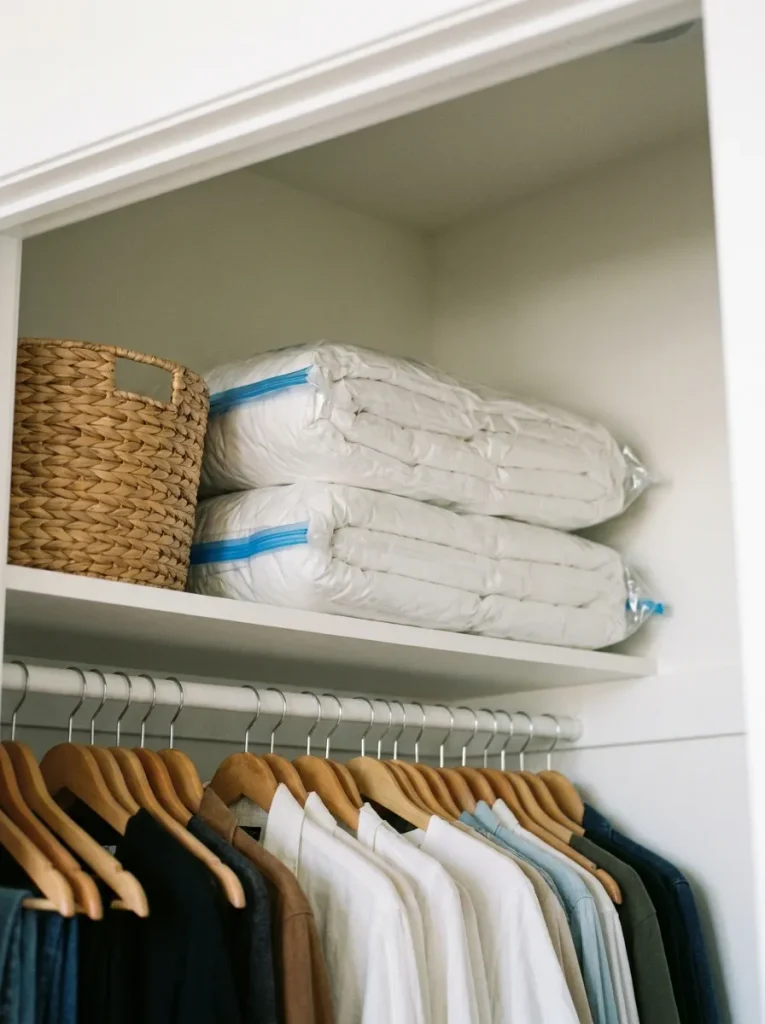
Winter duvets and spare pillows are mostly air. A vacuum bag pulls that air out and shrinks a duvet to roughly a quarter of its size, which is the difference between it eating a whole closet shelf and sliding into a gap above the rail.
Synthetic duvets, spare pillows, and fleece blankets.
Puffer coats and ski gear between seasons.
Down and feather, which can lose loft if squashed for a year.
Anything damp, since sealed moisture turns musty fast.
Wash and fully dry everything before it goes in. You are sealing it for months, and whatever smell goes in comes back out.
Write the contents on a strip of tape across the front. Three flat grey bricks on a high shelf look identical from the floor.
21. Put a Lid on Your Coffee Table

Living rooms collect the things with no drawer of their own. Remotes, chargers, a throw, last week’s magazines. A lift-top coffee table or a padded storage ottoman swallows all of it and gives you a surface back on top.
The lift-top version has a hidden bonus. The surface rises and tilts toward the sofa, so you can eat or type without hunching over a low table.
Split the inside into two zones, one for daily grabs near the front and one for the stuff you only want out of sight. Otherwise a big open box turns into a place things go to be forgotten.
22. Split Tall Cabinet Shelves in Two With Risers
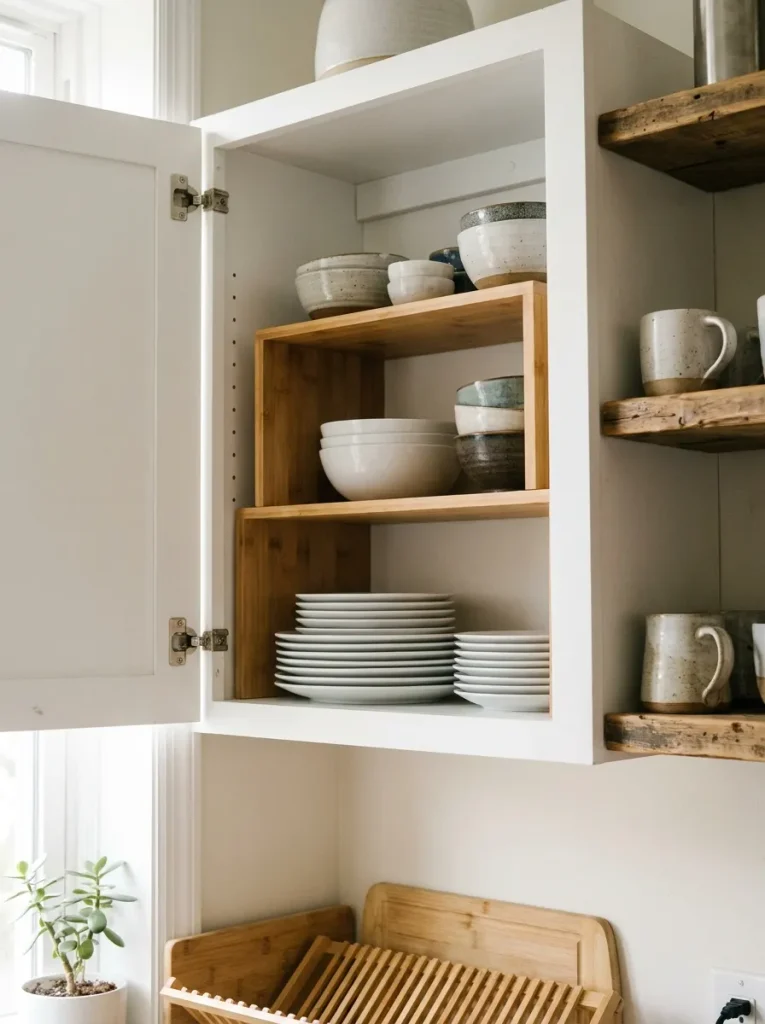
Stack four plates in a cabinet built for twelve inches of height and you waste eight inches of air above them. A shelf riser is a small metal or bamboo stand that sits on the existing shelf and creates a second level in that empty band.
Where a riser pays off most
Expandable ones adjust in width, which matters in older apartment kitchens where no two cabinets are the same size.
Measure the interior height first and buy a riser a couple of inches shorter, so you can still slide things in and out without scraping knuckles on the shelf above.
23. Mount a Floating Nightstand and Free the Bedroom Floor
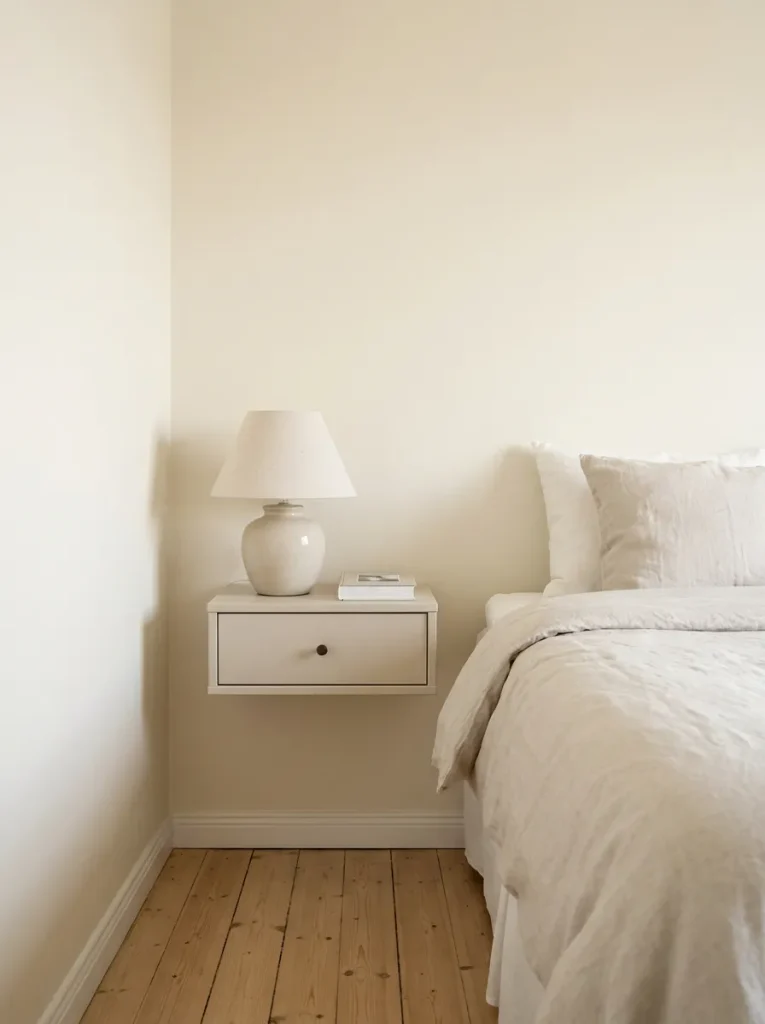
Bedside tables are the first casualty of a small bedroom. Push a bed into a corner and there’s no room for one on at least one side.
A four-legged table jammed beside the bed, blocking the walkway, with dust and cables gathering underneath it.
A small shelf or single drawer fixed to the wall at mattress height, clear floor beneath, and a vacuum that passes straight under.
Height is the whole trick. Set the surface level with the top of your mattress or an inch above, so reaching for a glass in the dark feels natural.
A version with one shallow drawer hides the things that make a bedside look messy, a charger, hand cream, a book you’re halfway through. The open shelf underneath takes the book you’re actually reading.
Check what’s behind the plaster before drilling, and use proper anchors. This one holds a lamp and a full glass of water every night.
24. Fix the Black Hole in Your Deep Corner Cabinet
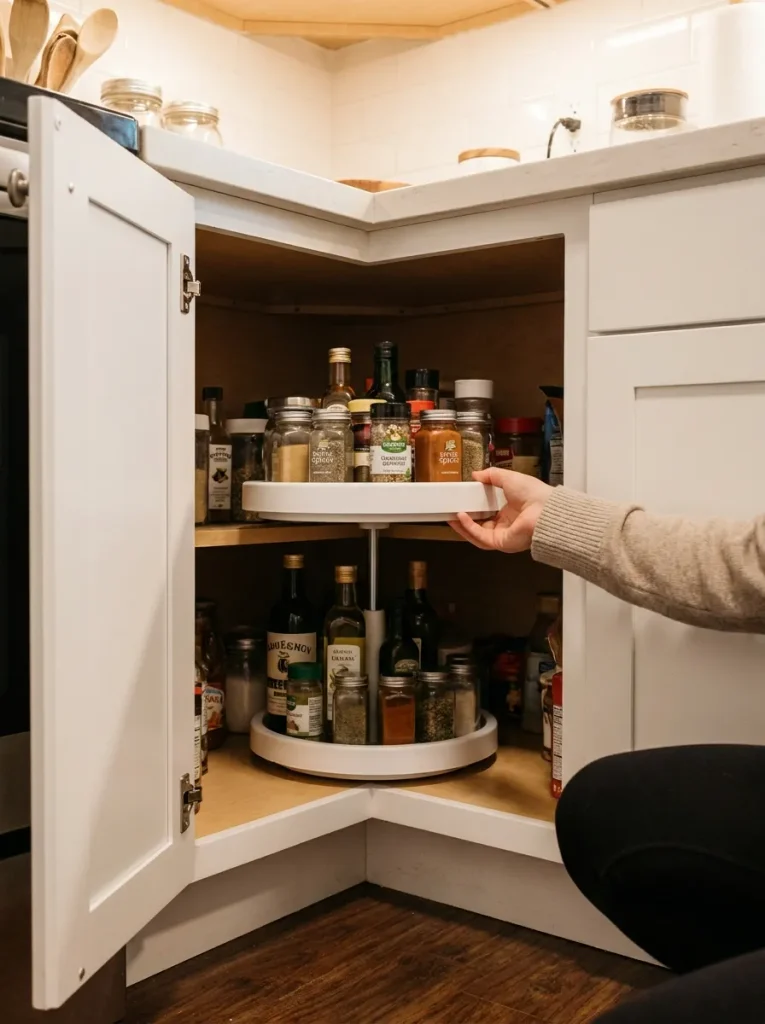
Corner cabinets swallow things. The opening is narrow, the interior runs back at an angle, and whatever lands at the back stays there until you move out. Two fixes, depending on your budget.
| Turntable | Pull-out bin |
|---|---|
| Cheap, and you just set it down inside. | Costs more and usually needs fitting. |
| Spin it to bring the back row forward. | Slides the whole load out into the room. |
| Best for jars, bottles, and sauces. | Best for heavy pans and appliances. |
| Renter friendly, leaves nothing behind. | May need screws, so check your lease. |
Whichever you pick, empty the cabinet completely first. Corner cupboards are where expired jars go to hide, and you’ll likely free half the space just by throwing things out.
25. Cover the Radiator and Gain a Shelf
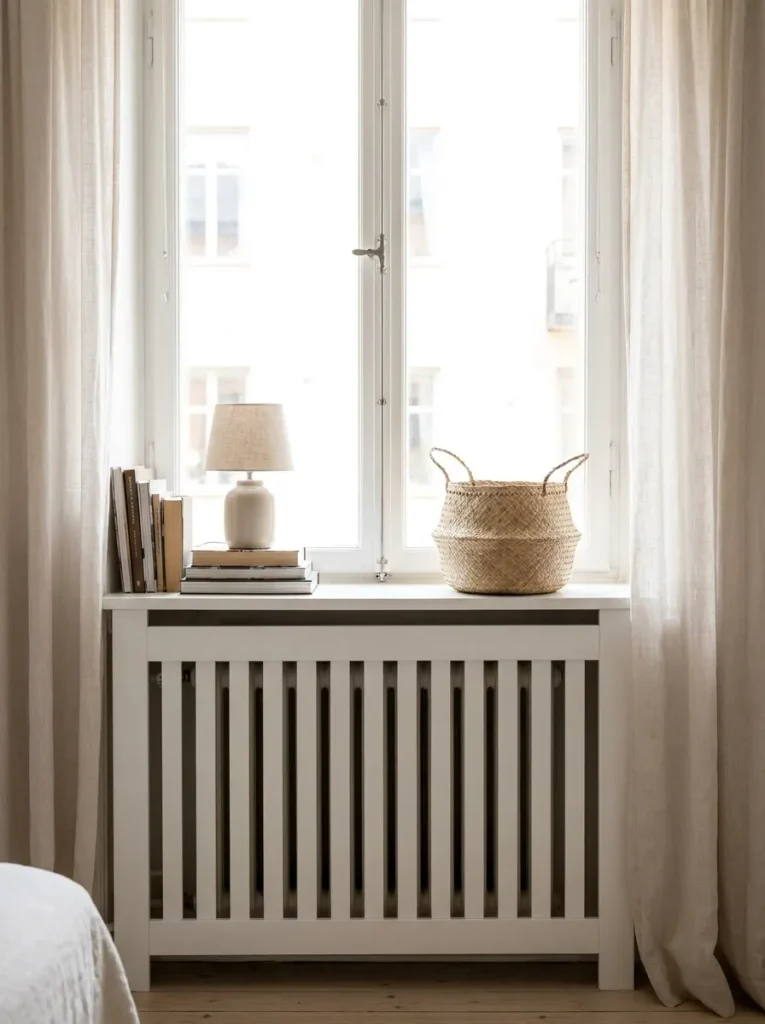
Old apartments come with radiators bolted to the best wall in the room, usually under the window where a table should go. A slatted cover boxes it in and gives you a flat surface at hip height along the whole length.
An ugly fixture you cannot remove becomes three feet of surface you did not have.
The slats matter for a real reason. Heat has to escape, so the front panel needs open grille work and the top needs a gap at the back against the wall.
Nothing heat sensitive goes on top. Candles slump, houseplants dry out, and vinyl records warp. Books, a lamp, a tray, and a small basket are all fine.
In a narrow hallway the same cover doubles as a drop spot for keys and post, which saves buying a console table you have no room for anyway.
26. Make the Mirror Above Your Sink Open Up
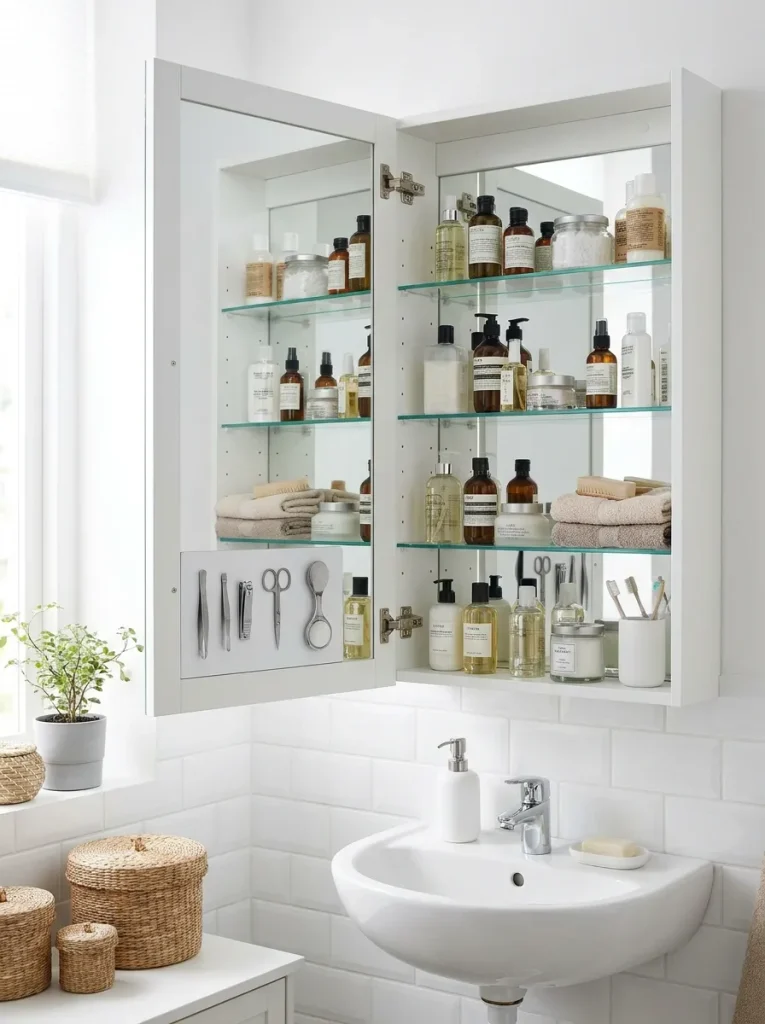
A flat mirror gives you one thing. A mirror cabinet gives you the same reflection plus three shelves of hidden depth behind it, which is the difference between a clear sink edge and a row of bottles crowding the tap.
Sort the inside by height, not by category:
- ▸Bottom shelf for tall things, sprays and bottles you use daily.
- ▸Middle shelf at eye level for the morning routine, since that’s the only shelf you see without stretching.
- ▸Top shelf for small flat backstock, spare blades and travel sizes.
A small magnetic strip stuck inside the door catches tweezers, nail scissors, and clippers, the tiny metal things that otherwise roll to the back of every shelf.
Renting with a fixed mirror you can’t swap? A shallow cabinet mounted on the side wall beside the sink does the same job, as long as the door swings clear of the mirror.
27. Hang Over-the-Door Hooks Where the Wall Ends
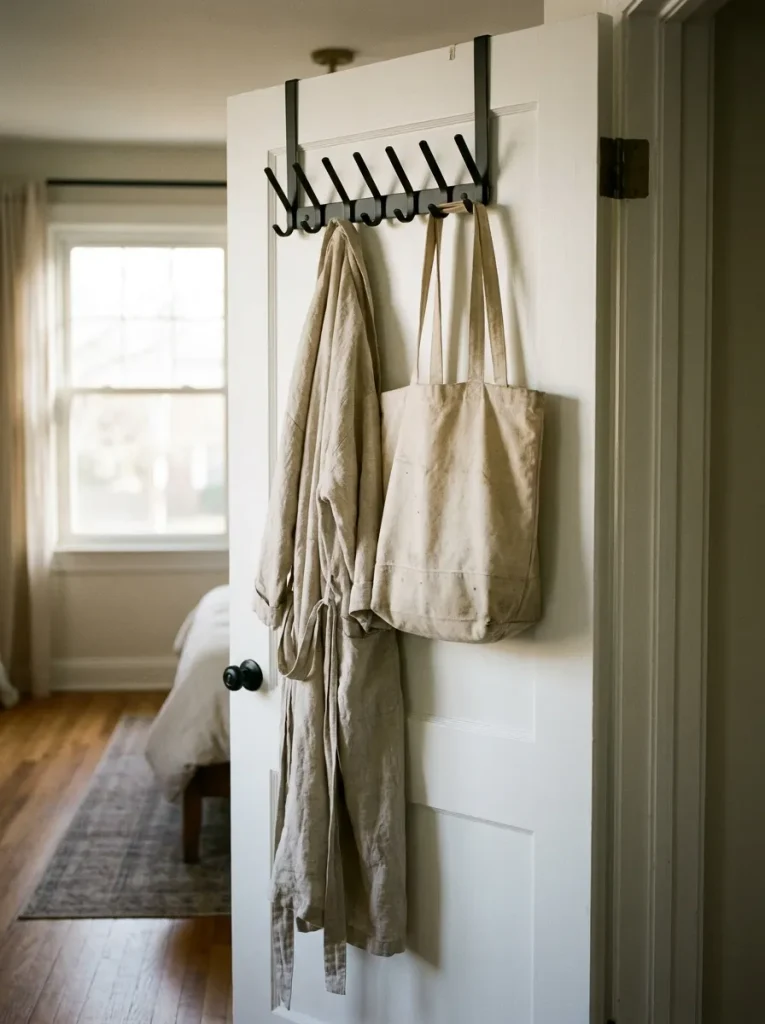
Bedroom and bathroom doors have a top edge that holds a hook rack with no tools and no holes. It’s the one storage spot that costs nothing and takes ten seconds.
Thickness is the catch. Bring a hook that matches your door depth, because a thick rack on a slim door rattles and a slim one on a thick door won’t seat at all.
Laying tomorrow’s clothes on one hook at night is a small habit that clears a chair. Most apartment bedrooms have one chair quietly doing the job of a wardrobe.
Padded or wide hooks stop the shoulder dents that thin metal leaves in knitwear.
28. Wheel a Pull-Out Pantry Into the Gap Beside the Fridge
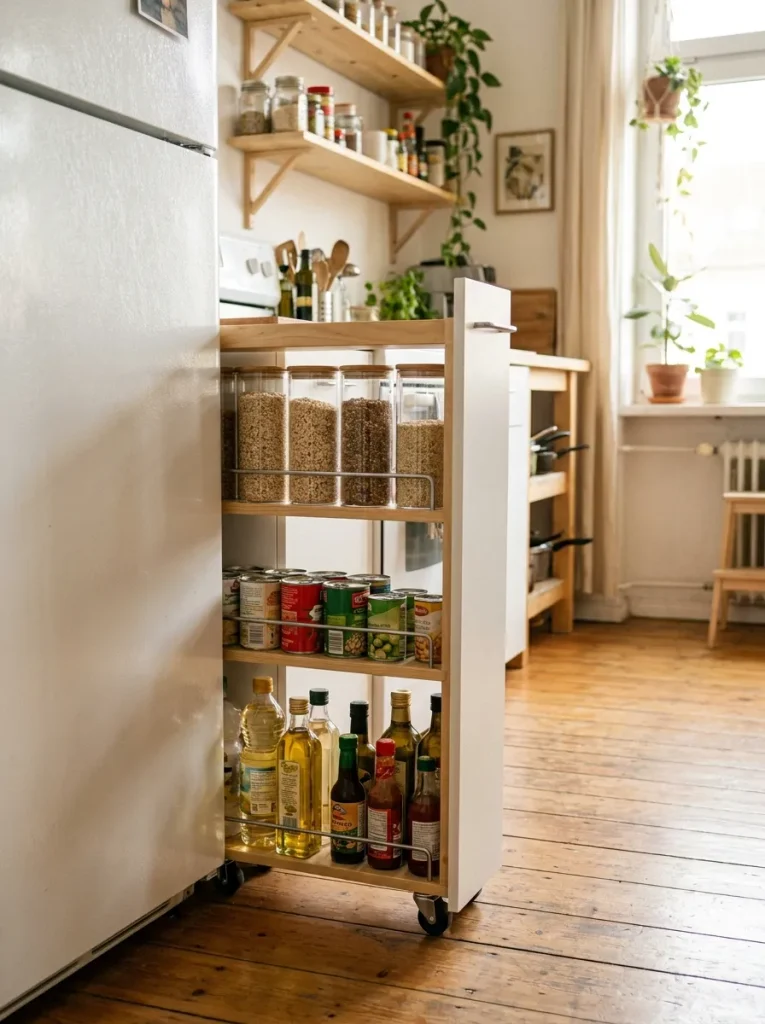
Most kitchens leave four to eight inches between the fridge and a wall or cabinet. It’s too narrow for furniture, which is why it usually holds nothing at all.
A tall wheeled rack built for that width slides in and pulls out like a drawer. Three or four tiers hold cans, jars, tall bottles, and dry goods standing upright where you can see them.
⚠️ Watch Out
Fridges vent heat out the back and sides. Leave a finger’s gap between the rack and the fridge wall rather than pushing it flush, or the motor works harder than it should.
Grab the handle rather than the frame when you pull, and load the heaviest cans on the bottom tier so it doesn’t tip as it rolls out.
Same shape works beside a freestanding stove, between a washing machine and a wall, or in the sliver beside a wardrobe.
29. Claim the Top of the Fridge With Matching Bins

The space above a fridge is usually a dumping ground: a cereal box on its side, a bread bag, three things nobody can reach. Two or three deep bins turn it into real storage and, more importantly, make it look deliberate.
Backstock you refill from once a month, pasta, rice, tinned goods.
Lightweight party things, paper cups, napkins, a cake stand.
Anything heavy, since you lift it down at arm’s length above your head.
Oils, chocolate, and anything that suffers in warmth, because the top of a fridge runs warm.
Bins with handles are the detail that makes it work. You hook a finger and slide one down instead of reaching blindly over the edge.
Matching containers do something a random pile can’t. A fridge top is at eye level in a small kitchen, so three identical baskets read as storage while five odd boxes read as mess.
30. Choose a Media Unit With Doors, Not Open Shelves

Open shelving looks good in photos and collects dust in real life. In a small living room, where the TV wall is the first thing you see from the door, closed doors do more for how calm the room feels than any amount of tidying.
Cables, consoles, and clutter on display. Needs styling and dusting to look right.
One clean front. Everything inside stays dust free and out of sight in a second.
Two practical checks before buying. Look for a cable cutout in the back panel so the mess routes through instead of piling on a shelf. And if your devices sit behind solid doors, make sure the unit has ventilation or a mesh panel, since a sealed box traps heat.
One shelf inside should stay half empty on purpose. That’s where the things with no home go when someone knocks on the door unexpectedly.
Conclusion
You don’t need all thirty of these. Pick the two or three that solve the mess you actually trip over, and let the rest wait.
The ideas that stick are the easy ones. A drawer beats a lid because you’ll open it without thinking. A labeled bin beats a good intention. Storage only works when using it takes less effort than leaving the thing on the floor.
Try one this weekend and see how much lighter the room feels.
Pin this post so it’s there when you’re standing in the middle of your apartment wondering where anything goes.
📌 Good To Know
Measure before you buy anything. Gaps beside fridges, under beds, and inside cabinets are never the round number you expect, and a return trip costs more than two minutes with a tape measure.