
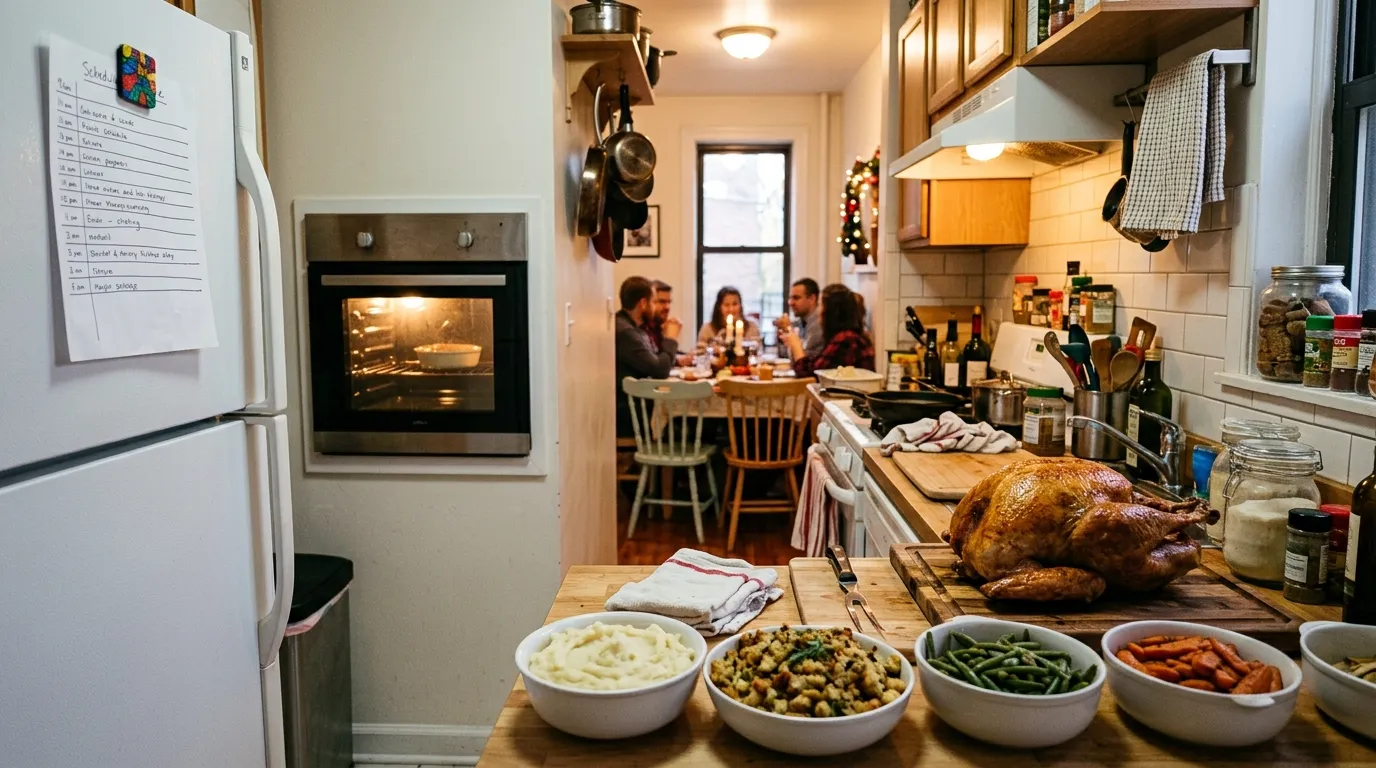
Your oven fits one rack. Your counter holds a cutting board or the dish rack, but not both. And six people are coming Thursday expecting a turkey.
Cooking Thanksgiving in a small apartment is not a cooking problem. It is a traffic problem. Every dish wants the oven at 4 p.m., and your oven holds exactly one thing. Most first-timers learn this at 3:45, standing in front of a hot oven holding a casserole dish with nowhere to put it down.
The fix is not a bigger kitchen. The fix is moving work off Thursday and off the oven.
By the end of this guide you will have roasted a 10 to 12 pound turkey, plus mashed potatoes, stuffing, green beans, cranberry sauce, gravy, and rolls, out of one oven rack and about three feet of counter.
Here is why this method works. Dessert and cranberry sauce get made two days early, while the oven is still yours. Stuffing and green beans move to the stovetop permanently. The rolls bake during the turkey’s rest, when the oven is sitting empty anyway. Nothing ever competes.
Hands-on time runs about five hours spread across three days. Thursday itself is roughly four hours, and most of that is standing around waiting.
Grab a pen. The first step is the one that saves you.
What You Need
- Roasting pan or a 9×13 metal baking pan
- Wire rack that fits inside the pan
- Instant-read thermometer
- Large stockpot (8 quart or bigger)
- Large skillet, 12 inch
- Sheet pan
- Cutting board, large
- Potato masher or heavy fork
- Fine mesh strainer
- Aluminum foil
- Paper towels
- Kitchen timer or phone alarms
- Frozen turkey, 10 to 12 pounds
- Kosher salt, 1/2 cup
- Unsalted butter, 1 1/2 cups
- Russet potatoes, 4 pounds
- Whole milk, 1 cup
- Bread cubes or stuffing mix, 12 ounces
- Yellow onion, 2 large
- Celery, 1 bunch
- Fresh green beans, 1 1/2 pounds
- Fresh cranberries, 12 ounces
- Sugar, 1 cup
- Orange, 1
- Chicken or turkey broth, 6 cups
- All-purpose flour, 1/2 cup
- Dinner rolls, 12 (bake-at-home)
- Black pepper, dried sage, dried thyme
- Pie or dessert of your choice
At a Glance
The whole plan, top to bottom.
- Write your one-rack oven schedule on paper
- Buy a 10 to 12 pound turkey and start thawing
- Clear your counters down to bare surface
- Bake the dessert two days early
- Simmer the cranberry sauce and chill it
- Dry-brine the turkey the night before
- Chop every vegetable the night before
- Take the turkey out one hour before roasting
- Roast the turkey uncovered, door shut
- Boil and mash the potatoes
- Cook the stuffing in a stovetop skillet
- Blister the green beans in one hot pan
- Rest the turkey for 30 minutes
- Bake the rolls in the empty oven
- Whisk the gravy from the drippings
- Carve and set up a one-way buffet line
1. Write your one-rack oven schedule on paper first
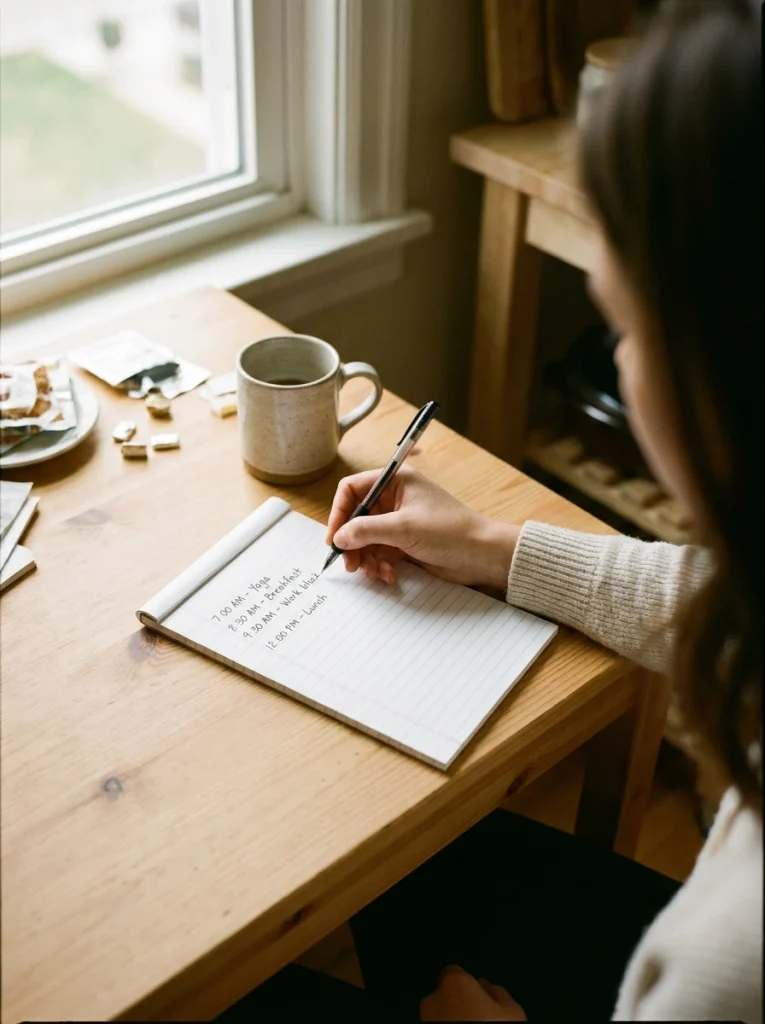
Six dishes, one rack, one afternoon. Something has to move, and deciding what at 4 p.m. is how dinner falls apart. Take a sheet of paper and write the hours down the left side, from 11 a.m. to 5 p.m., one line each. Then write only the oven jobs on the right: turkey in at 12:30, turkey out at 3:30, rolls in at 3:40. Everything else in this guide happens on the stovetop or on a different day. That paper goes on the fridge and it is the only plan you follow Thursday.
2. Buy a 10 to 12 pound turkey and thaw it three full days
Bigger is worse here. A 14 pound bird will not fit a small oven with the lid clearance you need, and it feeds the same six people with three days of leftovers you have no fridge space for. Frozen is fine and usually cheaper. The day you bring it home, put it breast-side up on a rimmed plate on the bottom fridge shelf, still in its wrapper.

A turkey thaws at roughly 24 hours per 5 pounds in the fridge. A 12 pound bird needs 3 full days — so it moves from freezer to fridge on Monday for a Thursday dinner. A partly frozen turkey roasts unevenly and can leave the thigh raw while the breast dries out. If Wednesday arrives and the bird is still hard in the middle, put it in a sink of cold water and change the water every 30 minutes until it gives.
3. Clear your counters down to bare surface
The toaster, the knife block, the fruit bowl, the mail pile. All of it goes on the floor of a closet until Friday. You are not decluttering for looks — you are buying landing space, and a hot pan needs somewhere to go the second it leaves the burner. Wipe the bare counter, then set a folded towel at one end as your designated hot-pan spot. Two clear feet of counter is the difference between calm and panic.
If bare counters still aren’t enough, here’s how to add counter space without drilling, from a stove cover to a cutting board over the sink.
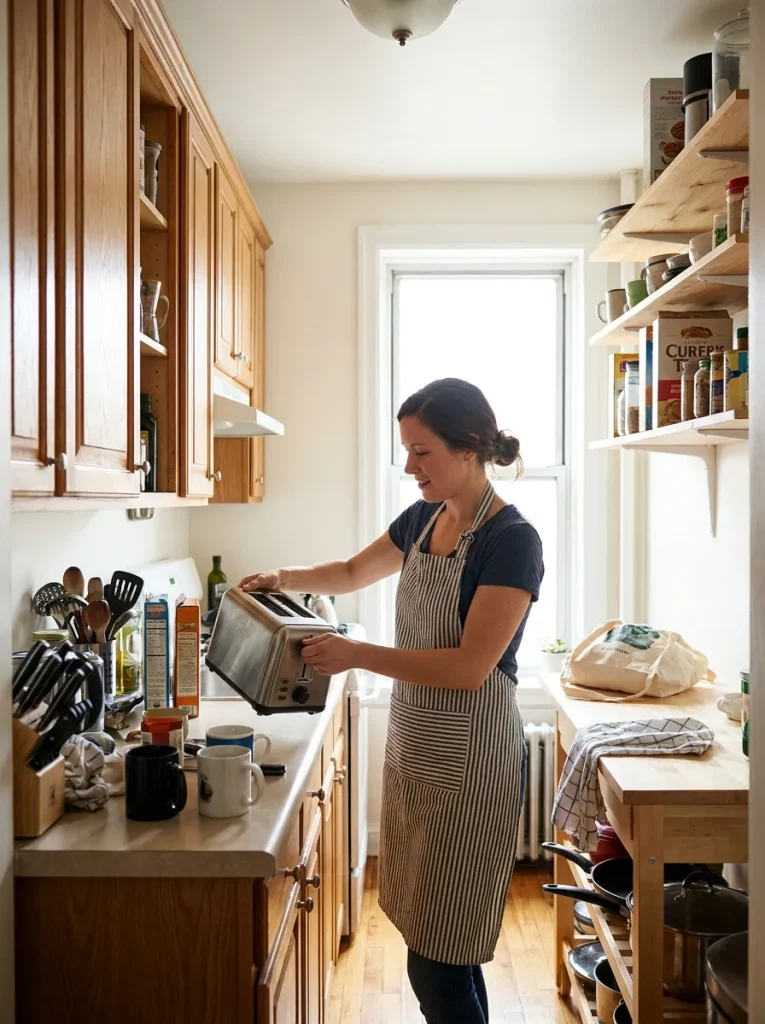
Your counter is not the only flat surface you own. An ironing board set to counter height gives you another 4 feet of staging space, and it folds away when you are done. Cover it with a cutting board or a sheet pan before putting anything hot on it.
4. Bake the dessert two days early while the oven is still free
Tuesday is the only day your oven has nothing to argue with. Use it. Pie, cake, or crumble all hold fine at room temperature for 48 hours under a loose sheet of foil. Baking it Thursday means giving up an oven slot you cannot spare.

5. Simmer the cranberry sauce and chill it
Cranberry sauce tastes better cold and better on day three, so this one is a gift to yourself. It needs one small pot and about 15 minutes of your attention, all on the stovetop. Here is the whole thing:
- Rinse 12 ounces of fresh cranberries and pull out the soft ones
- Add them to a pot with 1 cup sugar and 3/4 cup water
- Zest the orange straight into the pot, then squeeze in the juice
- Simmer on medium until the berries pop, about 10 minutes
- Pour into a jar or bowl, cool on the counter, then refrigerate
It thickens as it chills, so pulling it off the heat while it still looks loose is correct. Pot washed, burner free, one dish done.

6. Dry-brine the turkey the night before
Wet brining needs a bucket, a gallon of liquid, and fridge space you do not have. Dry brining needs a plate. Pat the thawed turkey completely dry with paper towels, then rub 1/4 cup kosher salt over the skin, inside the cavity, and under the breast skin where you can reach. Set it back on its plate, uncovered, on the bottom fridge shelf overnight. The salt pulls moisture out, then the meat draws it back in seasoned and the dry skin crisps much better.
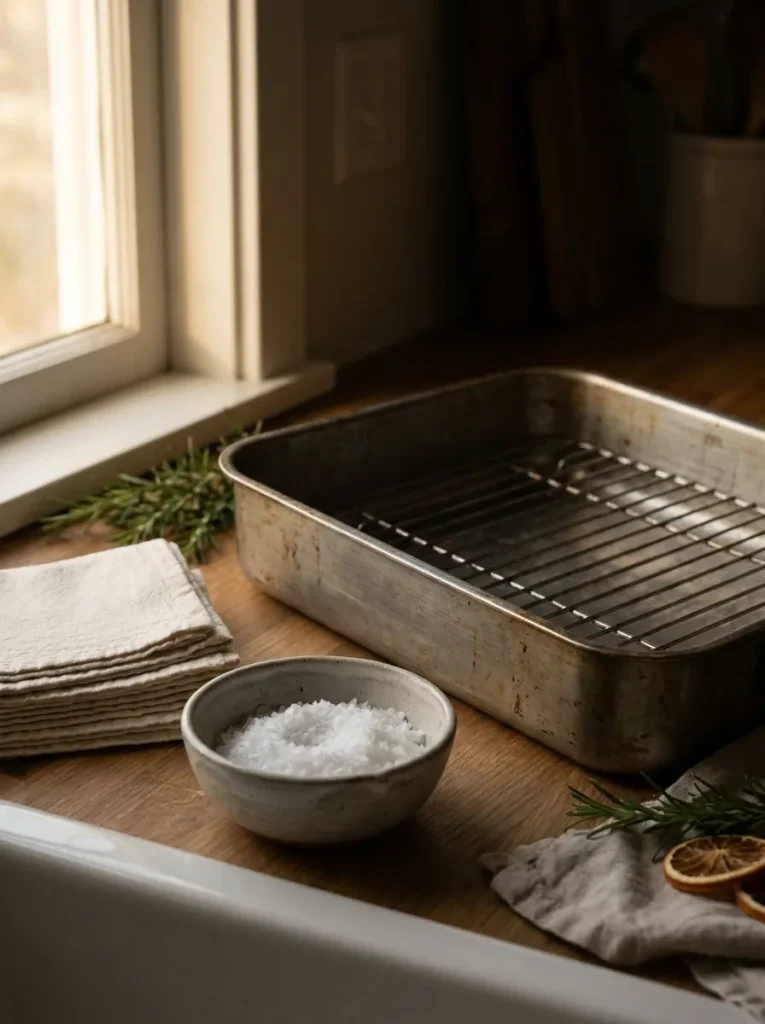
Leaving the bird uncovered in the fridge feels wrong, but the airflow is the whole point — covered skin stays damp and roasts pale. If your fridge is packed, pull out one shelf entirely and stand the taller bottles in the door for the night.
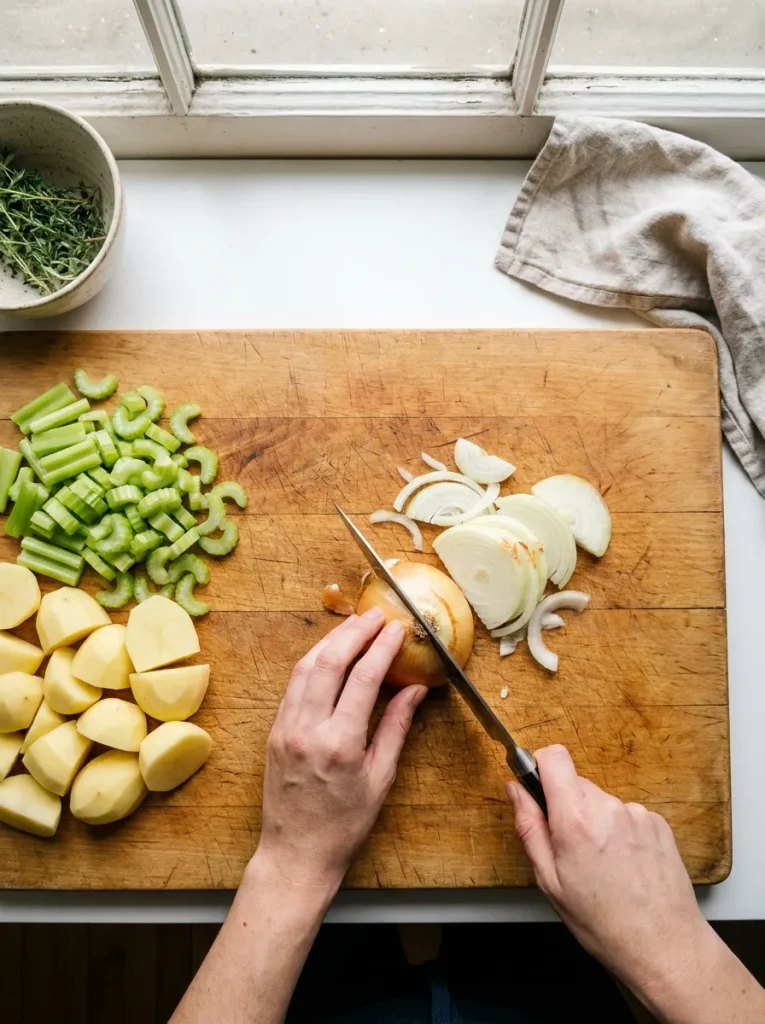
7. Chop every vegetable the night before and bag it
Twenty minutes of Wednesday chopping buys you back twenty minutes of Thursday counter space, and Thursday counter space is worth far more. Your cutting board only comes out once. Work through everything in one session:
- Dice 2 large onions and bag them
- Slice 1 bunch of celery and bag it with the onion
- Peel 4 pounds of russet potatoes, cut into 2 inch chunks
- Trim the stem ends off 1 1/2 pounds of green beans
Cover the cut potatoes with cold water in the stockpot and refrigerate the whole pot overnight. This keeps them from turning gray, and Thursday you carry the pot straight to the stove.
8. Take the turkey out of the fridge one hour before it roasts
A cold bird straight from the fridge cooks unevenly, and in a small oven that gap gets worse. Set it on the counter at 11:30 a.m. for a 12:30 roast. Do not rinse it. Pat any damp spots dry, rub 1/2 cup softened butter over the skin, and tie the legs together with kitchen twine or a strip of foil.

9. Roast the turkey uncovered and keep the door shut
Pull the top rack out of your oven completely and set the bottom one low, then preheat to 325°F. Put the bird breast-side up on a wire rack inside the pan so hot air circles underneath.
A 10 to 12 pound turkey takes about 2 1/2 to 3 hours, but time is a guess and the thermometer is the truth. Check at 2 hours, then every 20 minutes after.
You are done at 165°F in the thickest part of the breast and 175°F in the thigh, not touching bone. If the skin browns too fast, tent foil loosely over the top and keep going.

Every time you open the door, a small oven loses more heat than a big one and takes longer to recover — a peek can cost you 15 minutes. Turn on the oven light instead. Small ovens also run hot in the back, so rotate the pan once at the halfway mark and then leave it alone.
10. Boil and mash the potatoes while the turkey roasts
That stockpot of cut potatoes has been waiting in the fridge since last night, so carry it straight to the stove and top off the water until the potatoes sit 1 inch below the surface. Salt it well, bring it to a boil, then cook 15 to 20 minutes until a fork slides through with no resistance.
Drain and return them to the hot pot for 30 seconds before mashing. The leftover heat steams off the surface water, which is why some mashed potatoes turn out gluey and others do not.
Mash in 1/2 cup butter and 1 cup warm milk.

Mashed potatoes hold beautifully for an hour with no oven and no reheating. Put the lid back on the pot, set it on the back burner, and turn the heat to the lowest setting your stove has. Stir once every 20 minutes. They come to the table hotter than anything you could have kept in a warming drawer.
11. Cook the stuffing in a skillet on the stovetop
No casserole dish, no second oven slot, no compromise on taste. Melt 1/2 cup butter in a 12 inch skillet over medium heat and cook the bagged onion and celery until soft, around 8 minutes. Stir in 1 teaspoon dried sage and 1 teaspoon dried thyme, then add 12 ounces of bread cubes and 2 cups of broth. Press it flat and let the bottom crisp for 5 minutes without stirring. That crust is the part everyone fights over.

12. Blister the green beans in one hot pan
Wipe out the skillet the stuffing came from one pan, two dishes, one wash. Get it hot and dry over high heat, add 1 tablespoon butter, then the trimmed green beans in a single layer. Leave them alone for 3 minutes so they char in spots, toss once, and cook 3 minutes more. They should still snap when you bite one. Beans cooked in water go limp and olive-colored, and nobody reaches for those twice.

13. Rest the turkey on a cutting board for 30 minutes
Out of the pan, onto the board, loosely tented with foil. Thirty minutes is not a suggestion and it is not the turkey going cold — a large bird holds heat far longer than you expect, and the meat keeps climbing a few degrees after it leaves the oven. Leave the roasting pan on the stovetop exactly where it is. Those brown drippings are your gravy and you need them in 15 minutes.

Cutting early is the single most common Thanksgiving mistake. The juices are still moving toward the surface, and slicing into the bird at 10 minutes dumps them onto the board instead of keeping them in the meat. You get dry slices and a puddle. If people are hovering, hand them the cranberry sauce and a stack of plates.
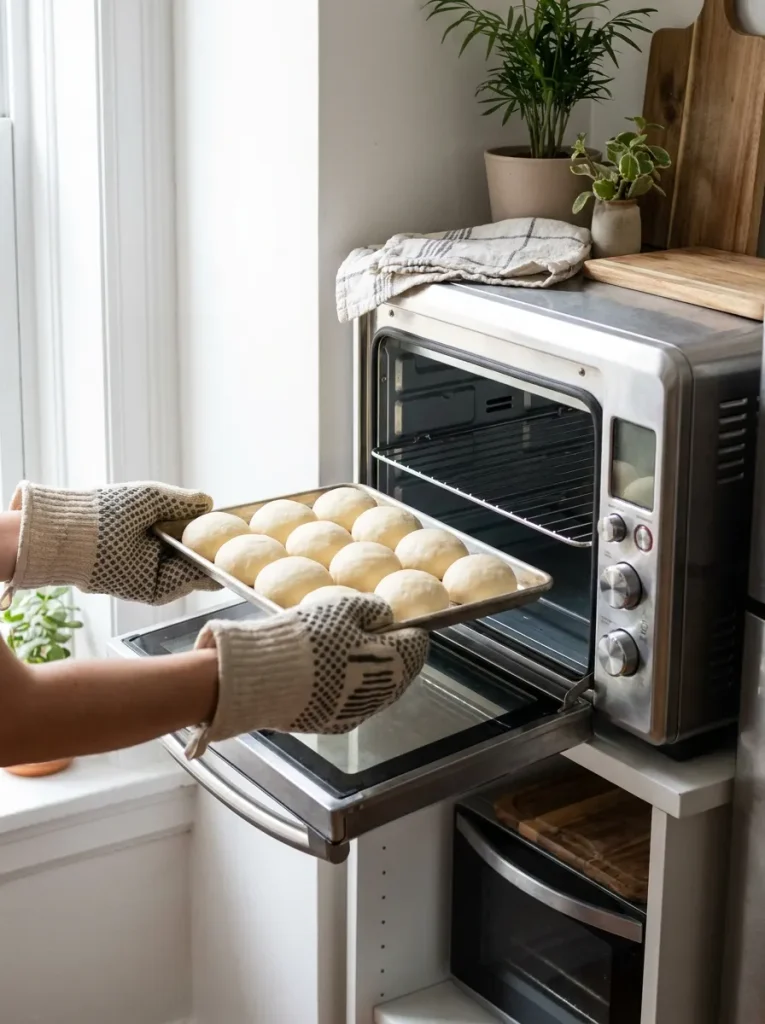
14. Bake the rolls in the now-empty oven during the rest
This is the slot you have been protecting all day. Turn the oven up to 375°F the moment the turkey comes out, slide 12 rolls onto a sheet pan, and bake 10 to 12 minutes until the tops are golden. They finish right as the turkey’s rest ends.
15. Whisk the gravy from the pan drippings
Set the roasting pan across one burner over medium heat and tilt it so the drippings pool at one end. Spoon off all but about 1/4 cup of the fat, then sprinkle in 1/2 cup flour and whisk hard for 1 minute — the raw flour needs to cook or the gravy tastes like paste. Pour in 4 cups broth a splash at a time, whisking between each. Simmer 5 minutes until it coats a spoon, then pour it through a fine mesh strainer into a jug. Lumps happen to everyone, and the strainer erases them.

16. Carve the turkey and set up a one-way buffet line
Legs and thighs come off first, then the breasts in whole pieces before slicing them across the grain. Pile it all on one platter rather than arranging it — it keeps the meat hotter and takes a quarter of the time.
Now the part that actually makes Thanksgiving in a small apartment work: do not put food on the dining table. Line every dish along the cleared counter in eating order, stack the plates at the front, and let people walk the line once. Your table stays free for people, drinks, and elbows.
Six guests need six seats. If you’re short, here’s how to find extra seating in a small apartment using what you already own.

Put the plates at the counter’s far end so the line runs toward the table instead of doubling back through your kitchen. In a narrow galley, that one change is the difference between a buffet and a traffic jam. Set the gravy jug last, right before the turning point.
When Something Goes Sideways
Every one of these is fixable from where you are standing.
Questions People Ask Every November
Will a 12 pound turkey actually fit in a small apartment oven?
Yes, as long as you pull the upper rack out and set the lower one at its lowest position. Measure your oven’s interior height first — you want about 4 inches of clearance above the bird for air to move.
Can I stuff the turkey instead of making stuffing separately?
Skip it. Stuffing inside the cavity has to reach 165°F to be safe, and by the time it gets there the breast meat is overcooked. The skillet version tastes better anyway because of the crust.
What if I do not own a roasting pan?
A 9×13 metal baking pan handles a 12 pound bird fine. Set the turkey on a wire cooling rack inside it, or on a bed of thick onion slices if you have no rack.
How much of this can I make ahead?
Dessert and cranberry sauce hold for 3 days. Chopped vegetables hold overnight. Stuffing and mashed potatoes are better made the same day, though mashed potatoes sit happily on low heat for an hour.
Where do I put six people’s coats and bags?
On your bed, with the bedroom door shut afterward. Coats on dining chairs eat the seats you need, and a pile by the door blocks your only walking path.
I only have four chairs. Is that a problem?
No. Pull in a desk chair and a small bench or ottoman, and put those at the table ends where legroom is easier. Mismatched seating reads as charming, not unprepared.
Small Apartment Thanksgiving Card
Serves 5 to 6 · One oven rack · 3 days
- Turkey, 10 to 12 lb frozen
- Russet potatoes, 4 lb
- Bread cubes, 12 oz
- Green beans, 1 1/2 lb
- Cranberries, 12 oz · orange, 1
- Onions, 2 · celery, 1 bunch
- Broth, 6 cups · flour, 1/2 cup
- Butter, 1 1/2 cups · milk, 1 cup
- Kosher salt, 1/2 cup · sage · thyme
- Dinner rolls, 12 · dessert
- Thermometer · foil · wire rack
- Write the oven schedule on paper
- Turkey to fridge, 3 days out
- Clear counters to bare
- Bake dessert, Tuesday
- Simmer cranberry sauce, chill
- Dry-brine turkey, Wednesday night
- Chop and bag all vegetables
- Turkey out at 11:30 a.m.
- Roast at 325°F, 2 1/2 to 3 hrs
- Boil and mash potatoes
- Stuffing in the skillet
- Blister green beans, same pan
- Rest turkey 30 min
- Rolls at 375°F, 10 to 12 min
- Gravy from the drippings
- Carve, then one-way buffet line
Numbers to remember: 325°F roast · 165°F breast · 175°F thigh · 30 min rest · 375°F rolls
Conclusion
You did it, a full turkey dinner for six out of one oven rack and three feet of counter.
The plan did the heavy lifting, not the kitchen. That is the whole secret to Thanksgiving in a small apartment: move the work off Thursday, and let the stovetop carry what the oven cannot.
Next year, start the same paper schedule a week earlier. You will be surprised how much of it you already remember.
Pin this before you forget where you found it, you will want that oven schedule again in November.
Cooking in a studio? Here’s how to host guests in a studio during the holidays, from zones to the coat drop by the door.