
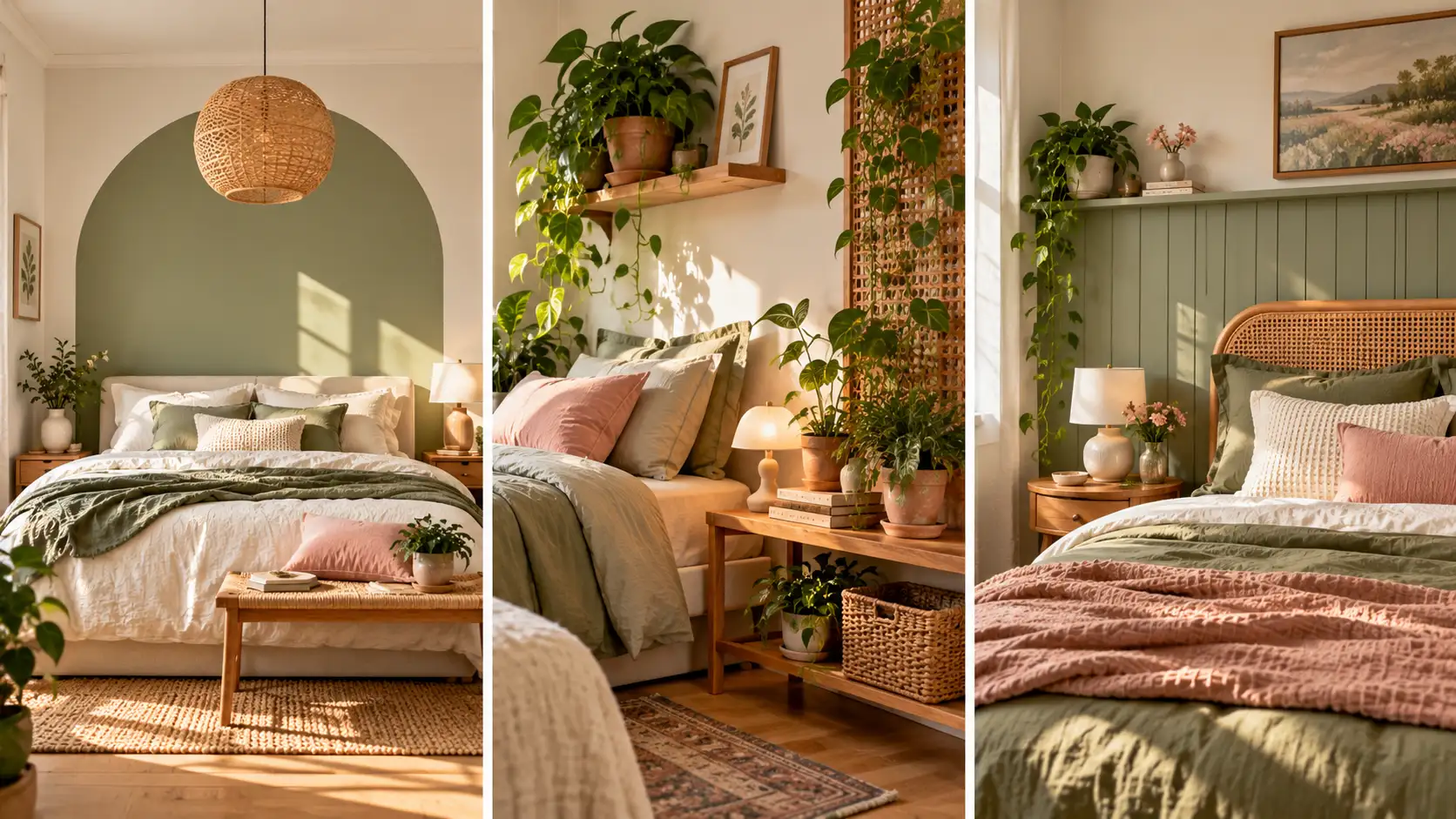
Green is the one color that seems to calm a bedroom down the second it shows up. It feels fresh in the morning, soft at night, and it gets along with wood, rattan, and plants. The catch is that most green bedroom ideas online are shot in huge rooms with tall windows. In a small apartment, the wrong shade or too much stuff can make the room feel tight fast.
So this list sticks to what actually fits a small space. Some ideas are bold, like drenching the whole room in forest green or painting stripes to stretch a low ceiling. Others take one afternoon, like a painted arch headboard or a single shelf of trailing plants. Renters get plenty of options too, with peel and stick wallpaper, plug-in sconces, and headboard panels that come down when you move.
You’ll also find storage that hides in plain sight, color pairings that keep green from feeling flat, and a simple way to pick the right shade for your light. Save your favorites and start with just one.
1. Layer Four Shades of Green on a Low Floor Bed
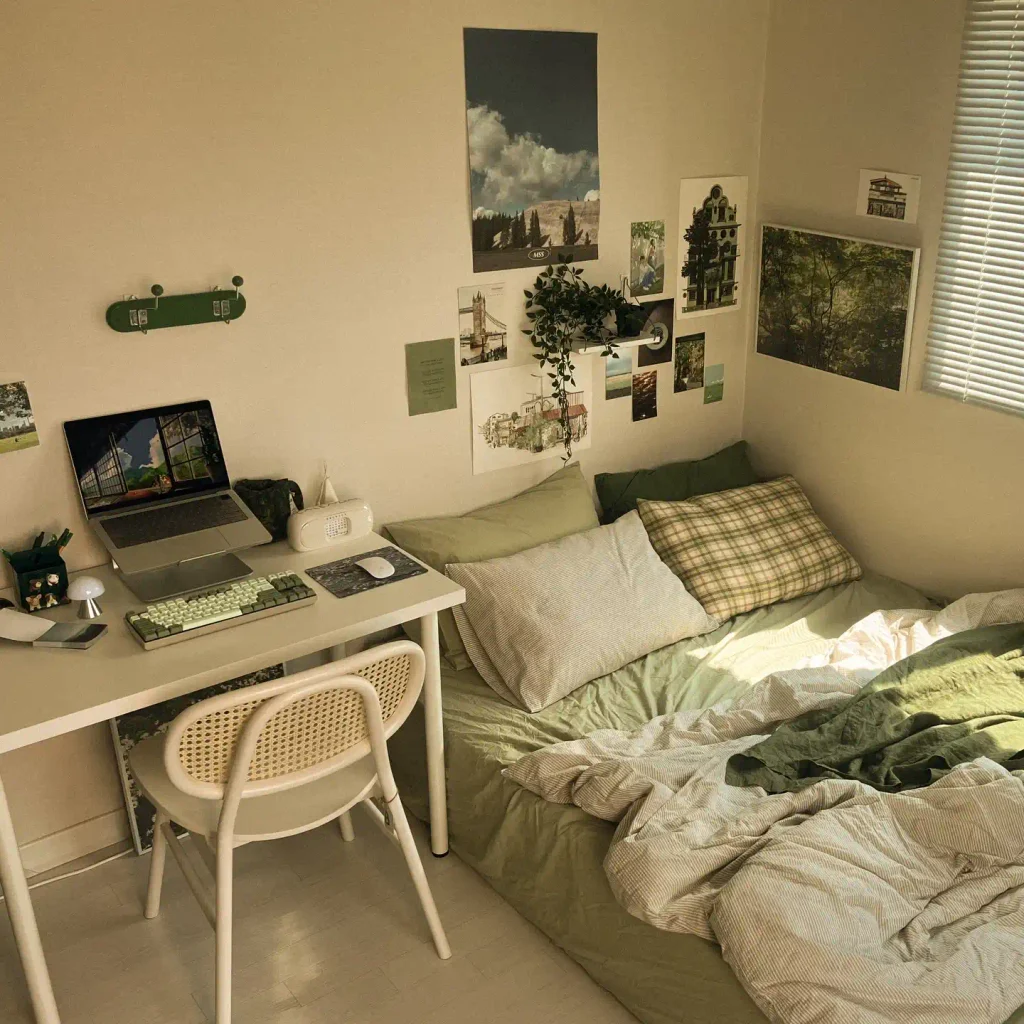
Cream walls keep this tiny room bright, so almost all the color lives on the bed. The mattress sits low, close to the floor, which makes the walls feel taller and the room less crowded.
Here’s how the greens stack up:
- A pale sage fitted sheet as the base
- Pillows in sage, deep forest green, and a small green plaid
- A thin striped duvet to break up the solid colors
- A dark olive throw tossed loose across the foot
The mix works because no two pieces match exactly. Keep any pattern small in scale so it reads as texture, then let a few green accents around the room pick up the same shades.
Where the green repeats in this room
2. Let a Wall of Real Plants Be Your Green
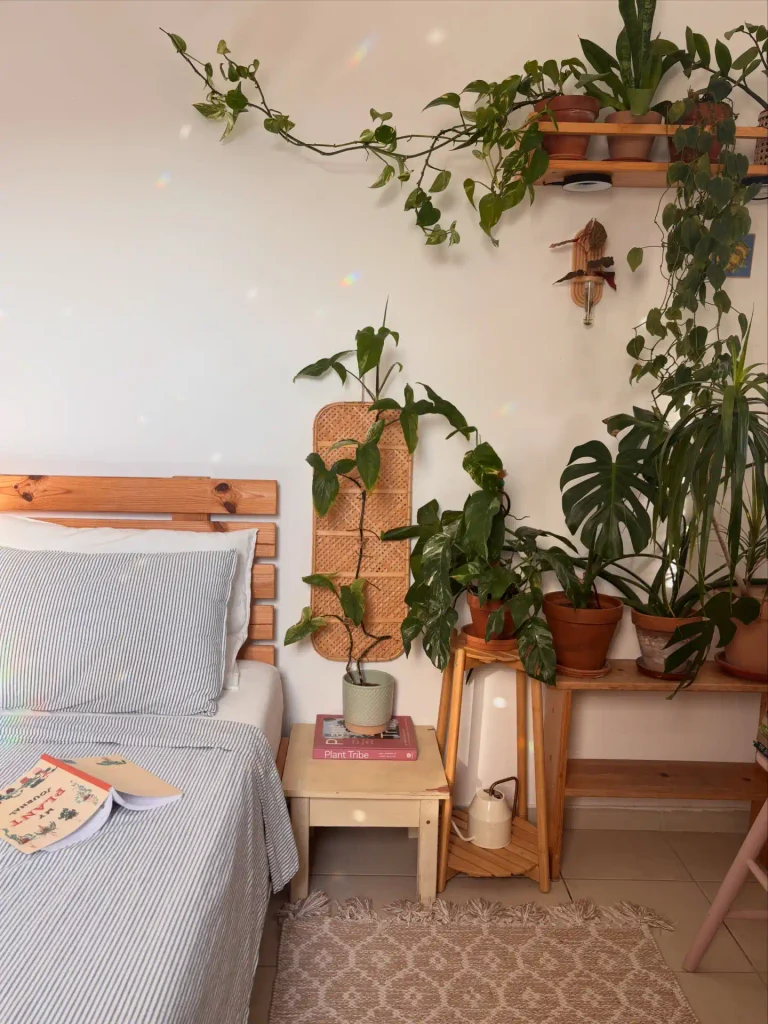
No green paint here at all. The walls stay plain white, and the color comes from a small indoor jungle climbing up the corner beside the bed.
What makes it work in a tight room is that the plants go up, not out. A long pothos vine is trained sideways across the wall, a woven cane panel acts as a trellis for a climbing plant, and a narrow wooden bench holds the bigger pots, including a monstera.
Terracotta pots and pine wood keep the whole corner warm, so the greens look rich instead of cold. Even the nightstand is just a small wooden stool with one pale green pot on top.
Start with one shelf. You can always grow out from there.
Build your plant wall in 4 layers
Up high: mount a two-tier wooden shelf and fill it with trailing plants that can spill over the edge.
Across the wall: guide the longest vine sideways with small removable hooks so it frames the bed.
Mid height: hang a cane or rattan panel as a trellis for one climbing plant beside the nightstand.
Down low: line up the big leafy pots on a slim bench or tall stand, and clip small grow lights under the shelf if the corner is dim.
3. Paint Every Wall Sage, Then Warm It Up With Rattan
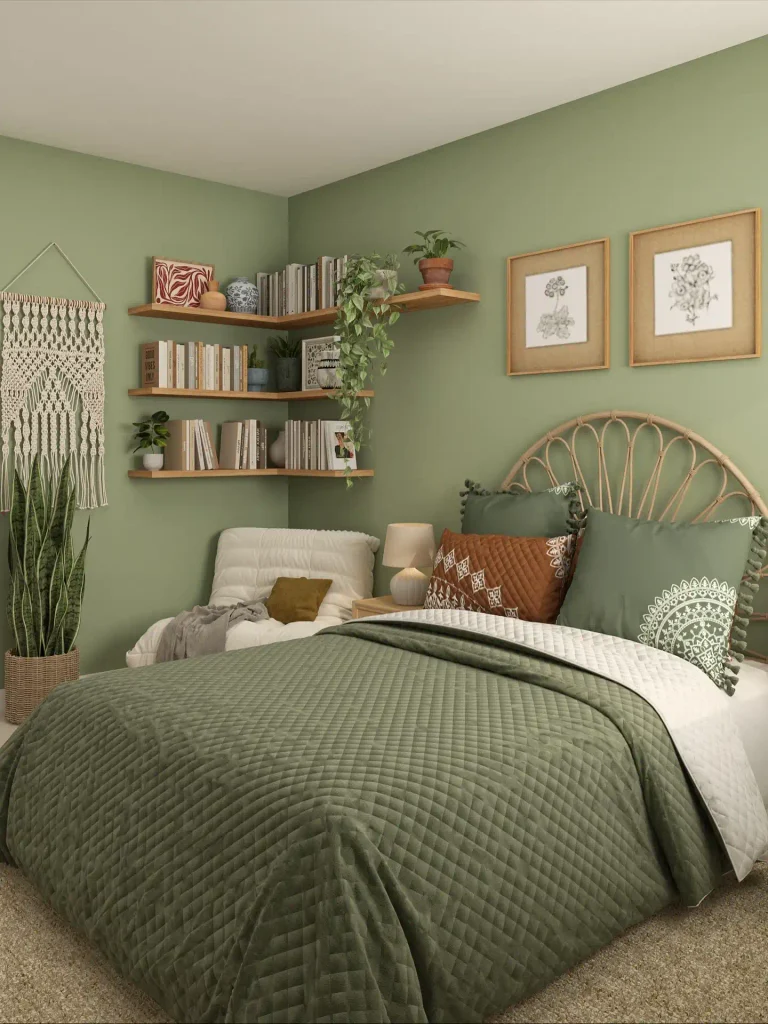
Full sage walls sound bold for a small bedroom, but a soft, grayed green like this feels calm instead of loud.
Two things keep it from closing in:
- A white ceiling. It stops the green at the top edge, so the room still feels tall.
- Warm natural pieces. A round rattan headboard, honey wood shelves, and a woven plant basket break up all that cool color.
The bed repeats the walls with a quilted sage spread, and one rust pillow keeps the greens from going flat. Up in the corner, wraparound floating shelves turn a dead angle into book and plant storage.
Test a swatch first, though. Some sages lean gray and can look muddy in a dim room.
Recreate this look
4. Pair Sage Wall Paneling With Soft Blush Pink
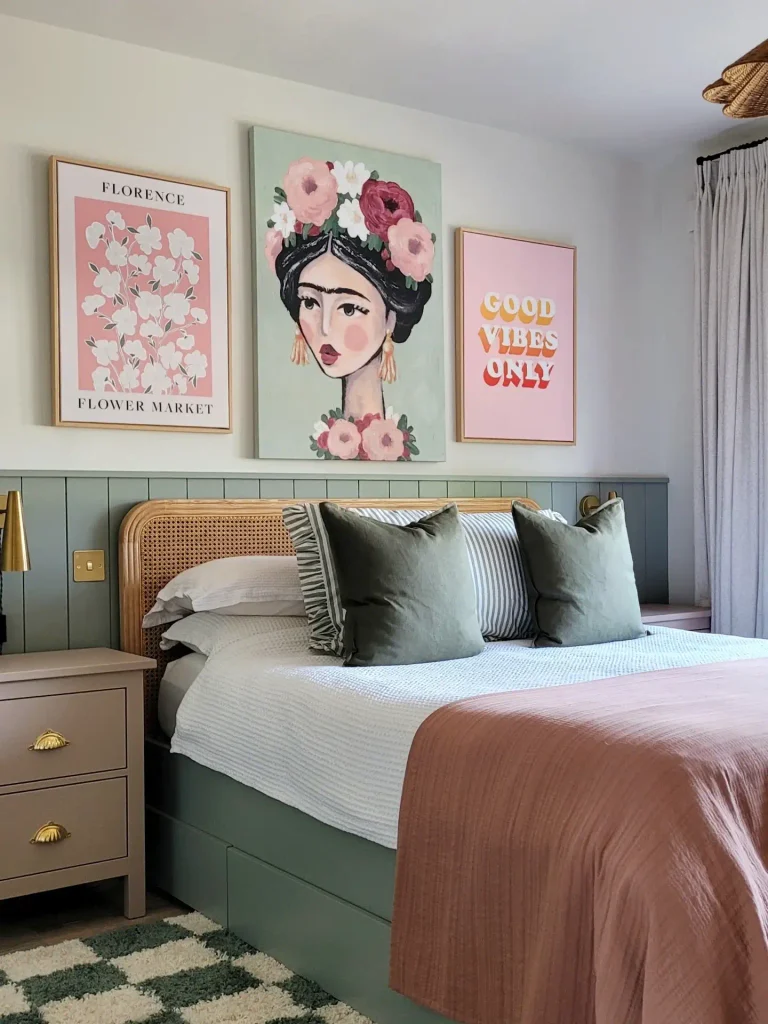
Not ready to paint the whole room green? Run sage paneling just halfway up the wall behind the bed instead.
Here the vertical boards stretch wall to wall with a thin trim on top, so they work like one long headboard. Brass sconces mount right onto the panels, which keeps the nightstand clear. The bed base is painted the same sage, with drawers built underneath for extra storage.
Why the pink matters: sage on its own can feel a little serious. Blush art prints, a dusty pink throw, and a mushroom pink nightstand warm it up, while olive pillows and a green checkered rug tie everything back to the paneling.
Keep the top half of the wall light so the art stands out.
Mixing green and pink in a small bedroom
Choose a grayed sage and a dusty, muted pink so neither color shouts.
Repeat the pink at least three times, like art, a throw, and one piece of furniture.
Let brass or natural wood bridge the two colors.
Bright mint with hot pink. In a small room it starts to look like a nursery.
Pink in only one spot. It looks like an accident, not a choice.
Pink on the walls too. Let the green own the walls and keep pink for the details.
5. Go Dark and Drench the Whole Room in Forest Green
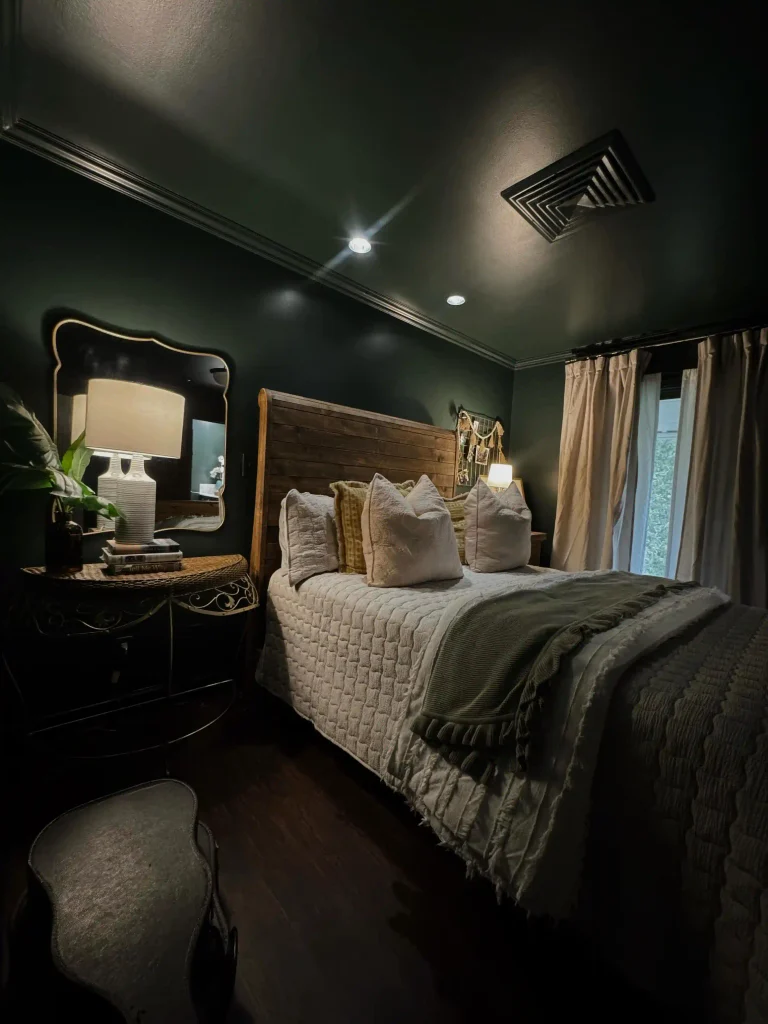
Deep forest green covers everything here, the walls, the crown molding, and even the ceiling. With no white edges to stop your eye, the corners blur and the small room feels wrapped up instead of boxed in.
Light and texture keep it cozy, not gloomy:
- Two warm lamps glow on either side of the bed
- Cream curtains hang high, right under the molding
- Pale quilted bedding and fluffy pillows bounce light back
- A rustic plank headboard and an olive ruffled throw add warmth
A wavy mirror with a thin gold edge sits above a half-moon wicker side table and catches the lamplight too.
Save this look for a room you mostly use at night. It’s made for sleeping, not for bright mornings.
Dark green walls only vs. a full color drench
| Walls only | Full drench | |
|---|---|---|
| What gets painted | The four walls | Walls, trim, molding, and ceiling |
| How it feels | Dark sides with a bright white lid on top | Soft, seamless, and wrapped in color |
| Effort | One weekend | Longer, the ceiling is the slow part |
| Best for | Testing dark green before going all in | A bedroom used mostly at night |
6. Paint a Sage Green Arch as a Headboard
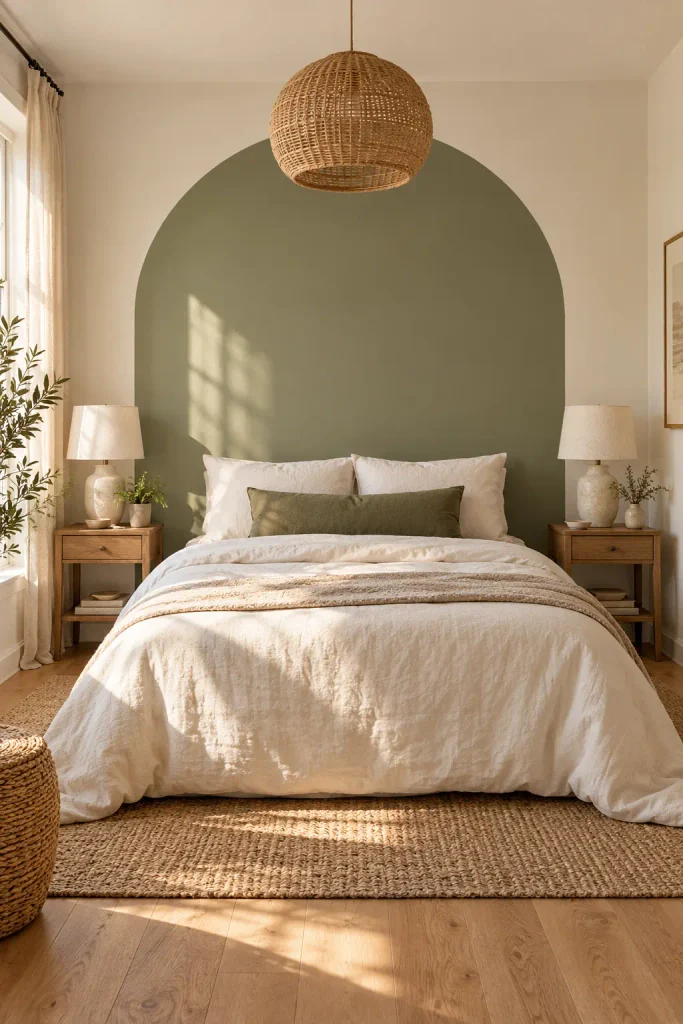
No room for a real headboard? Paint one. A tall sage arch behind the bed gives the room a focal point and takes up zero floor space.
How to sketch it:
- Center the arch on the bed and make it a little wider than the mattress.
- Tie a pencil to a string, pin the other end at the center point where the curve begins, and swing it to draw a clean half circle.
- Tape the straight sides, then paint the curve by hand with a small angled brush.
Take it almost to the ceiling. A tall arch pulls the eye up and makes a low room feel taller.
7. Cover One Wall in Peel and Stick Leaf Wallpaper
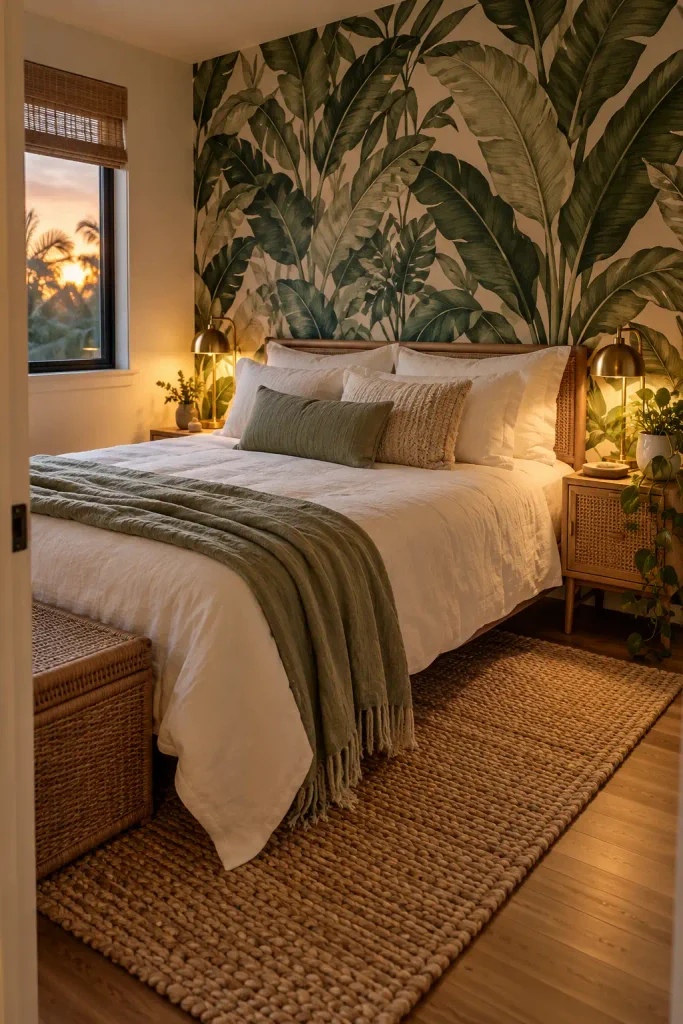
Renting doesn’t mean you’re stuck with plain walls. Peel and stick wallpaper goes up with no paste and is made to come off when you move out.
Pick your print by where it’s going:
Large leaf prints belong on the wall behind the bed. The big shapes read as one calm backdrop instead of a busy pattern.
Small, busy prints suit a tiny spot, like the back of an open closet or a reading nook. Across a whole wall in a tight room, they can start to feel jittery.
Keep the bedding plain white or cream so the leaves stay the main event.
⚠️ Watch Out
Stick a small test piece in a hidden corner and leave it for a week before doing the whole wall. On cheap or freshly painted walls, some wallpapers can pull paint off when you peel them. Smooth walls also hold much better than textured ones.
8. Hang Olive Velvet Headboard Panels on the Wall

A basic bed frame looks far more finished once soft olive velvet goes up behind it. Wall-mounted panels are the small space version. They hang straight on the wall, so you don’t need a new bed or extra floor depth.
Why they suit a tiny bedroom:
- The panels can run wider than the bed and frame two small nightstands
- Soft velvet cuts down the echo in a bare rental room
- Some sets hang with a single cleat or strong strips, so check which kind is renter friendly
Run a lint roller over them once a week. Dust shows up fast on deep green.
A plain metal frame pushed against a bare white wall. The bed looks temporary, and there’s nothing soft to lean on when you read at night.
Olive velvet panels stretch past both sides of the bed. It reads like a custom headboard, and sitting up with a book is finally comfortable.
9. Close Off a Studio Bed Nook With Floor to Ceiling Green Curtains

Studio living means your bed is always on display, even when friends drop by. A deep green curtain on a ceiling track turns the sleeping corner into its own little room, then slides open again in the morning.
Setting it up:
- Mount the track along the edge of the bed zone, in a straight line or an L shape around the corner.
- Buy panels long enough to just brush the floor. Short curtains end up looking like a shower curtain.
- Get about twice the track width in fabric so it falls in full, soft folds when closed.
A tieback on the wall keeps it neat during the day.
Pick your curtain fabric
10. Go Japandi With Olive Green and Light Oak
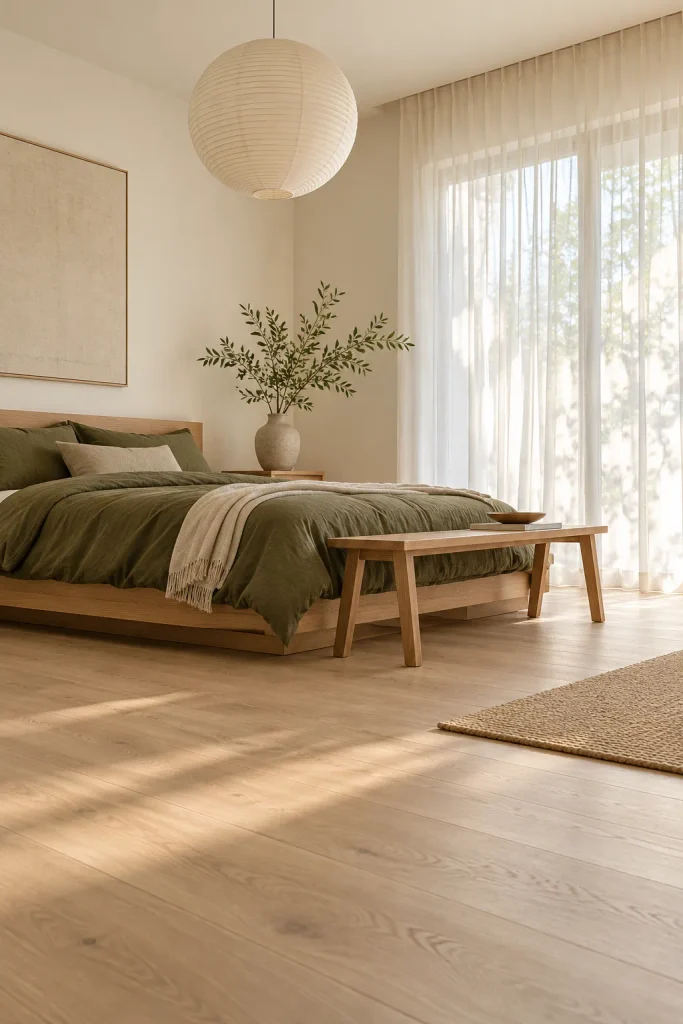
Japandi mixes Japanese calm with Scandinavian warmth, and it works beautifully in small rooms. Fewer things, better materials, lots of breathing room.
The formula is simple: olive green, pale oak, and warm white. That’s it.
A low oak platform bed keeps the sight line open across the room. Olive linen bedding, one paper lantern, and a single stoneware vase with a branch are about all the decor you need. Storage hides behind closed oak doors instead of sitting out on open shelves.
The hard part isn’t shopping. It’s leaving the empty space alone.
In a small bedroom, empty space is part of the design. Three colors and a few natural materials let a tiny room breathe instead of feeling stuffed.
11. Paint the Wardrobe the Same Green as the Walls
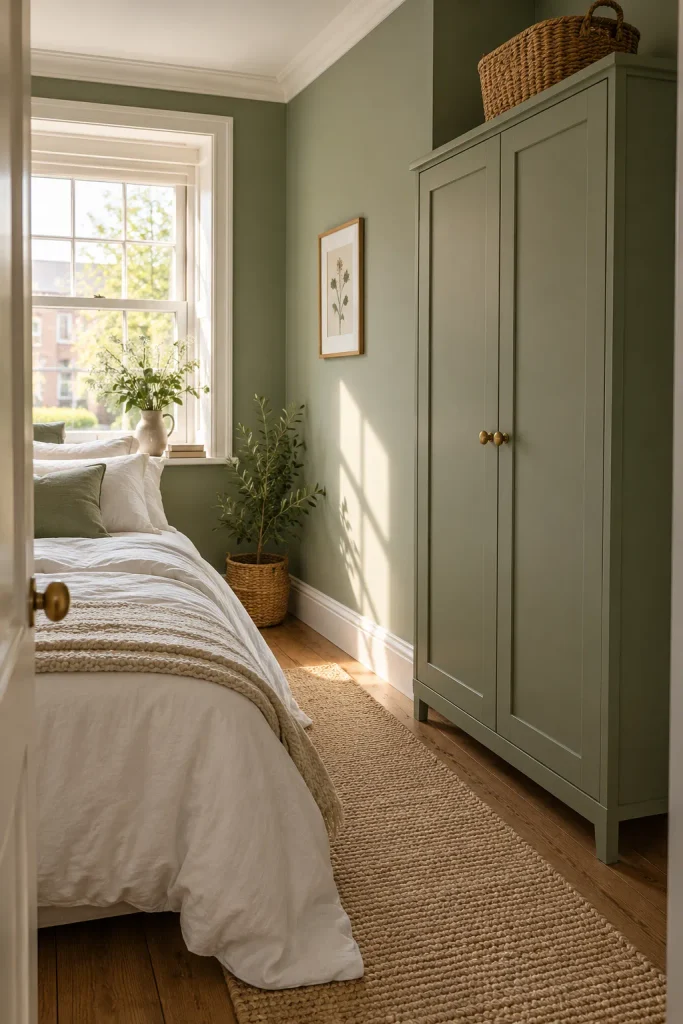
A big wardrobe can eat up a small bedroom, even when it’s the only one you have room for. Paint it the same green as the wall, and it sinks into the background.
Two ways to play it:
Match it exactly. Same color on the wall and the doors. The wardrobe nearly disappears, which helps a lot when it stands right beside the bed.
Go one shade darker. It still blends in, but you get a soft built-in look with a bit of depth.
Swap the knobs for brass or wood so the doors still have a little personality.
How to paint wardrobe doors so the color lasts
Take off the doors and hardware, then wipe everything down with a degreaser.
Lightly sand and use a bonding primer, especially on shiny laminate.
Roll on two thin coats of a durable satin paint instead of one thick one.
Let the doors dry for a few days before rehanging so they don’t stick. Renting? Stick to a freestanding wardrobe you own.
12. Light It With Green Glass Lamps and Plug-In Sconces
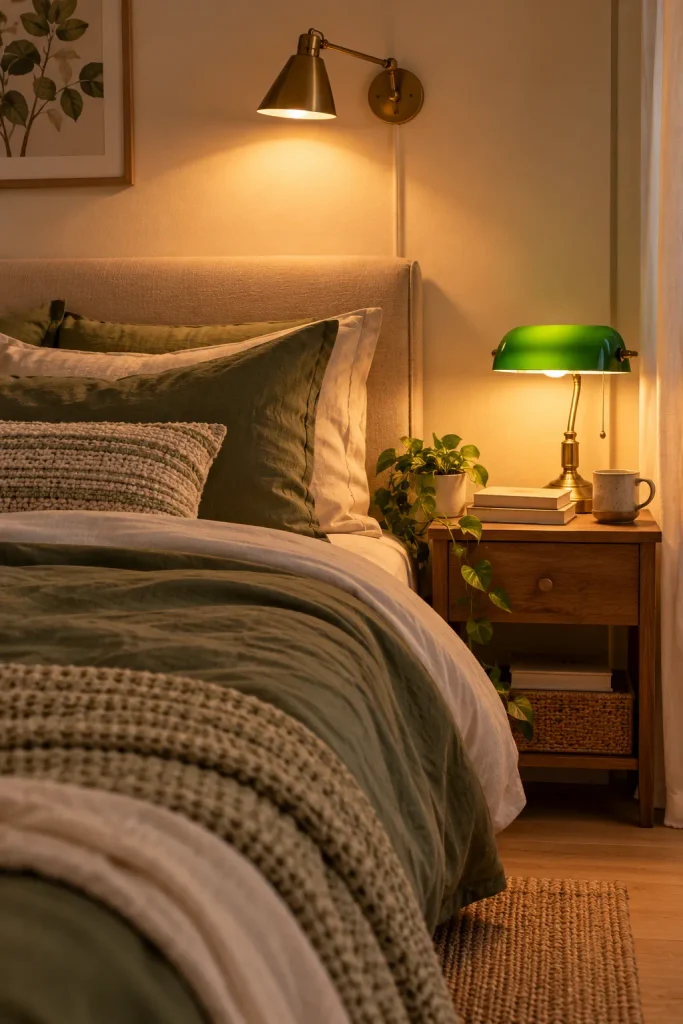
Green doesn’t have to come from paint or fabric. It can glow.
A green glass table lamp gives off a soft, tinted light that feels cozy at night, especially against white or cream walls. A classic banker’s lamp with a green shade or a fluted glass base both work.
Short on nightstand space? A plug-in wall sconce mounts with a couple of screws and runs on a cord, so no electrician is needed. Hide the cord inside a paintable cord cover in your wall color.
Pick warm white bulbs. Cool ones make green glass look a little clinical.
Table lamp or plug-in sconce?
| 💡 Table lamp | 🔌 Plug-in sconce | |
|---|---|---|
| Space it takes | Most of a small nightstand top | None, it lives on the wall |
| Setup | Plug in and go | A couple of screws plus a cord cover |
| Best for | Wider nightstands and dressers | Beds squeezed between two walls |
| Renters | No holes at all | Small screw holes, easy to patch |
13. Hang a Green Framed Mirror Across From the Window
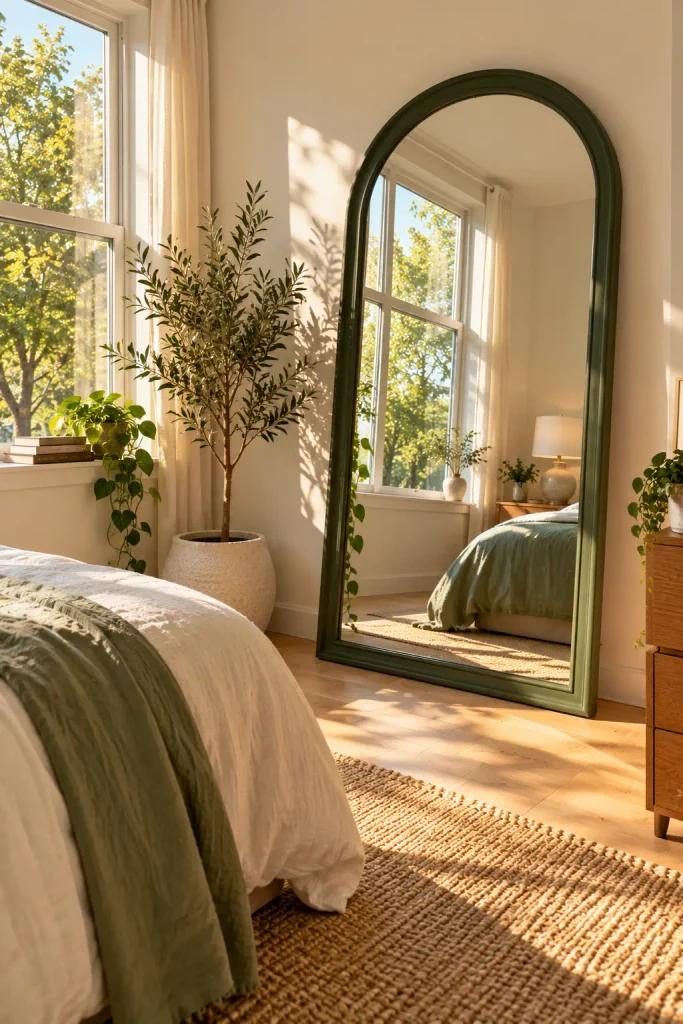
A big mirror is the oldest small space trick, and it still works. Placed straight across from a window, it bounces daylight deeper into the room and doubles the view outside.
Make it part of the green story with a painted frame:
- Find a mirror with a wide wooden frame. Thrifted is fine.
- Tape off the glass with painter’s tape.
- Brush on two thin coats of forest or olive green.
- Hang it at eye height, or lean a tall one against the wall.
Go as big as the wall allows. A small mirror just looks lost.
📌 Good To Know
A leaning floor mirror still needs a furniture strap anchoring it to the wall. Big mirrors are heavy, and a bedroom is where you’re stumbling around half asleep. Check what the mirror will reflect too. You want the window and the light, not the laundry pile.
14. Swap the Nightstand for a Green Floating Shelf
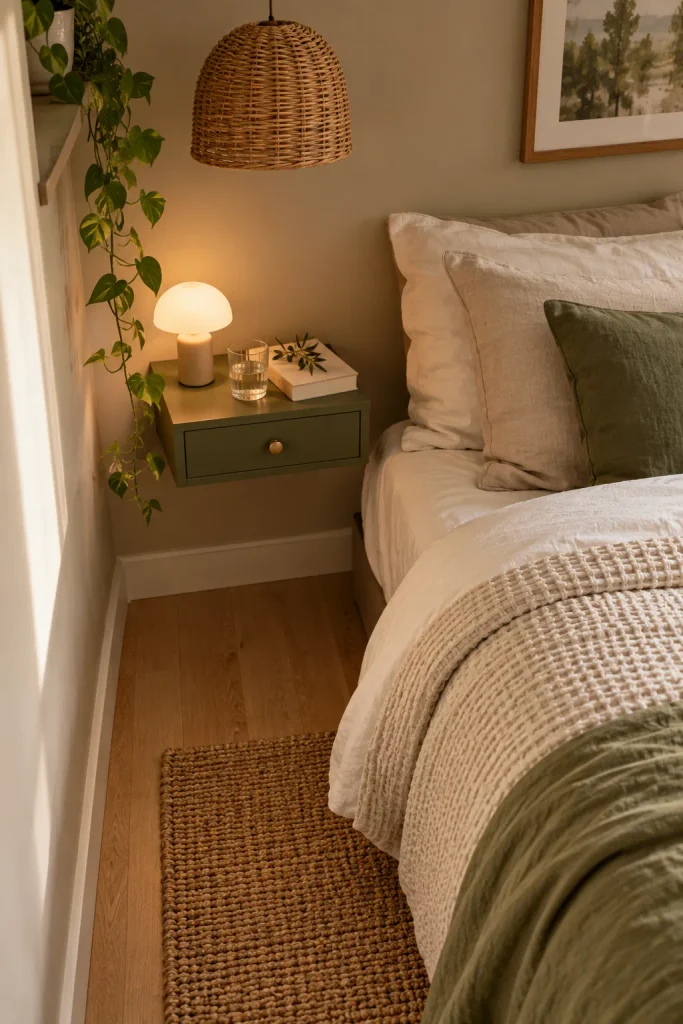
In a narrow bedroom, every inch of floor beside the bed counts. A small floating shelf or wall-mounted drawer painted green holds your phone and a book, with no legs eating up space.
Get the details right:
- Hang it level with the top of the mattress so nothing is a reach at night
- Keep it shallow, just deep enough for a small lamp and a glass of water
- Paint it a shade darker than the wall so it looks planned, not stuck on
Bonus: clear floor underneath makes the room look wider and the vacuum’s job a lot easier.
A boxy nightstand wedged between the bed and the wall. It blocks the path, and its bottom shelf quietly fills with clutter.
A slim green shelf on the wall with open floor below. The bedside feels lighter, and there’s still room for the things you actually reach for.
15. Paint Vertical Green Stripes to Make the Ceiling Feel Higher
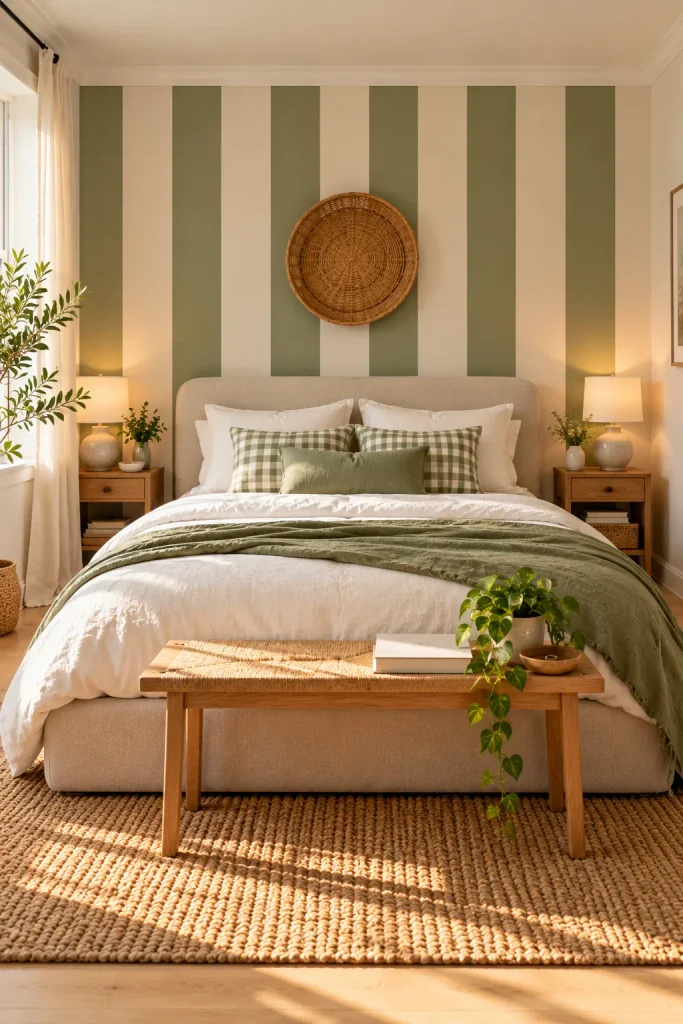
Low ceilings come with a lot of apartments, and vertical stripes are a cheap way to fight back. Your eye follows the lines up, so the wall reads taller than it really is.
Wide stripes look calmer than skinny ones in a small room. Try sage and warm white in equal widths on the wall behind the bed, and leave the other three walls plain.
Watch the corners, though. Few rooms are perfectly square, so start your first stripe at the center of the wall, not the edge. That way the stripes at both ends come out even.
How to get crisp stripe lines
Paint the whole wall warm white first and let it dry overnight.
Mark each stripe from the center out with a level and a light pencil line.
Tape the lines, then brush a thin coat of the white over the tape edges. This seals them so the green can’t bleed under.
Roll on the sage, and peel the tape while the last coat is still slightly wet.
16. Pair Olive Green With Mustard for a Warm Retro Look
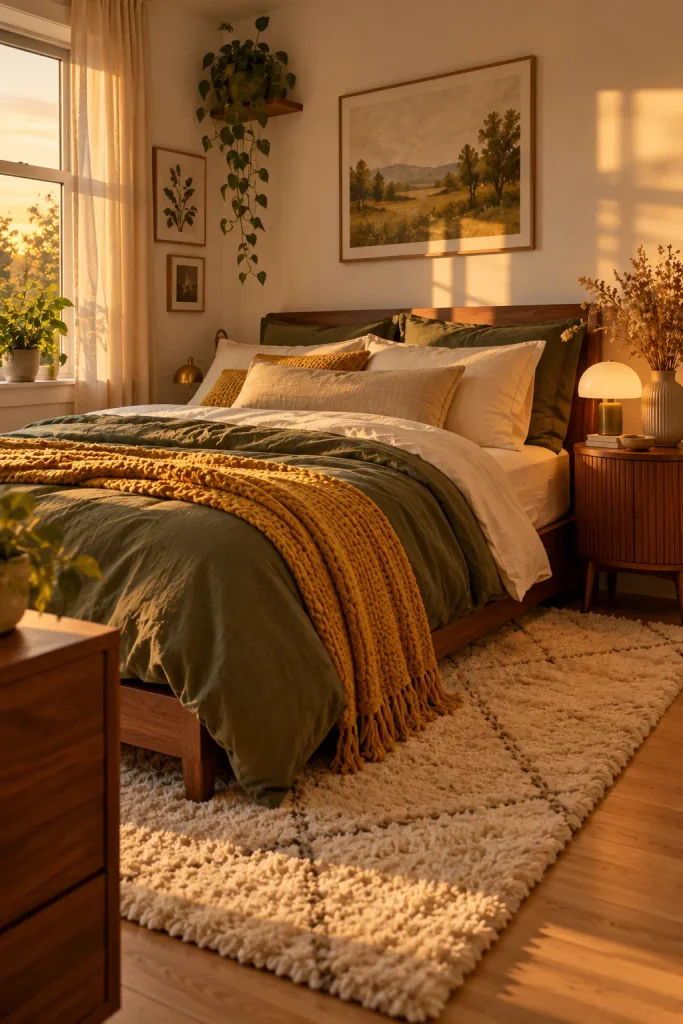
Olive and mustard were all over 1970s bedrooms, and the combo is back for good reason. Both colors are earthy, so they glow together instead of fighting.
Keep it fresh, not dated:
Let olive lead. Use it on the bigger things, like the duvet or one painted wall.
Use mustard in small hits. A throw, a lampshade, one cushion. Any more and the room starts to feel heavy.
Add one curvy piece. A mushroom lamp or a rounded walnut nightstand nods to the era without turning the room into a costume.
Cream sheets underneath keep the whole bed from going too dark.
The retro palette and where each color goes
17. Paint Just the Ceiling a Soft Sage

Leave the walls white and paint the ceiling a soft sage instead. It’s a quiet way to try green, and you notice it most while lying in bed, right when you want something calming to look at.
Three reasons it’s worth the sore neck:
- The walls stay bright, so the room still feels open
- The room feels cozier without shrinking
- Bedding and furniture can stay neutral since the green is already overhead
Stick to a pale sage. Deep green on a low ceiling can feel like it’s pressing down on you.
Use a flat finish. It hides bumps and patches overhead.
Grab an extension pole and work in small sections to avoid lap marks.
Pick a white wall shade with a warm undertone so it sits nicely next to the sage.
Glossy paint. It shows every dent and ripple.
Deep forest green if your ceiling is already low.
Rolling straight over a textured popcorn ceiling without testing a patch first. It can soak up paint and flake.
18. Add a Green Upholstered Storage Bench at the Foot of the Bed
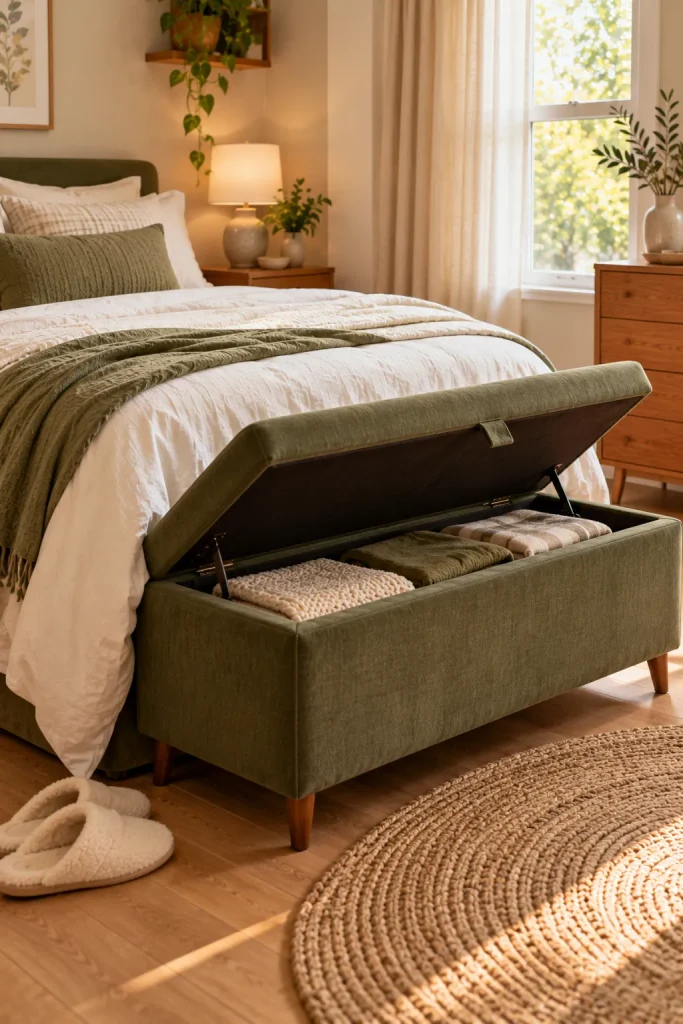
Extra blankets, spare pillows, winter sweaters. In a small apartment they all need somewhere to go, and the foot of the bed is usually wasted space.
A lift-top storage bench in green fabric solves it. It hides the bulky stuff, gives you a seat for putting on shoes, and repeats the green right where your eye lands when you walk in.
Measure before you buy:
- Keep it a little narrower than the mattress so it doesn’t poke out past the sides.
- Choose one that sits just below the mattress edge.
- Leave enough room to walk past it without turning sideways.
Wipeable fabric is worth it here. This bench gets sat on with jeans and bags every day.
19. Match Your Shade of Green to Your Window
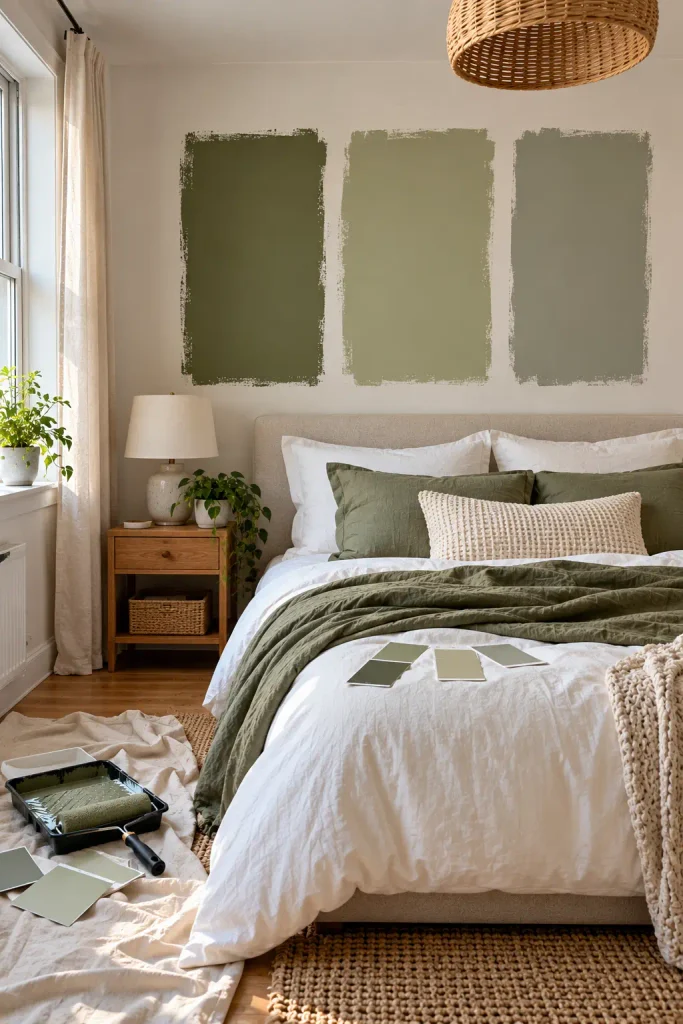
The same can of green can look totally different in two rooms. The direction your window faces does most of that work.
North-facing rooms get cool, grayish light all day, which can turn a soft sage dull and a little muddy. South-facing rooms get strong, warm sun, which can push bright greens close to neon by afternoon.
Test before you commit. Paint two big swatches, each at least the size of a sheet of paper, on two different walls. Look at them in the morning, late afternoon, and at night with your lamps on.
Pick the one you still like at night. That’s when you’ll see it most.
Which green suits your light?
| ❄️ North-facing | ☀️ South-facing | |
|---|---|---|
| The light | Cool, soft, and even | Warm and strong, brightest midday |
| Greens that work | Warm greens with a yellow lean, like olive, moss, and warm sage | Softer, grayer greens, like eucalyptus and muted sage |
| Greens to skip | Blue-gray greens that can look cold | Bright lime or kelly green |
| Pair it with | Warm whites and honey wood | Crisp whites and pale linen |
📌 Living south of the equator? Swap the two columns.
20. Give the Room a Green Refresh on a Small Budget
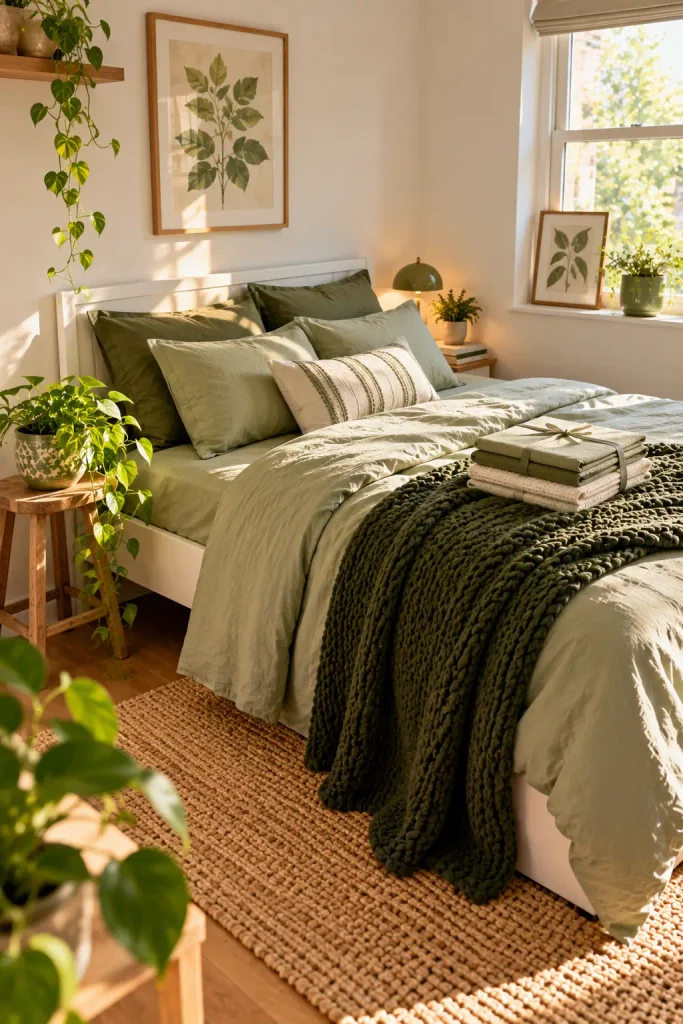
Not every green bedroom needs paint. Sometimes swapping a few soft things is enough.
Start with whatever covers the most area and work down. Bedding comes first, since it’s the biggest patch of color in a small room. Next come pillow covers, which cost far less than whole new pillows. After that, a throw, a plant, and a print spread the green around so it isn’t all sitting on the bed.
Shop your own home first. An old frame can hold a new green print, and a plain pot can take a coat of leftover paint.
Best part for renters: every piece moves with you when the lease ends.
Your small budget green swap list
Bring a Little Green Into Your Small Bedroom
A bedroom doesn’t need to be big to feel good. It just needs a plan, and green is a forgiving place to start. Pick the shade that suits your light, then decide how far you want to go. A new duvet and a pothos can shift the mood in an afternoon. Paneling, stripes, or a full color drench can change the whole room over a weekend.
Whatever you choose, repeat the green in a few spots so it looks planned, and leave a little empty space to breathe.
If one of these ideas caught your eye, pin it to your bedroom board so it’s there when you’re ready to start.