
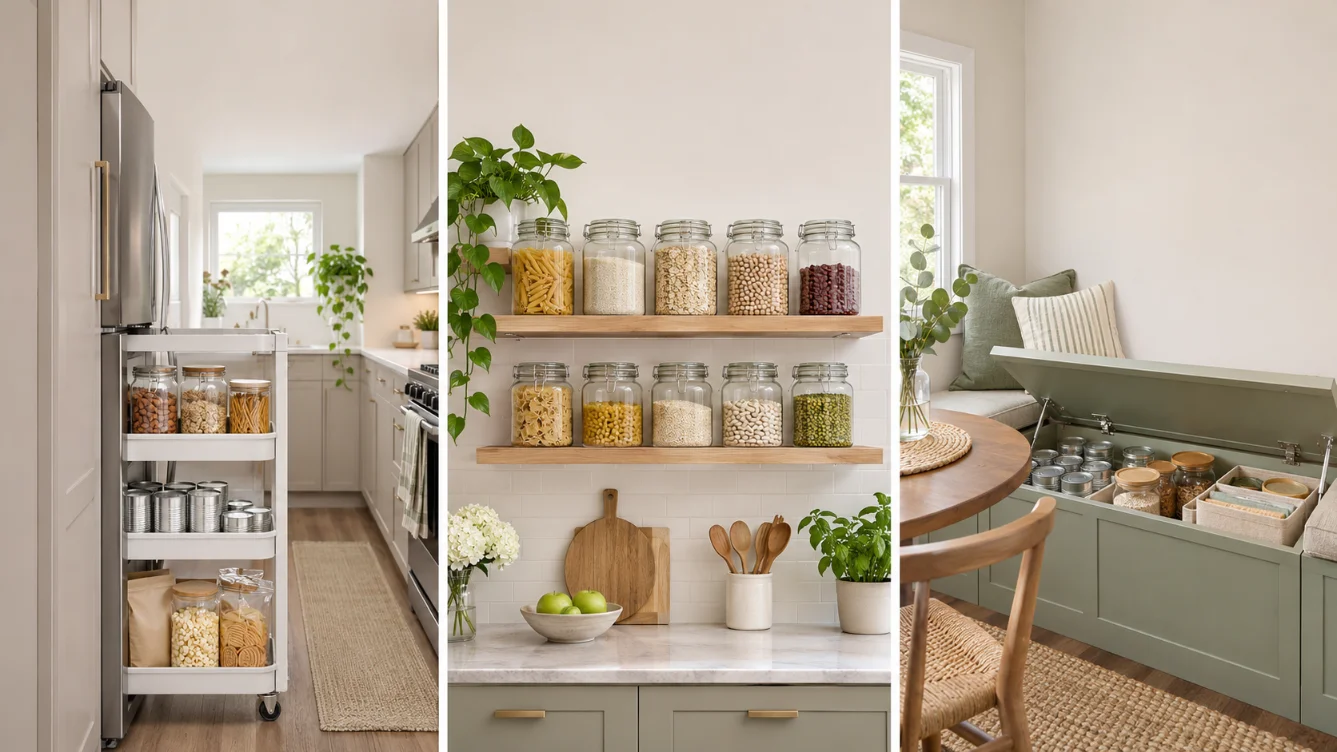
Most apartment kitchens weren’t built for people who actually cook. You get two upper cabinets, one lower cabinet that holds the pots, and a drawer that sticks. Then someone tells you to “just declutter,” as if you can declutter rice.
The real problem isn’t that you own too much food. It’s that the food has no fixed place to live. So it ends up on the counter, on top of the microwave, and in the grocery bag you never fully unpacked.
The fix is to give food a home somewhere else in the room. That might be a gap you’ve been ignoring, a door, a cart, or a bench you already sit on.
These no pantry kitchen ideas are built around ten common apartment setups and the spot each one found for food. Each one works in a rental, costs little, and needs few or no tools. Pick the one that fits your layout, or borrow two.
1. The Galley Kitchen That Squeezed a Pantry Into the Gap Beside the Fridge
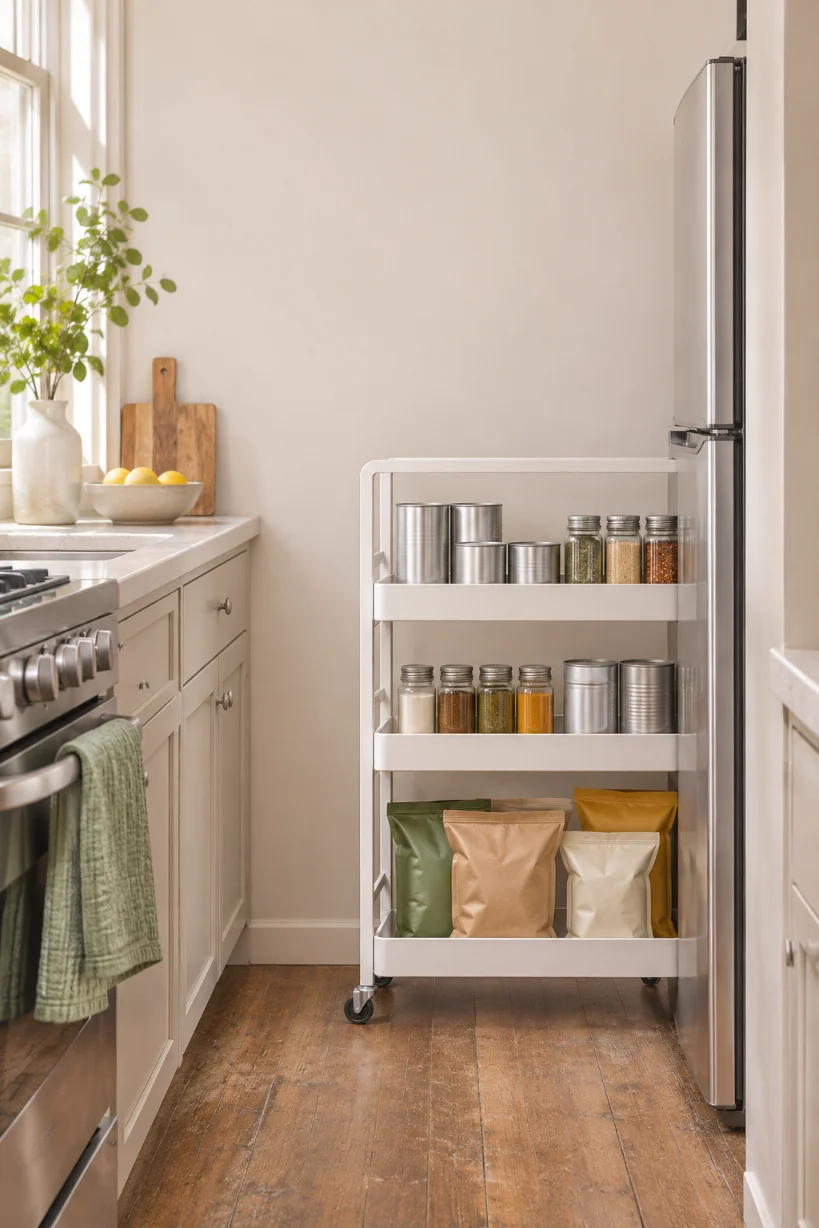
That skinny gap between the fridge and the wall collects crumbs, a broom, and the odd fallen takeout menu. In a galley kitchen, it’s also the only spare floor space you’ve got.
A slim rolling cart turns that gap into a pantry you pull out like a drawer. Some are made only a few inches wide, so measure the gap at the top and the bottom.
How to load it:
- Cans and jars on the bottom shelf, where the weight keeps it steady
- Spices and baking basics in the middle
- Snack bags up top, where they’re easy to grab
Pick a cart with a raised lip on every shelf. Without one, jars slide right off when you yank it out.
2. The Studio Kitchen With a Tall Cabinet Standing In for a Pantry
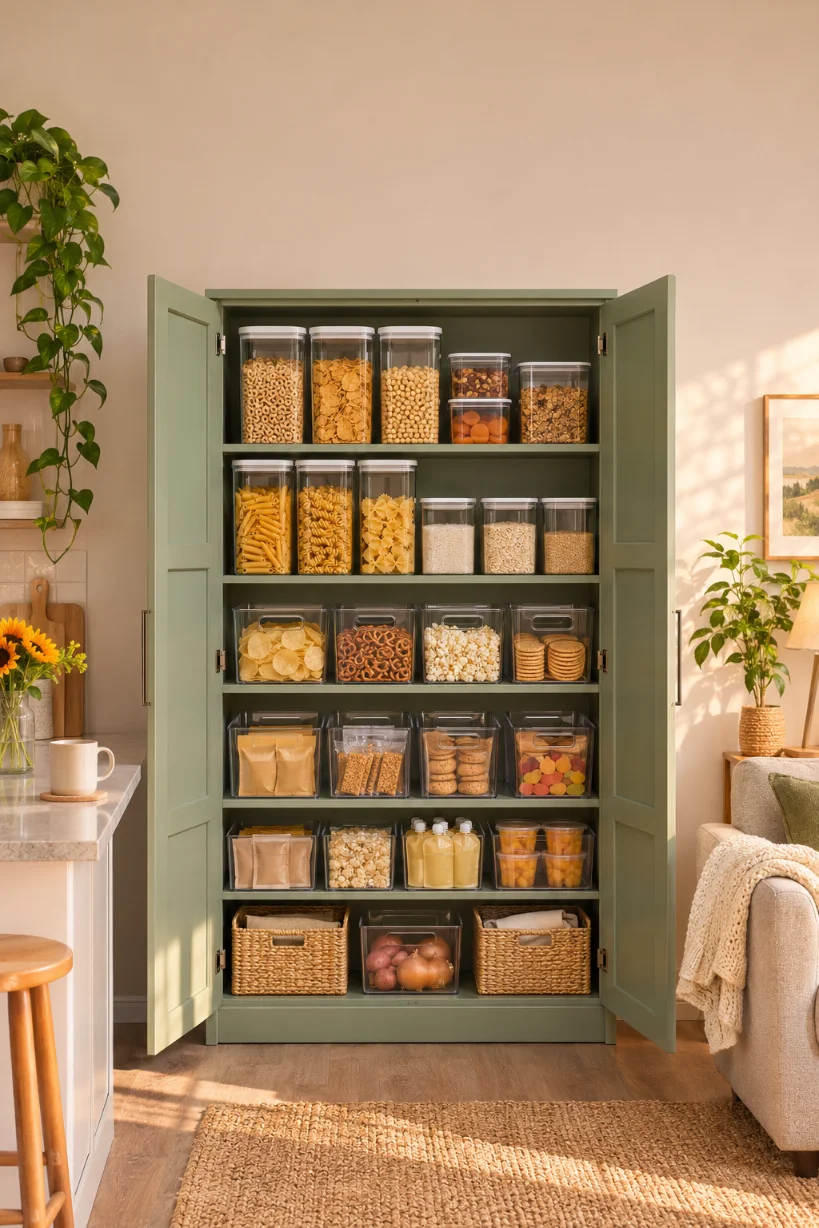
Buy one tall cabinet with doors and call it the pantry. That’s the whole plan, and it beats scattering food across three different spots.
Doors matter more than you’d think. In a studio, open shelves put cereal boxes right next to your sofa. Closed doors hide the mess, so the room still feels like a home instead of a stockroom.
Inside, give every shelf one job. Breakfast goes on one shelf, dinner basics on the next, and snacks at hip height. Clear bins with labels on the front show you what’s running low without pulling everything out.
This setup suits studios where the kitchen and living area share one long wall.
Check before you buy
3. The Rental Kitchen That Keeps Its Snacks on the Back of a Door
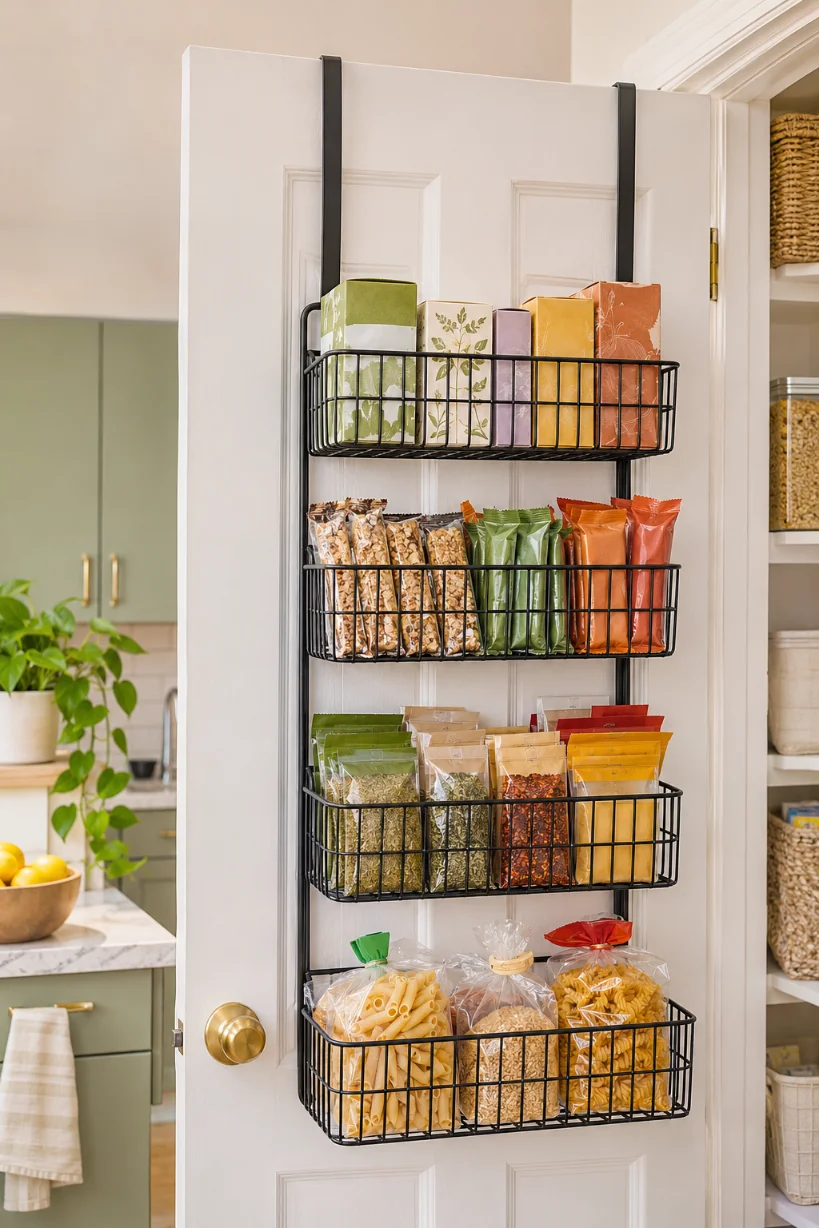
Over the door racks aren’t just for shoes.
Hang one on the inside of a kitchen door, a broom closet, or the coat closet nearest the kitchen. A rack with deep wire baskets holds a lot of the small, light stuff that clutters cabinets: tea boxes, spice packets, granola bars, and those half bags of pasta.
Before you buy, test the fit. Some hooks are too thick and stop the door from latching, which is common in older rentals with tight frames.
A small tip: stick felt pads on the back of the rack. They stop the rattle every time the door swings.
Store light boxes, packets, tea, and snack bars.
Give each basket one food group so you know where to look.
Glass jars and big cans that swing and clank.
Loading past the weight limit printed on the box.
4. The Tiny Kitchen That Uses the Top and Side of the Fridge
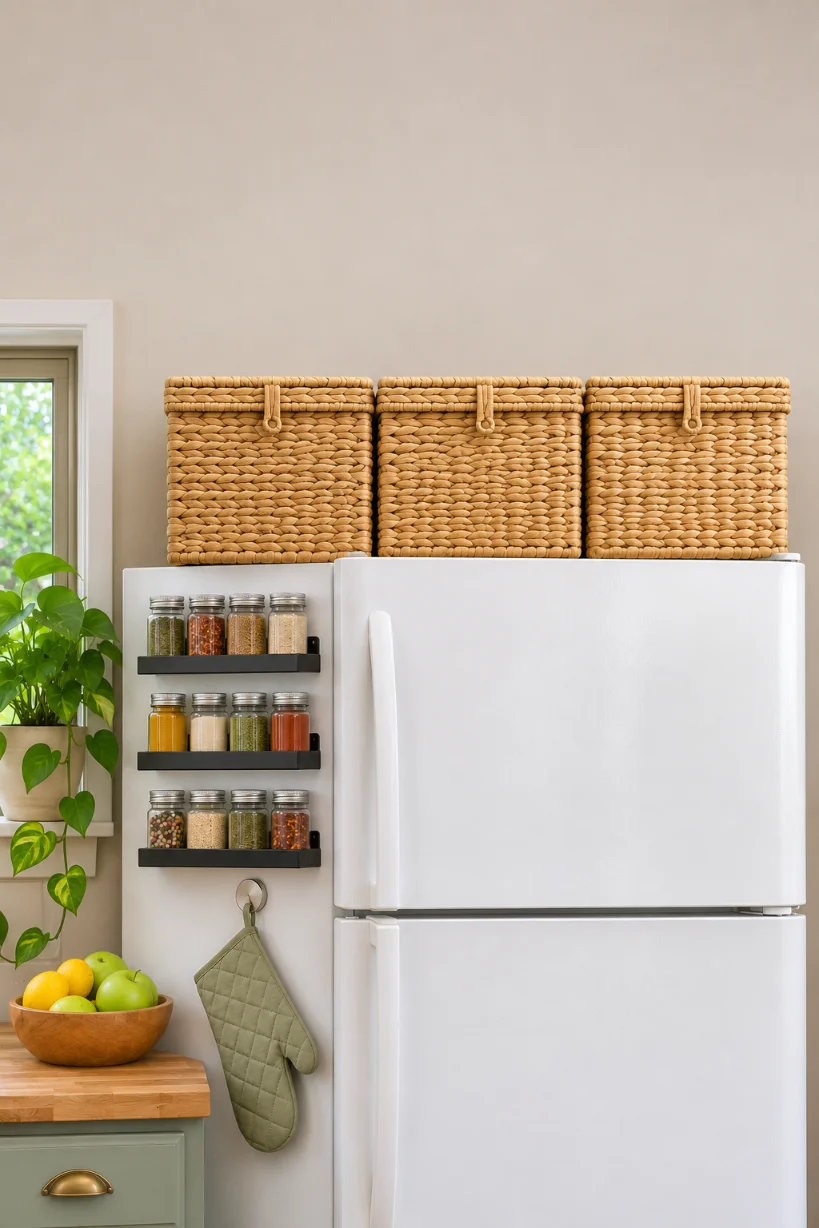
Look up. The top of most fridges is a flat, empty shelf, usually holding a dusty bag of chips and a cookbook nobody opens.
Clear it off and set two or three lidded bins up there, sized to sit edge to edge. Put labels on the front, since you’ll be reaching up without seeing inside.
Use the top for backups, not daily food. An extra box of cereal, spare pasta, and baking supplies you touch once a month all earn the high spot.
The side of the fridge works too:
- A magnetic spice rack for the jars you grab every day
- A magnetic shelf for a few small packets
- A hook for a bag clip or two
⚠️ Watch Out
Check your fridge manual first. Some models need open space on top for airflow. The top can also run warm, so skip oils, chocolate, and anything that melts. And test the side with a fridge magnet before you buy a rack, because many stainless fridges aren’t magnetic.
5. The Open Shelf Kitchen That Stores Dry Goods in Plain Sight
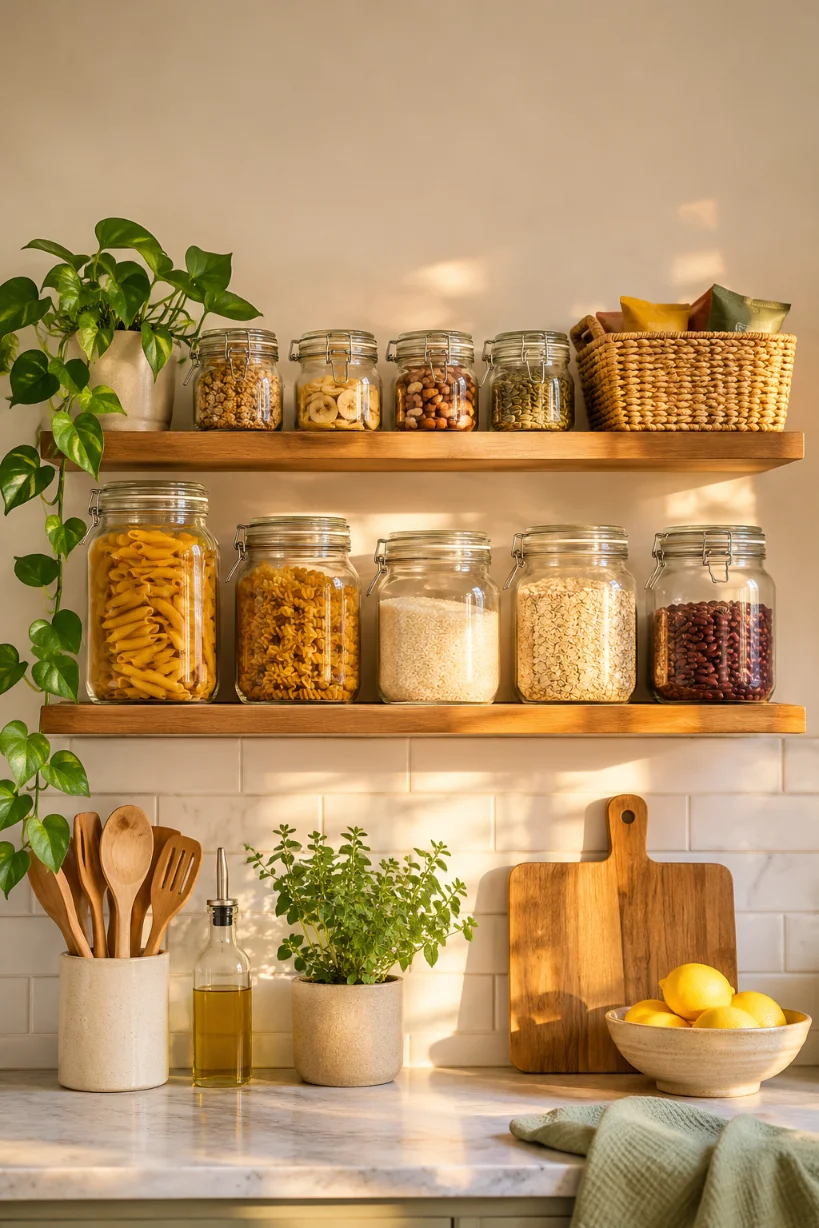
If food sits on an open shelf, it sits in a jar. That one rule keeps a wall of shelving from looking like a corner store.
Matching jars make pasta, rice, and oats something you don’t mind seeing. They also show you what’s low at a glance, which saves you from buying a third bag of lentils.
Renters have a few low-damage options:
- A freestanding baker’s rack against the wall
- A ladder shelf that leans
- A couple of floating shelves above the counter, if small holes are allowed
Put the heaviest jars on the lowest shelf. Always.
6. The Kitchen That Rebuilt Its Upper Cabinets With Risers and Square Bins
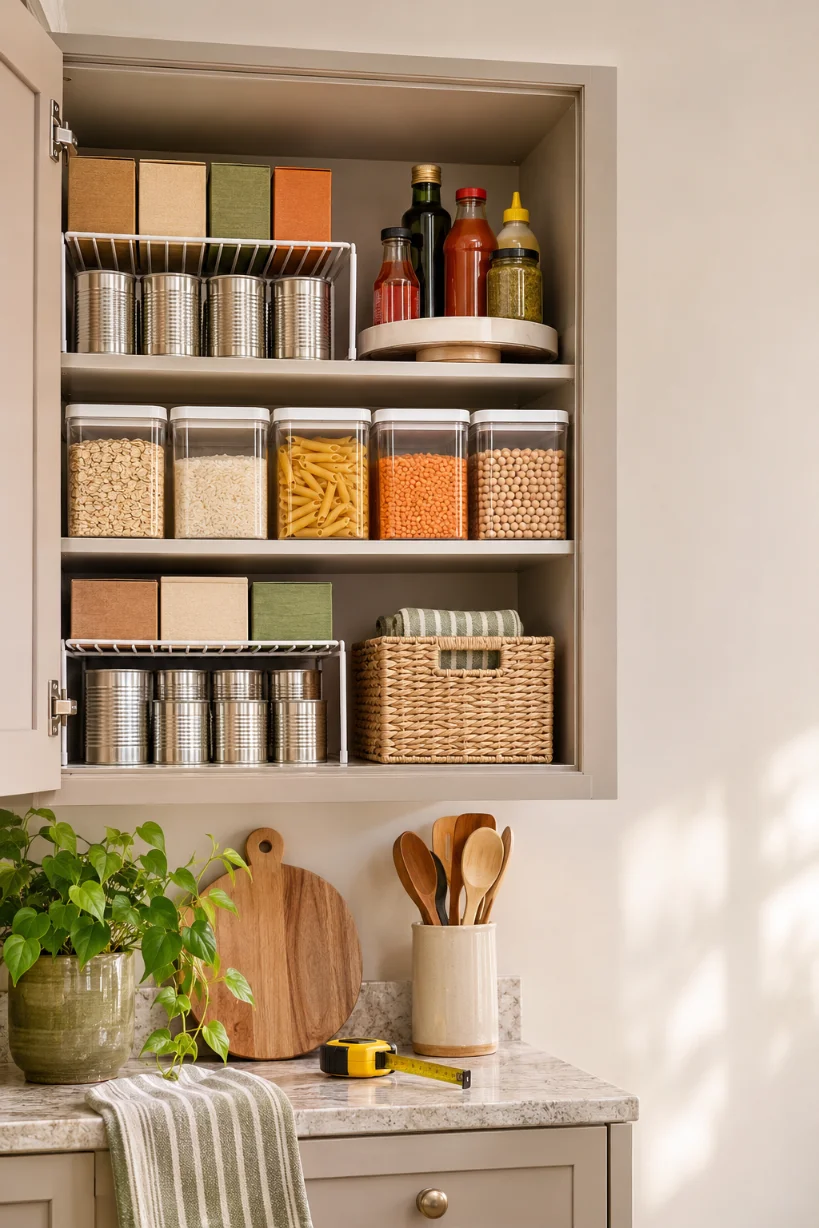
The usual mistake with upper cabinets is stacking food right onto the shelf. One can goes on top of another, a box leans on both, and the back half of the shelf turns into a mystery.
Most cabinets have more height than their shelves use. A wire shelf riser splits that height into two levels, so cans sit below and small boxes sit on top.
Two more pieces help:
- A turntable in the corner cabinet, so nothing gets stuck in the back
- Square containers instead of round ones, since they line up with no wasted gaps
Bring a tape measure to the store. Risers come in different sizes, and one that’s a little too deep won’t fit past the door hinge.
Empty one cabinet all the way and wipe the shelves.
Sort what came out into groups: breakfast, dinner, baking, and snacks.
Measure shelf height and depth, then add risers and a turntable to fit.
Put back only what you use every week. Move the extras to a backup spot.
7. The Kitchen That Turned One Deep Base Cabinet Into Pull Out Drawers
It’s dinner time, you need a can of tomatoes, and you’re on your knees with your head inside the lower cabinet.
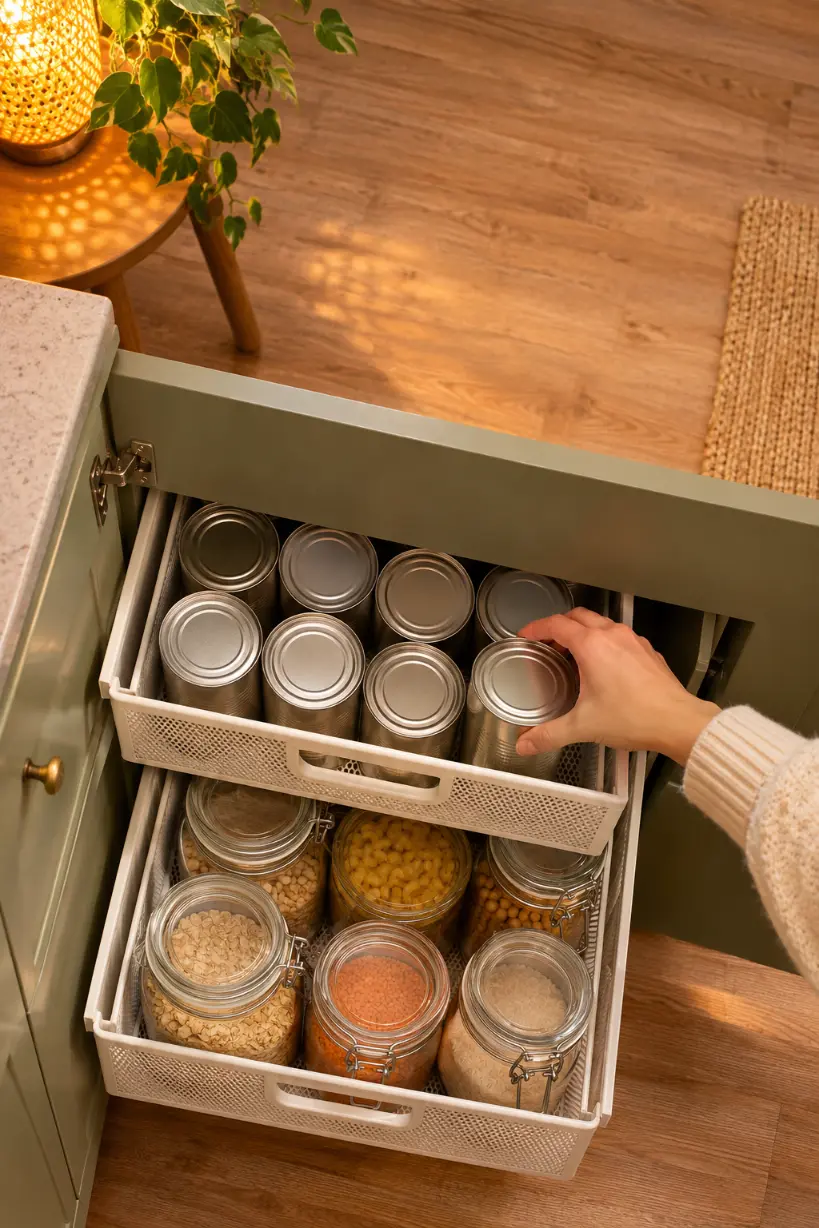
Deep base cabinets are where cans go to be forgotten. Pull out drawers fix that by bringing the back of the cabinet to you.
Renters have two easy routes. Freestanding pull out organizers sit on the cabinet floor with no screws at all. Plain bins with handles work too, and they cost less. Slide one out, grab what you need, and slide it back.
Measure the door opening, not just the inside. The cabinet frame often makes the opening narrower than the space behind it.
Cans stacked three deep. You buy tomatoes you already own because you can’t see the ones in the back.
Two pull out bins, one for cans and one for jars. Everything comes into view with one pull.
8. The No Pantry Kitchen That Rolls Its Storage Around on an Island Cart
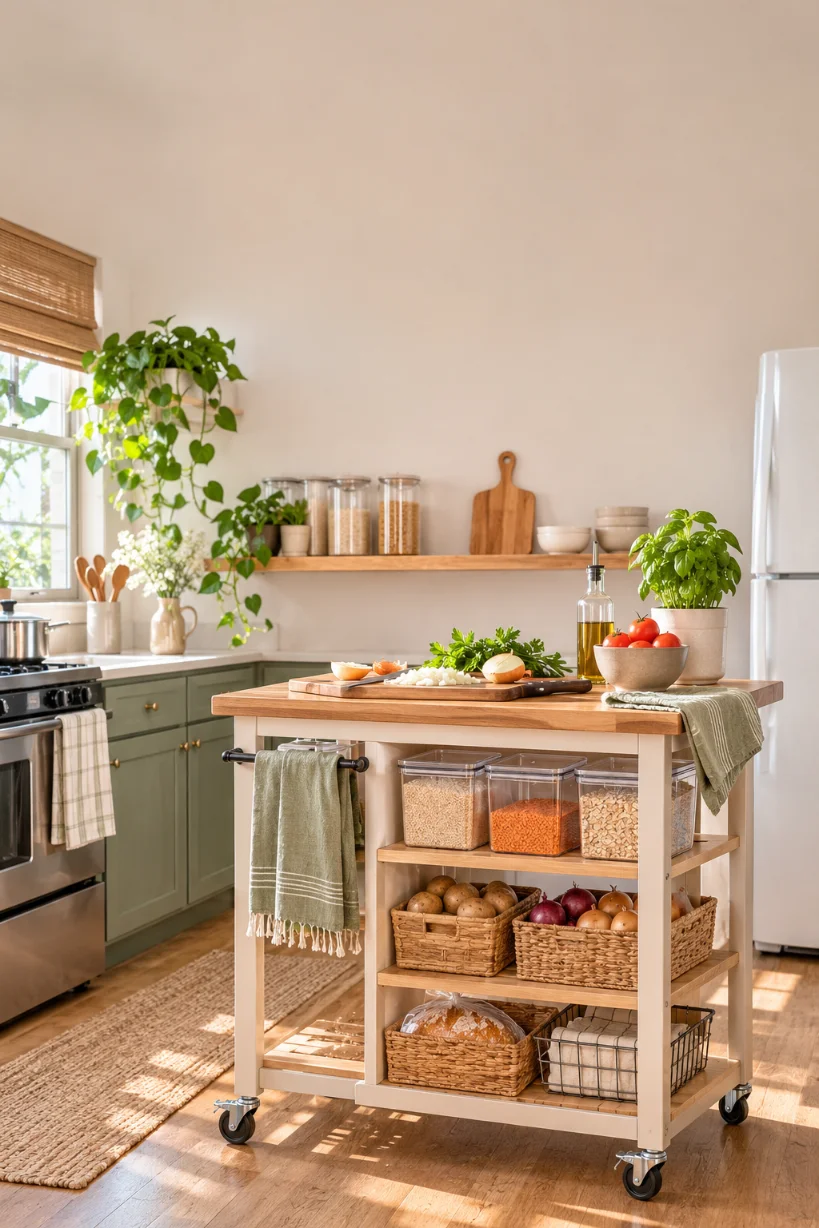
An island cart does two jobs in a kitchen with almost no counter. The top gives you extra prep space, and the shelves underneath become your pantry.
The big choice is open shelves or doors. Open shelves are faster to grab from. Doors hide everything, which helps if the cart sits where guests can see it.
A few things that store well underneath:
- Potatoes and onions, each in its own basket
- Bulk bags in lidded bins
- Bread and wraps in a shallow tray
Lock the wheels before you chop. A cart that drifts while you’re cutting onions makes the job harder than it needs to be.
| Open shelf cart | Cart with doors | |
|---|---|---|
| Grab speed | Fast | A step slower |
| Looks | Shows everything, so use baskets | Tidy no matter what’s inside |
| Best spot | Tucked inside the kitchen | In view of the living area |
| Watch for | Dust on loose packages | Doors need room to swing |
9. The Dining Nook Bench That Holds All the Canned Goods
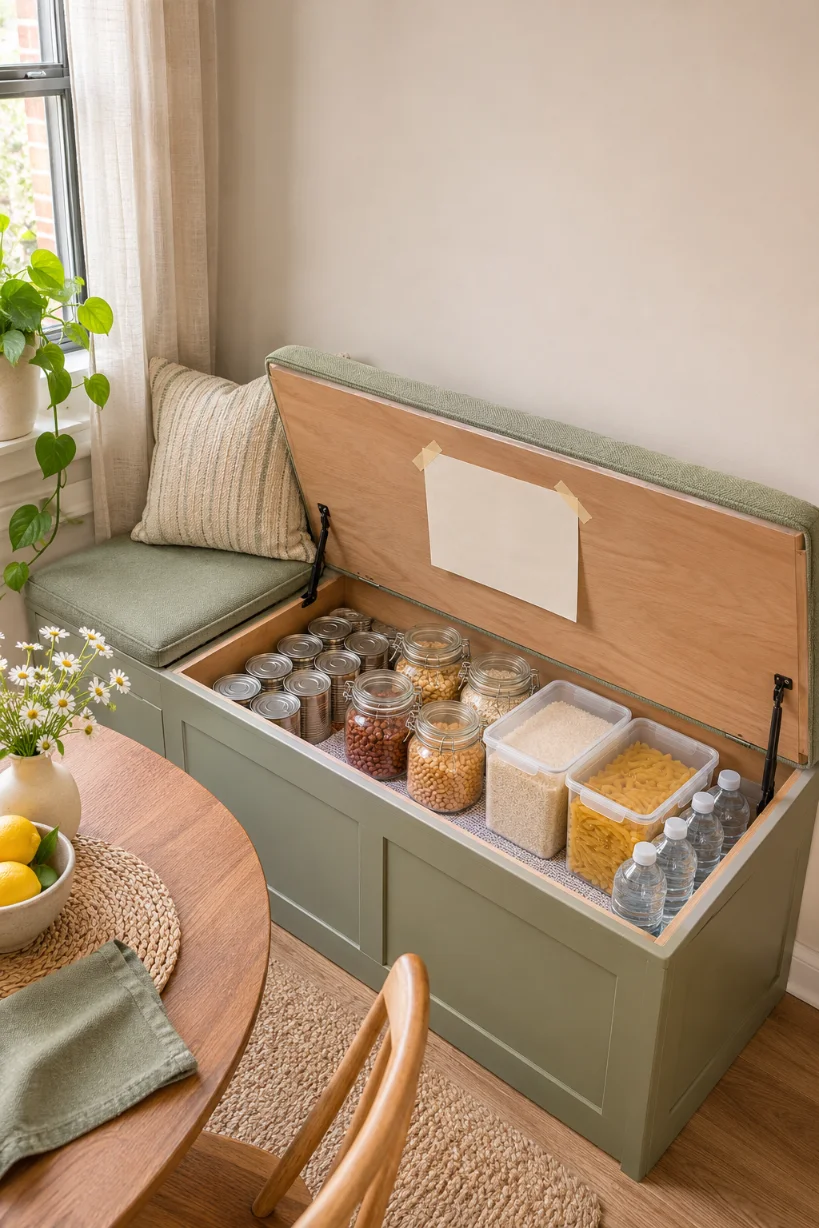
A storage bench gives you a seat and a pantry in the same spot. In a small apartment, the dining nook is often the one corner with a little room to spare.
Lift top benches cost the least. Benches with baskets under the seat are easier to reach every day.
What belongs inside:
- Canned goods and jars
- Bulk rice and flour in sealed bins
- Bottled water and extra drinks
Line the bottom of a lift top bench with shelf liner. Cans won’t roll around, and spills wipe right out.
Keep heavy, shelf stable backups in the bench, and tape a list inside the lid. Then you know what’s in there without unpacking it.
10. The Apartment That Borrowed a Shelf in the Hall Closet
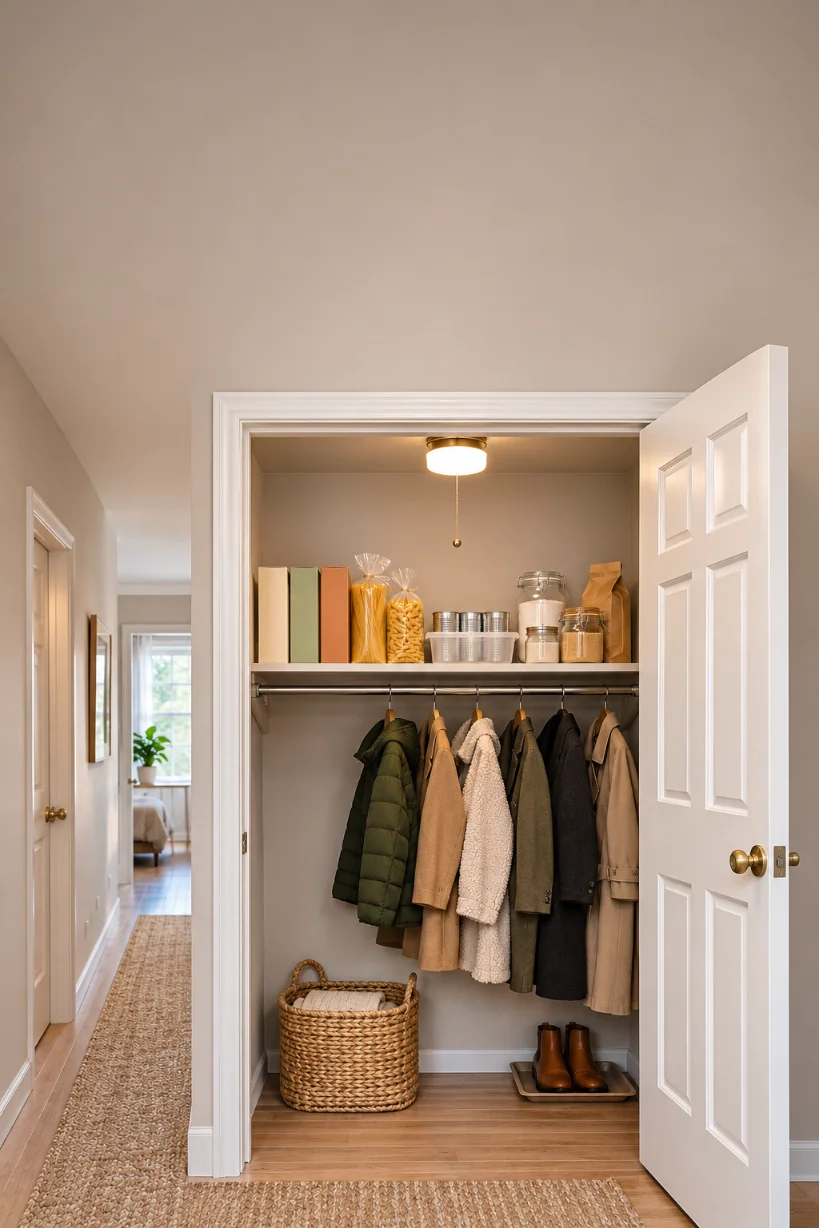
Nearly every apartment has one closet shelf holding old shoeboxes and a board game nobody plays. Clear that shelf and it becomes an overflow pantry.
This works because your kitchen only needs to hold what you’ll use this week. The closet holds the rest. When the cereal runs out, you shop the closet before the store.
Keep it tidy with one rule: only unopened food goes in the closet. Opened bags stay in the kitchen, where you’ll see them and finish them.
Pick a closet away from the bathroom and the heater. Food keeps better somewhere cool and dry.
What belongs in an overflow pantry
Your Kitchen Can Work Without a Pantry
A kitchen without a pantry isn’t a broken kitchen. Its food just needs a few new places to live, like a gap, a door, a cart, a bench, or one borrowed closet shelf.
You don’t need all ten. Start with the spot that bugs you most, maybe the counter you can never clear, and give that food one fixed home. Once one zone works, the next one is easier.
The best no pantry kitchen ideas are the ones you’ll keep up with on a busy Tuesday, so pick what fits how you really cook.
Save this list for the next time your counter starts filling up with groceries.