
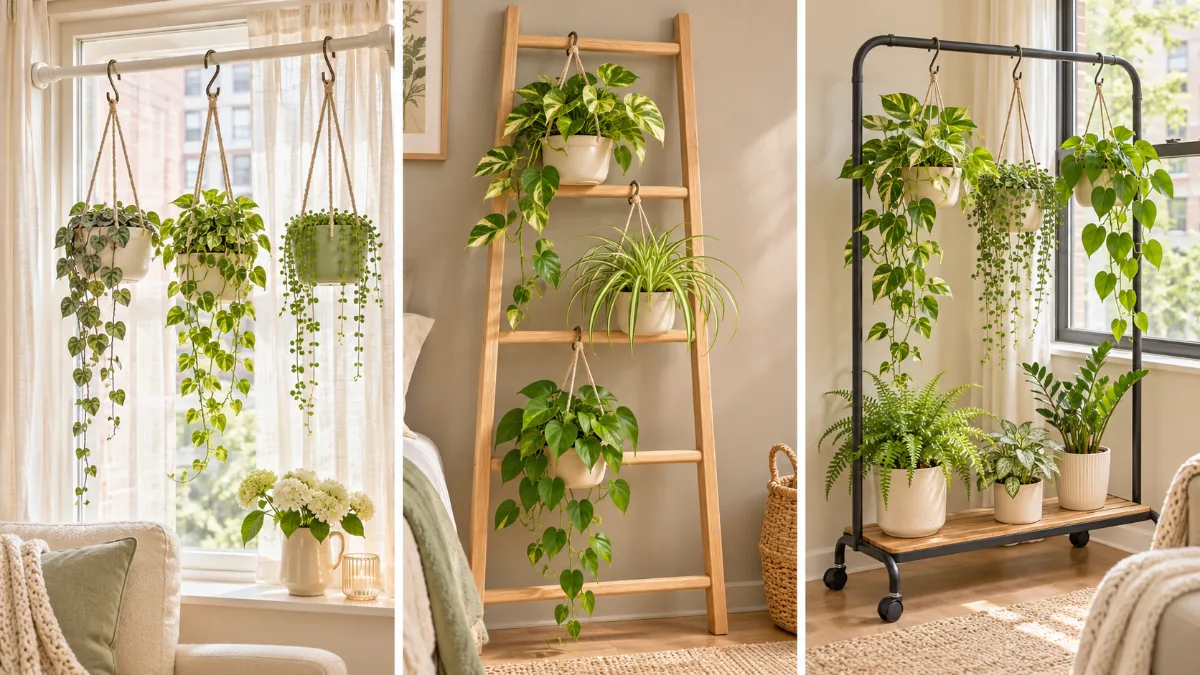
Read the fine print on almost any lease and you’ll find a line about walls. No holes, or nothing bigger than a nail. That one rule kills most hanging plant setups before they start, because so many tutorials begin with a drill and a ceiling hook.
Still, a small apartment is exactly where hanging plants make the most sense. Floor space is tight, shelves fill up fast, and the window sill already has three pots crammed on it. Getting plants up and off your surfaces frees room and makes the place feel greener without feeling crowded.
The trick is to work with what you’re allowed to touch. Window frames, curtain rods, the side of the fridge, a ladder that leans instead of mounts. Pair those with lighter pots and the right plants, and you get a full setup that comes down in minutes on move out day.
These hanging plant ideas for an apartment all skip new holes. Each one covers what it costs, how to keep the weight safe, and the small mistakes to dodge so your deposit stays yours.
1. Run a Tension Rod Across Your Window and Hang a Row of Trailing Pots
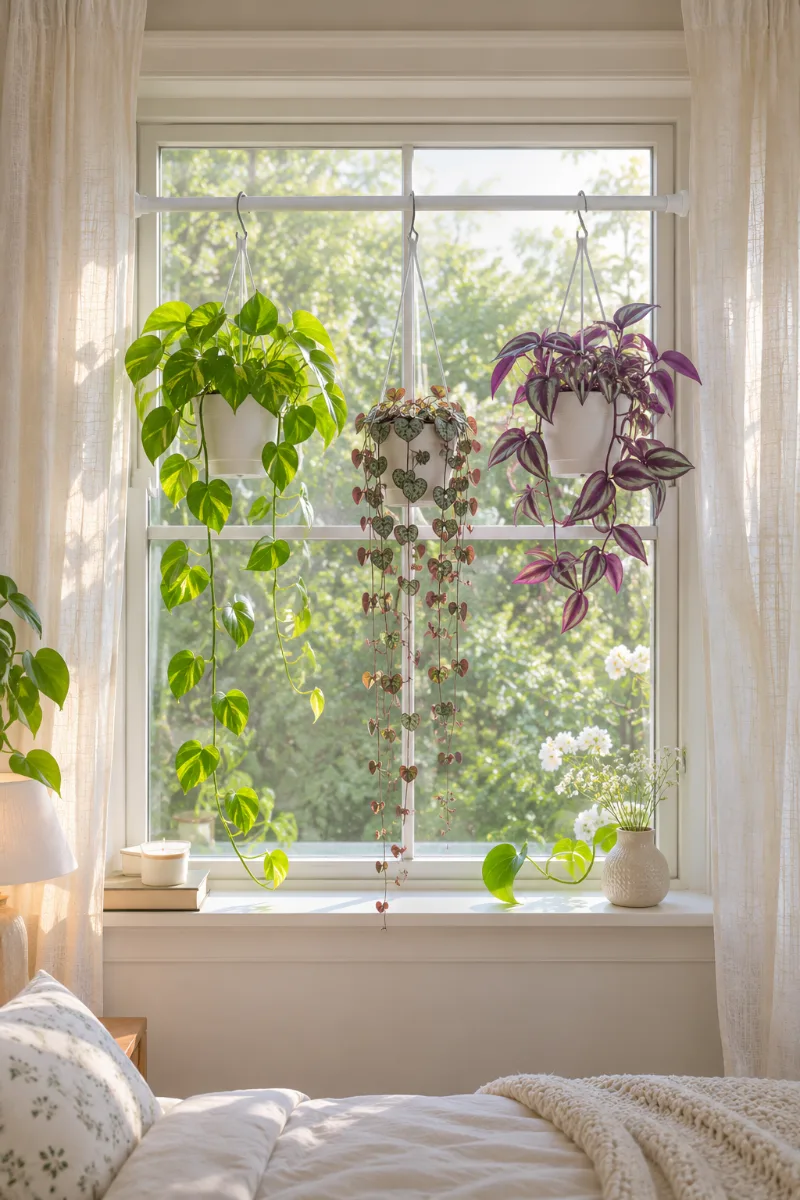
A window is the brightest spot in most apartments, and a tension rod lets you use the top half of it, not just the sill.
Fit a spring tension rod inside the window frame, a few inches below the top. Then hang two or three small pots from it with S hooks or short macramé hangers. Trailing plants do best here:
- Pothos, which handles a wide range of light
- String of hearts, which likes it bright
- Tradescantia, which grows fast and fills in
Keep the pots small. A tension rod holds by pressure alone, so a heavy pot can slowly pull it loose. Rods with rubber end caps grip the frame better and won’t scuff the paint.
2. Swap Heavy Ceramic for Plastic Nursery Pots Inside Your Macramé Hangers
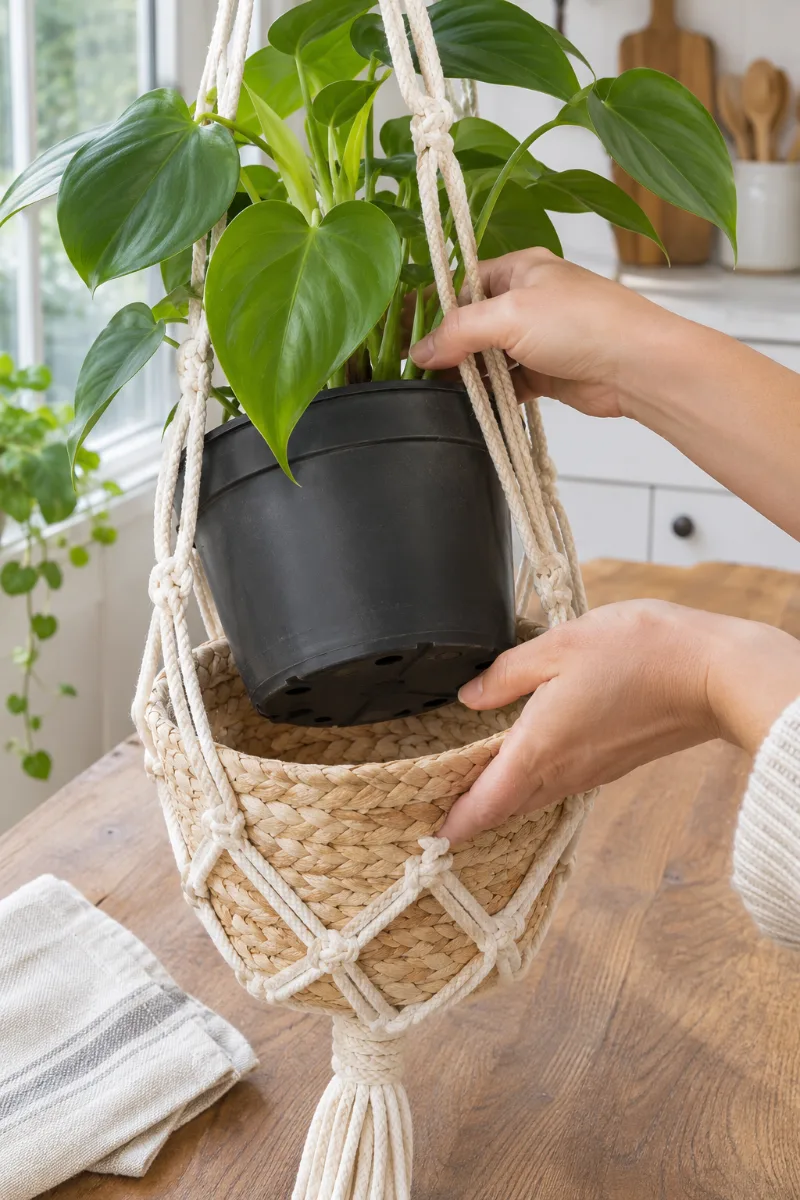
When a hanging plant falls, the pot is usually the problem, not the hook.
Glazed ceramic looks lovely on a shelf, but up in the air it causes trouble. It’s heavy before you add anything, and the soil soaks up water and gets heavier after every watering. That extra load is what makes rods slip and hooks sag.
The fix is simple. Keep the plant in the plastic nursery pot it came in and set that right into the macramé. If the plastic looks too plain, drop it into a lightweight woven basket first. You get the texture without the weight, and the drainage holes keep the roots from sitting in water.
| Ceramic Pot | Plastic Nursery Pot ✅ |
|---|---|
| Heavy, even when the soil is dry | Light, even right after watering |
| Often has no drainage hole | Drainage holes built in |
| Can crack or shatter if it falls | Usually survives a drop |
| Looks finished on its own | Looks best tucked in a woven basket |
3. Set Up a Floor to Ceiling Tension Pole in That Empty Corner
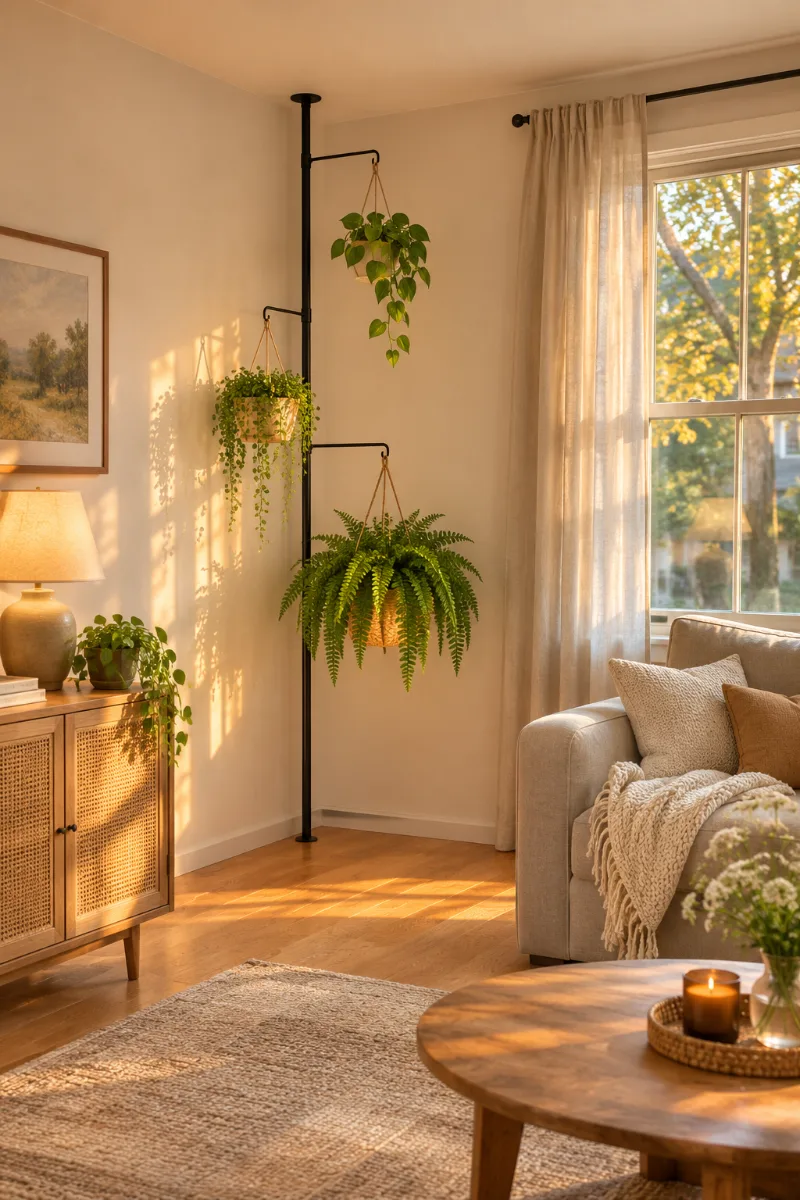
Every apartment has one corner that just sits there. It’s too tight for a chair and too awkward for a shelf, so it ends up holding a laundry basket.
A floor to ceiling tension pole puts that corner to work without a single screw. It braces itself with spring pressure, and many come with arms or hooks that slide up and down.
- Pick a corner close to a window, since the plants still need light.
- Twist the pole until it feels firm, then give it a gentle tug.
- Hang the heaviest plant on the lowest arm and the lightest near the top.
Skip this if your ceiling has that bumpy popcorn texture. The top pad can crush it and leave a mark.
A bare corner and a blank stretch of wall, with nothing at eye level to break it up. The room feels a little unfinished.
Three plants stacked at different heights on one slim pole. The floor underneath stays clear, so vacuuming is still easy.
4. Hang Air Plants in Glass Globes Light Enough for Adhesive Hooks
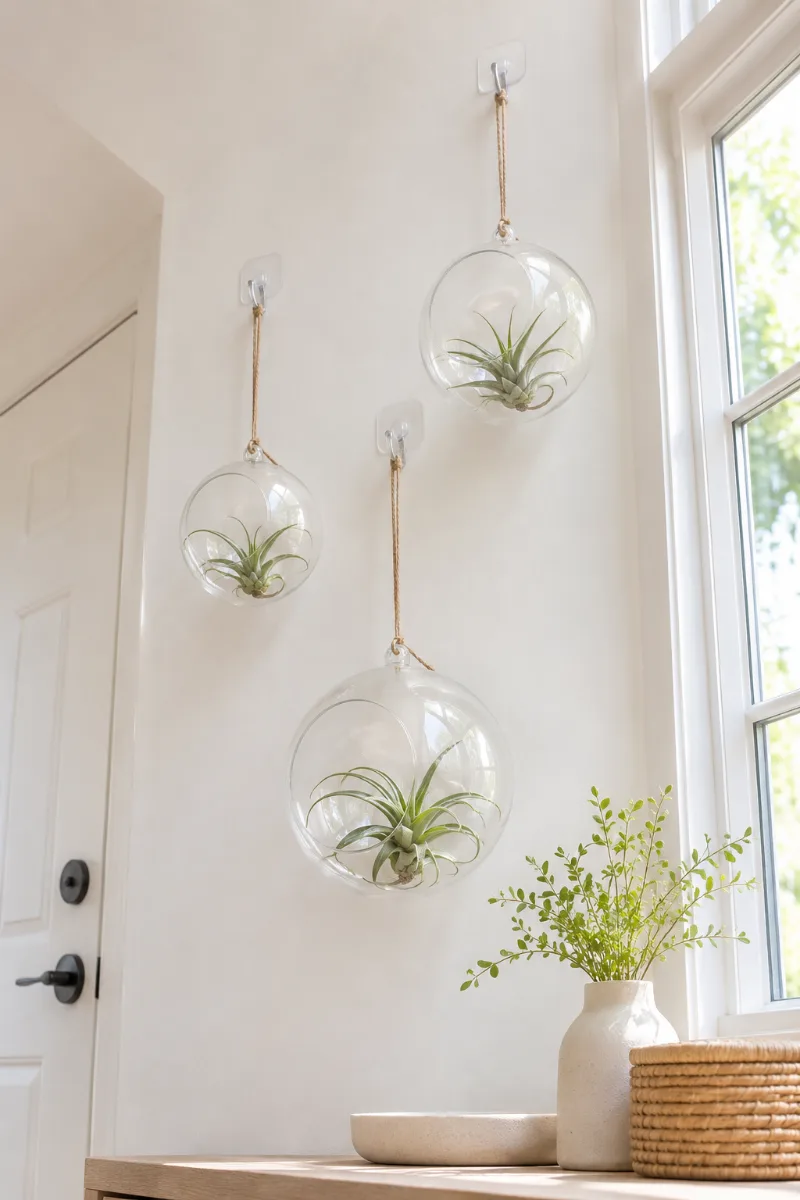
Here’s a simple rule: if a plant needs soil, it’s probably too heavy for a sticky hook.
Air plants don’t use soil at all. They sit loose in a glass globe, so the whole setup weighs very little. That makes them one of the few hanging options that works with removable adhesive hooks.
A few basics keep them alive:
- Bright light, but not hot afternoon sun hitting the glass
- A soak in water every week or two, then a full dry upside down before they go back in
- Open globes, not sealed ones, so air can move
Hang three globes at slightly different heights near a window. Together they read as one display instead of three lonely glass balls.
⚠️ Watch Out
Every adhesive hook has a weight limit printed on the package. Stay under it, and wait the full time it lists before you hang anything. Skip steamy bathrooms, where moisture can loosen the strip. When you take it down, pull the tab straight down along the wall so the paint stays put.
5. Lean a Blanket Ladder Against the Wall and Hang Small Pots From S Hooks
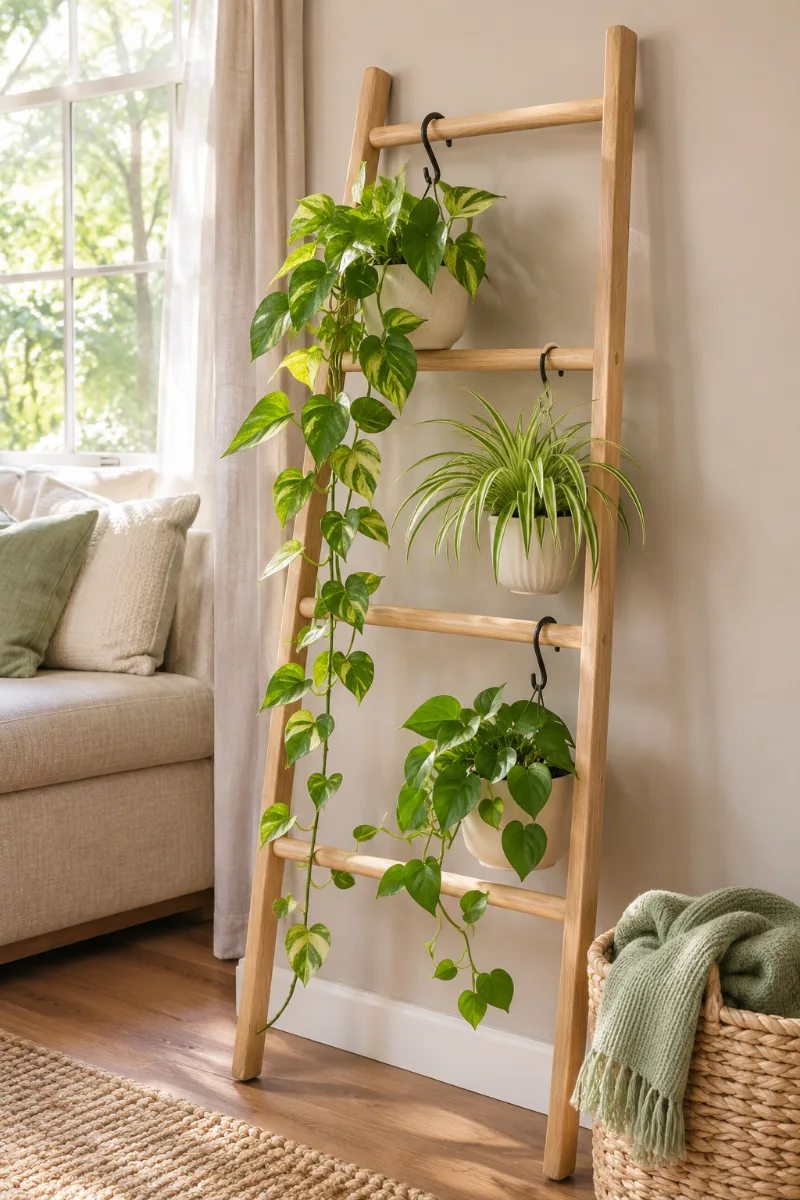
A wooden ladder with vines spilling down every rung looks like it took real planning. It’s actually one of the easiest setups on this list.
Lean a blanket ladder against a wall near a window. Hook small pots onto the rungs with S hooks, and spread them out so no single rung carries everything. The ladder’s weight sits on the floor, so the wall barely feels it.
Two small details make it work:
- Stagger the pots left and right so the leaves don’t crowd each other
- Stick felt pads on the feet and the top ends to stop sliding and wall scuffs
This one suits a bare living room wall that gets decent daylight.
6. Hook a Planter Onto the Curtain Rod Brackets You Already Have
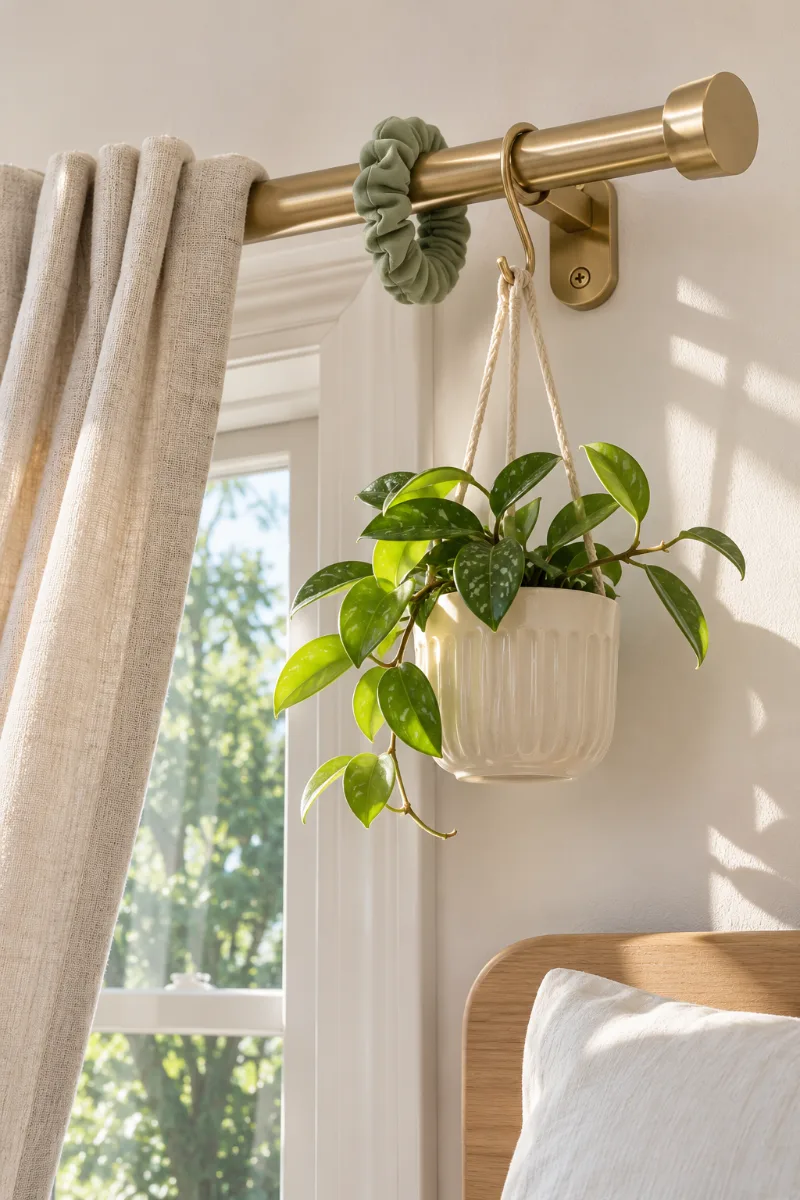
Look at the ends of your curtain rod. On most windows, the rod runs a few inches past the frame on each side, and that stretch holds nothing but a finial.
That’s a good spot for one small hanging plant. It sits right beside the glass, so it gets light, and it stays clear of the curtain when you open and close it.
Good picks for the job:
- A small pothos or philodendron in a 4 inch nursery pot
- A hoya, which trails slowly and stays tidy
Curtain rods are built to hold fabric, not soil. Stick to one light plant per side.
Hang the hook right next to the bracket, where the rod has the most support. The middle of the rod is where it starts to bow.
Loop a hair tie around the rod beside the hook. It keeps the planter from sliding every time you pull the curtain.
On watering day, lift the plant off, water it at the sink, and hang it back once it stops dripping.
7. Give a Fern the Spot by the Shower Where the Steam Does Half the Watering
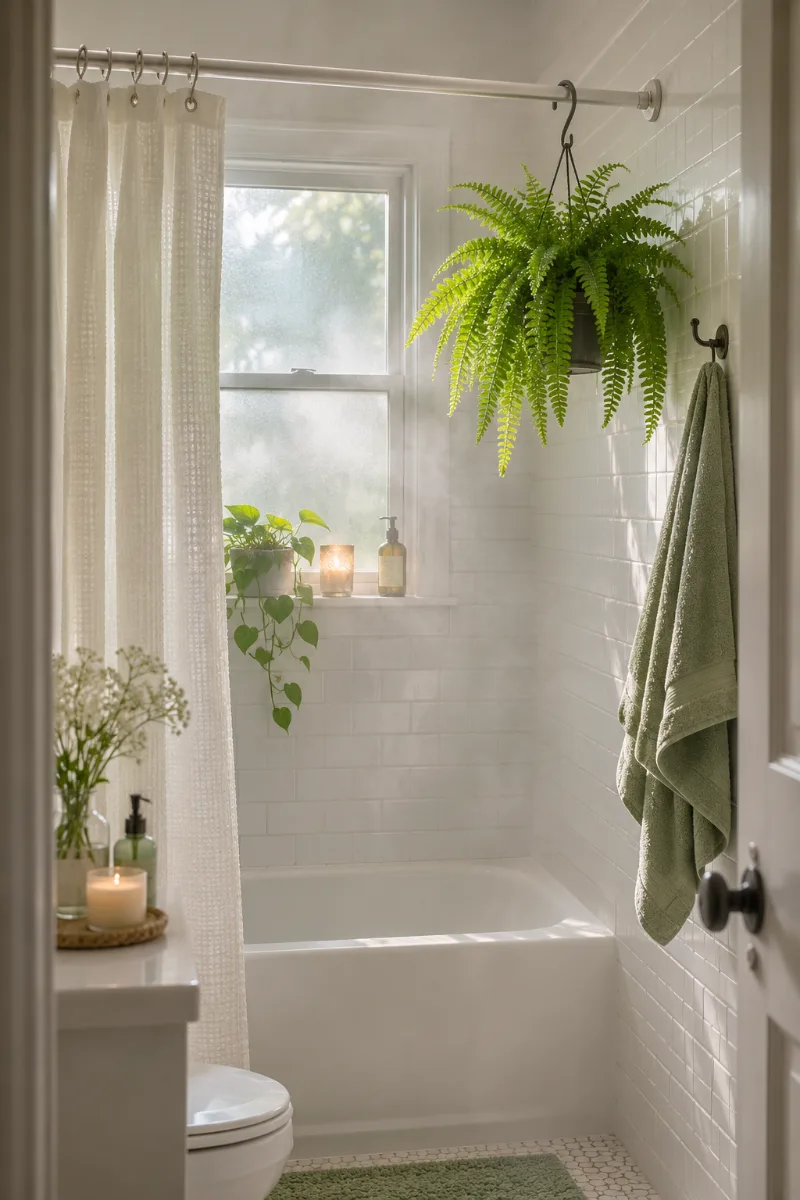
The bathroom mirror fogs up every morning, and most of us just wipe it and move on. A fern would gladly take that steam.
Ferns that do well in a bright, steamy bathroom:
- Boston fern, the classic hanging basket plant
- Bird’s nest fern, with wide wavy leaves that stay compact
- Rabbit’s foot fern, which grows fuzzy roots that creep over the pot edge
Hang it from the shower curtain rod with an S hook. Keep it to a small plant in a plastic pot, since many shower rods are tension rods too. Damp air slows down how fast the soil dries, so check it with a finger instead of watering on a schedule.
Hang it at the end of the rod farthest from the shower head.
Pick a bathroom with a window, even a small frosted one.
Hanging it where the spray hits the leaves directly.
Expecting it to grow in a windowless bathroom with no grow light.
8. Stick Magnetic Hooks to the Side of Your Fridge for a Tiny Herb Hanger
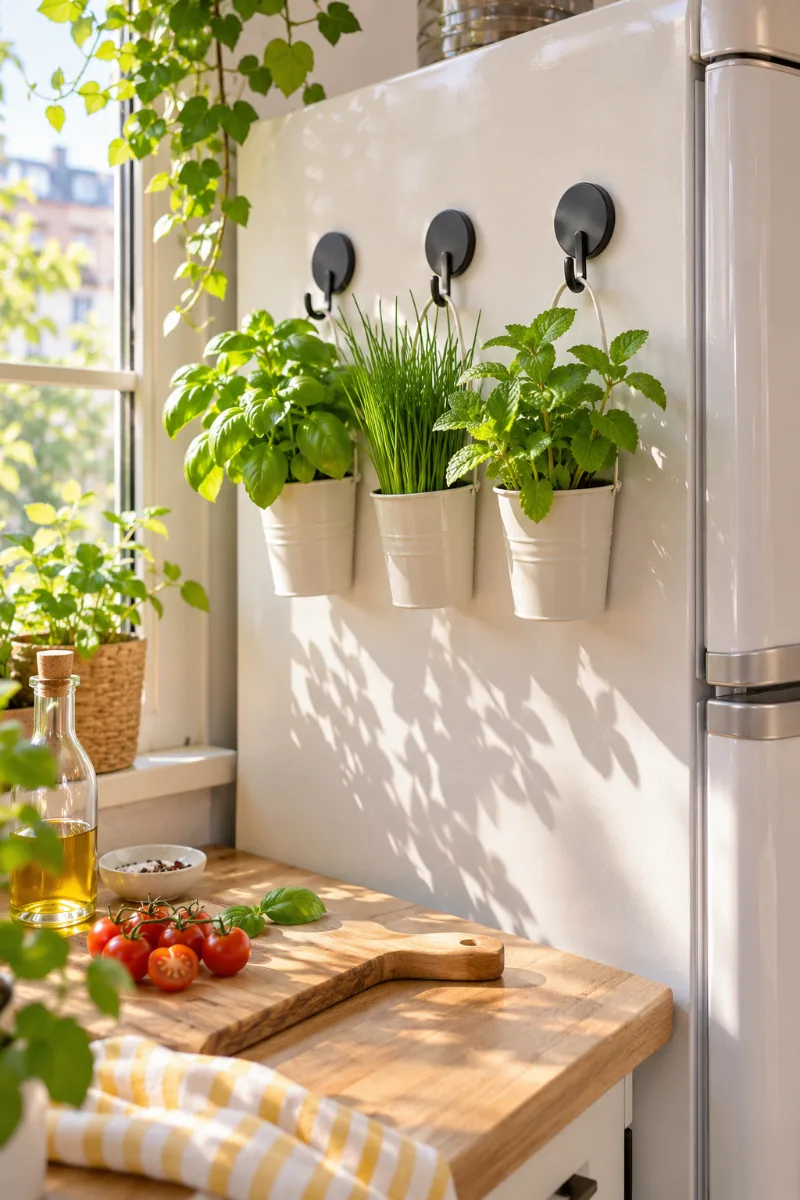
Magnetic hooks get filed under garage tools, but the side of your fridge is the biggest metal wall in most apartments. And no lease says you can’t stick things to it.
If that side sits near a sunny window, it makes a handy herb hanger. Basil, chives and mint all grow fine in small pots, and they stay within arm’s reach while you cook.
One thing to know before you load it up. A magnet that grips hard when you pull it straight off can still slide down when weight hangs from it.
Test each hook with a freshly watered pot before you trust it.
What to grab first
9. Roll a Garment Rack Into the Sunniest Spot and Use It as a Movable Plant Bar
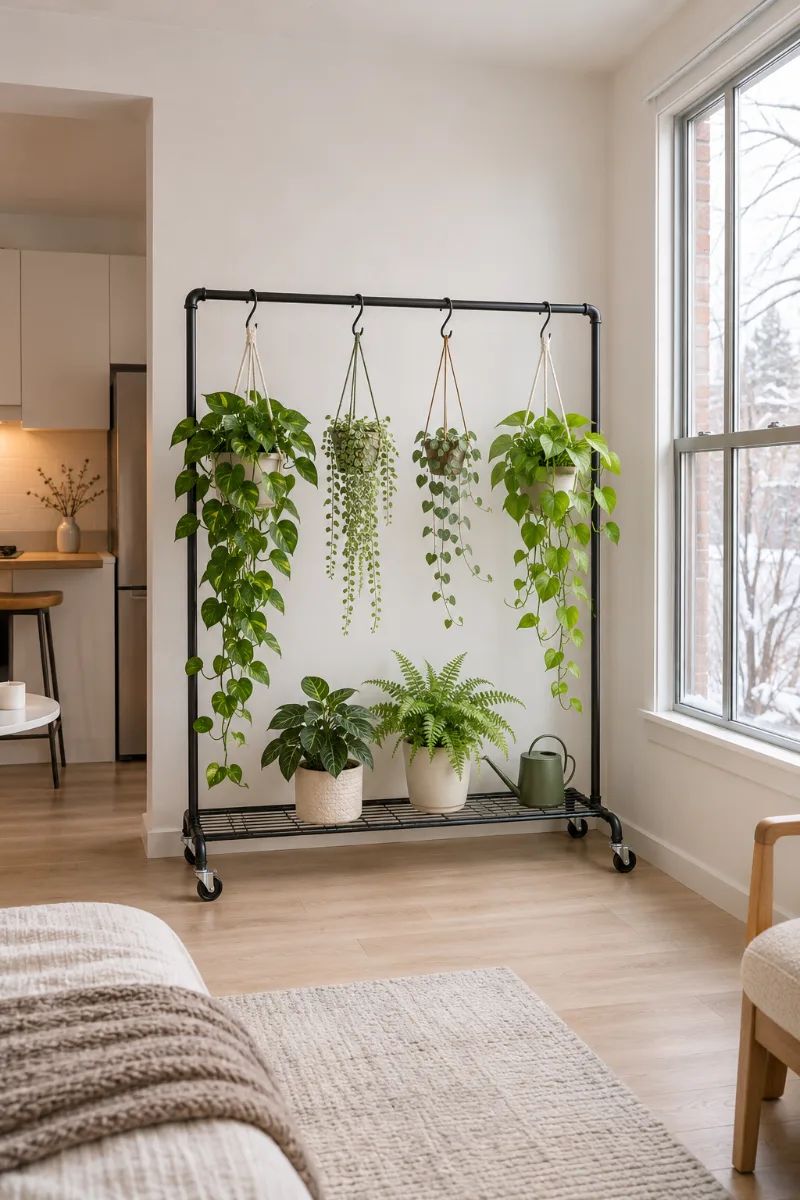
A plant shelf stays where you build it. A garment rack rolls.
That’s the whole appeal. Hang plants from the top bar with S hooks and set floor pots on the bottom shelf if it has one. In winter, when the light gets weak, wheel the whole thing closer to the window. Before an inspection or a move, it rolls out of the way in seconds.
What to look for in the rack:
- A sturdy metal bar, not a thin one that bends under a few pots
- Wheels that lock
- A bottom shelf for extra plants or a watering can
It’s a smart pick if you move every year or two.
Keep the heaviest pots close to the side posts and space the rest evenly along the bar. A rack loaded on one end is the one that tips.
10. Stop Drips Before They Reach the Landlord’s Floor
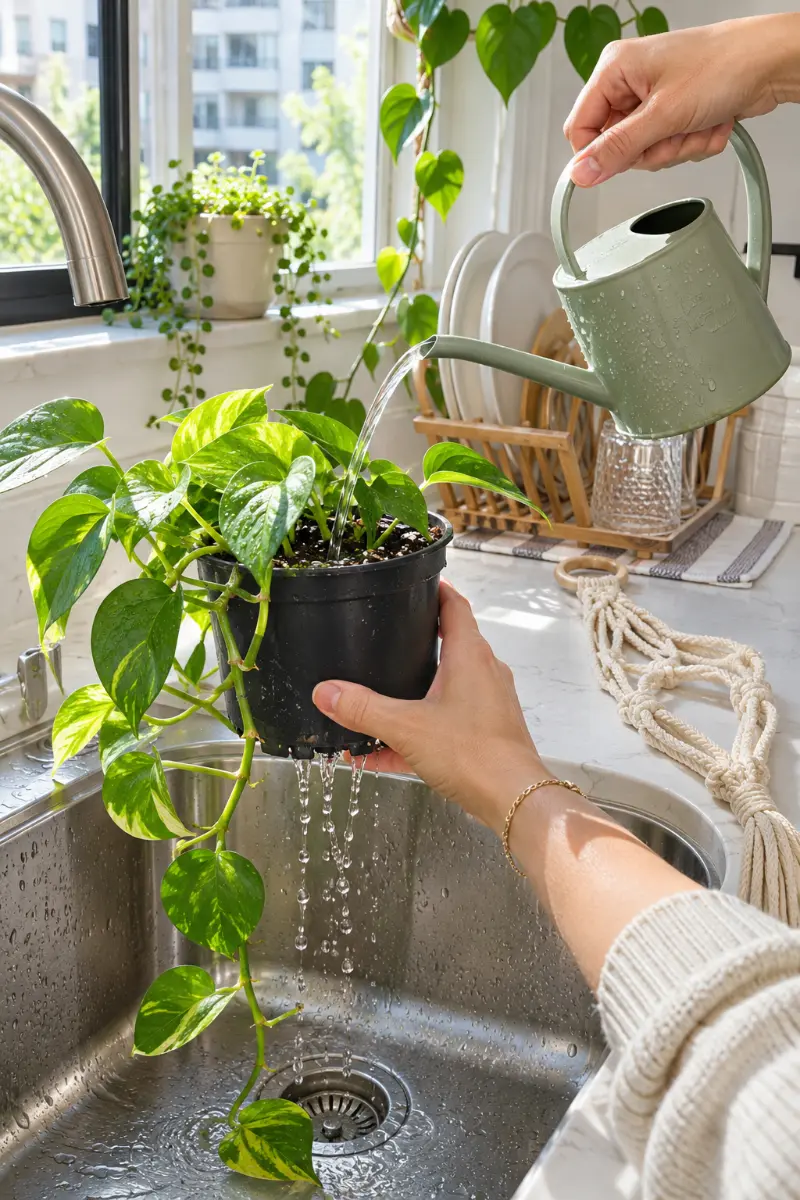
Take every hanging plant down to the sink when it’s time to water.
Watering in place feels faster, but the extra water has to go somewhere. Usually it ends up on the floor, the windowsill or the wall behind the pot. Over a few months, that leaves rings on wood floors and stains on paint, and both can come out of your deposit.
At the sink, pour slowly until water runs out the bottom. Then let the pot sit in the dish rack until it stops dripping completely before you hang it back up.
Your floors stay dry, and so does your deposit.
For plants that are a pain to take down:
- ▸Choose hanging pots with a built in saucer that catches the runoff.
- ▸Set a small plastic saucer inside woven baskets, under the nursery pot.
- ▸Water with a small cup, a little at a time, and stop as soon as the first drops reach the bottom.
11. Reuse a Nail Hole That’s Already in the Wall Before You Make a New One
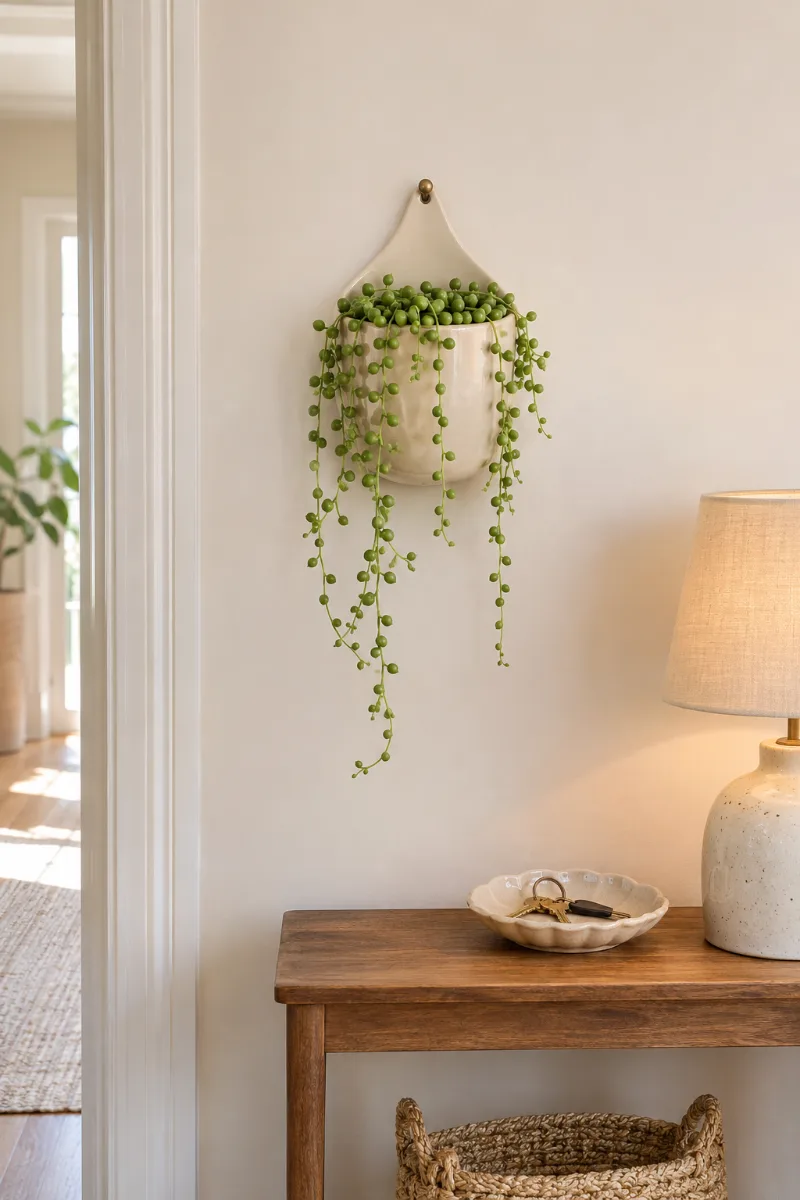
A lot of renters pull an old nail out just to move it two inches to the left.
That leaves two holes instead of one. A nail that’s already in the wall, from your old art or the last tenant, is a free hanging spot. Plan the plant around the nail, not the other way around.
Light options for a single nail:
- A small wall pocket planter with a plastic liner
- A macramé wall hanger holding an air plant or a tiny trailing pot
- A wooden frame with air plants tucked into wire mesh
When you move out, one small nail hole is far easier to explain than three.
Press down firmly on the nail first. If it wiggles or bends, find another spot.
Hang something that weighs about the same as the frame that used to be there.
Hanging a ceramic pot full of soil from a thin picture nail.
Hanging anything above a bed or sofa, where a fall lands on someone.
12. Go Faux in the Corners Where No Real Plant Will Survive
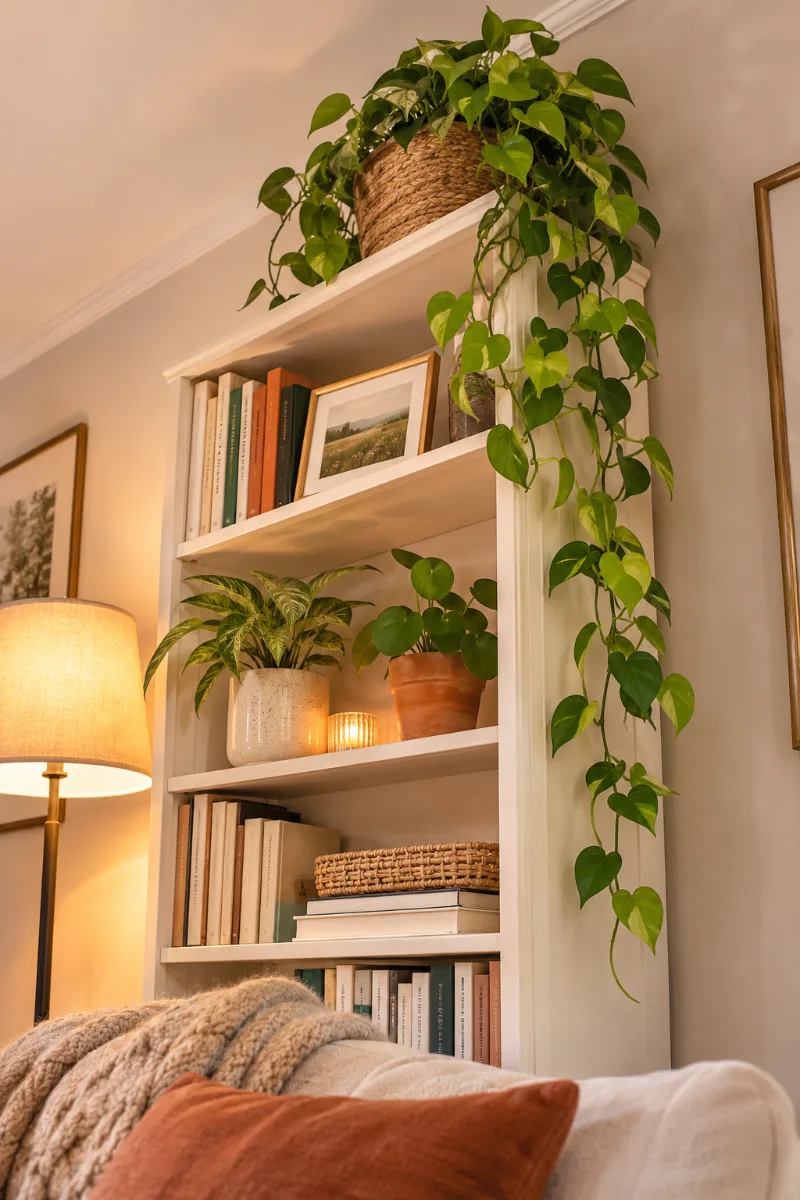
A faux pothos never needs water, never drops a leaf on the floor, and doesn’t care that your hallway has no window.
Some spots just can’t keep a real plant alive: the top of a tall bookcase, a dark entryway, the corner behind the TV. Instead of buying plant after plant and watching each one fade, hang a good fake there and save the real ones for the light.
What makes faux look real:
- Leaves in slightly different greens, not one flat shade
- A real nursery pot or basket, not the shiny plastic it shipped in
- A spot near your living plants, so the eye reads them as one group
Up high, even a mid range fake passes a second glance.
📌 Good To Know
Dust gives faux plants away faster than anything else. Wipe the leaves with a damp cloth every few weeks, or rinse the whole thing in the shower. Many fake plants also fade in direct sun, so keep them in the shady spots they were bought for.
A small apartment and a strict lease don’t have to mean bare windows and empty corners. Every idea here uses a spot you already have, like a window frame, a curtain rod or the side of the fridge, and comes down in minutes.
Start with one setup this week. The tension rod and the ladder are the easiest first moves.
Keep the pots light and water at the sink, and your walls will look the same on move out day as the day you moved in.
If these hanging plant ideas for your apartment gave you a few to try, save this list for the next time a corner looks bare.