
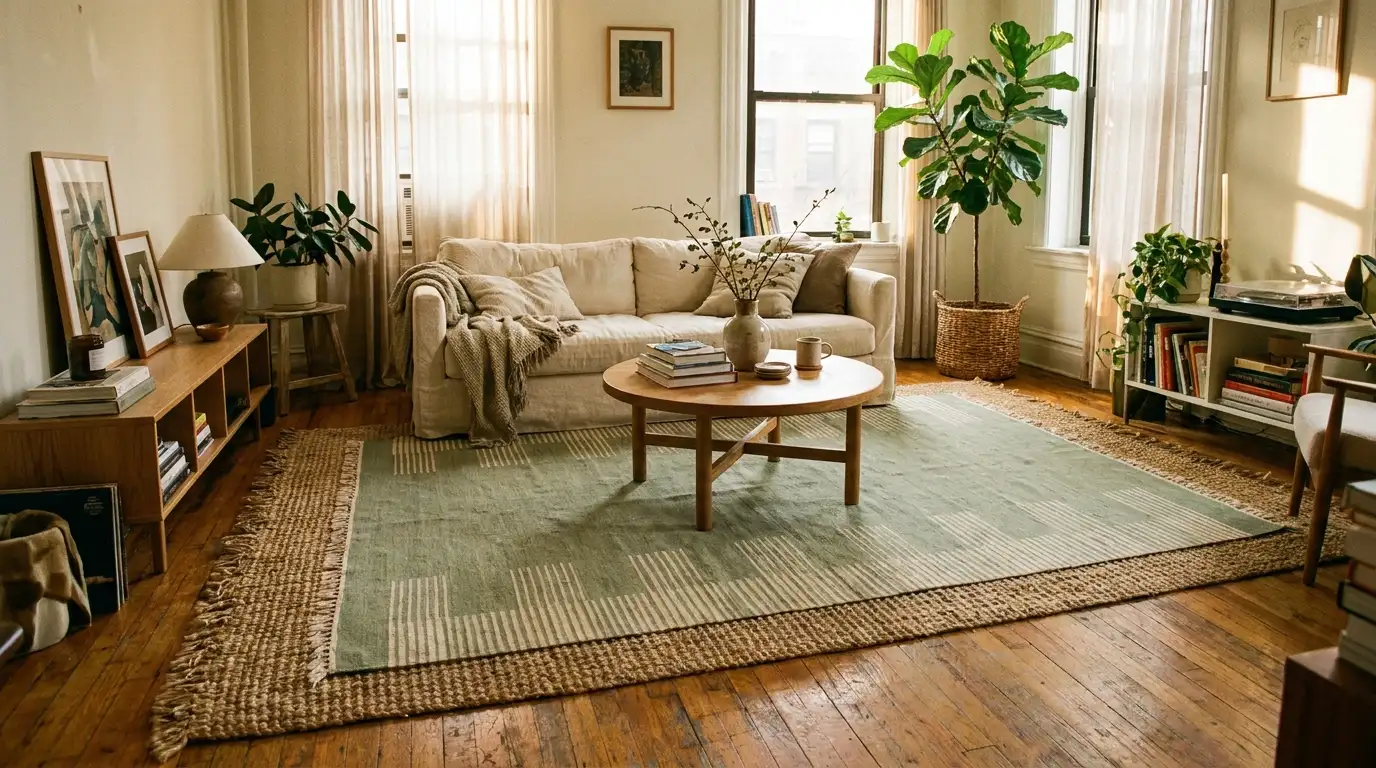
Ugly floors are the one thing almost every renter gets stuck with. You can’t rip up the beige carpet, the cracked kitchen tile or the scratched laminate, and your deposit depends on leaving them alone.
The good news is that you don’t have to live with them. Learning how to cover rental flooring mostly comes down to choosing the right layer for each room.
Some fixes cost nothing, like moving a dresser over a burn mark. Others take a weekend, like clicking together a floating vinyl floor that comes right back up when you move out.
Below are 18 renter-friendly ideas. There are plenty of rugs and runners, washable and outdoor options, peel-and-stick and click-together tiles, a DIY painted floor cloth, and a few smart fixes for bathrooms, balconies and desk nooks. Each one comes with a quick visual guide, so you can find the fix that suits your space and your budget at a glance.
1. Cover Nearly the Whole Floor With One Big Patterned Rug
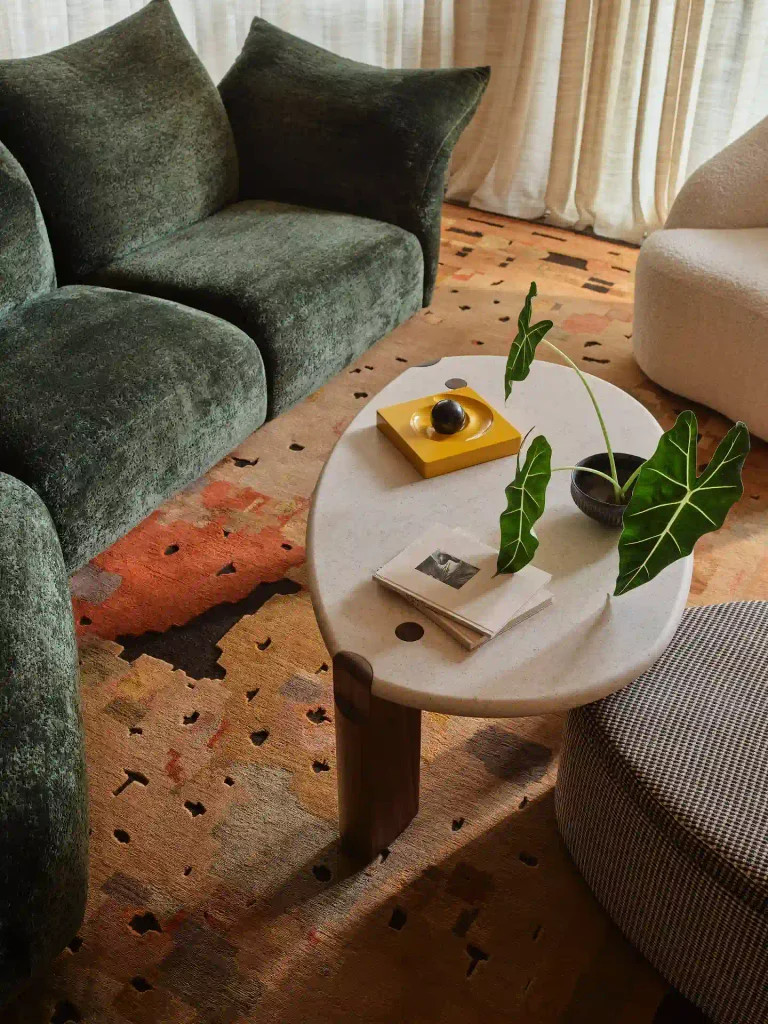
Sometimes the easiest fix is to cover the floor with something better looking.
In this living room, one large rug runs from the curtains to past the sofa and chairs, so only a thin strip of the real floor shows. Its warm mix of amber, rust, soft pink and charcoal draws the eye.
Why it hides a bad floor so well:
- Small flecks and blocky shapes make crumbs, stains and scuffs hard to spot.
- Earthy tones hide everyday dust better than a pale solid rug would.
- The pile looks carved in spots, and that texture keeps your eye on the rug instead of the floor around it.
Size up before you buy. A rug that feels huge in the store usually looks right once the furniture is on it.
Going big on the rug does more than hide the floor. Sizing up is one of the easiest ways to make a small room look bigger.
Sizing a Cover-Up Rug
2. Layer a Patterned Rug Over a Big Woven Base
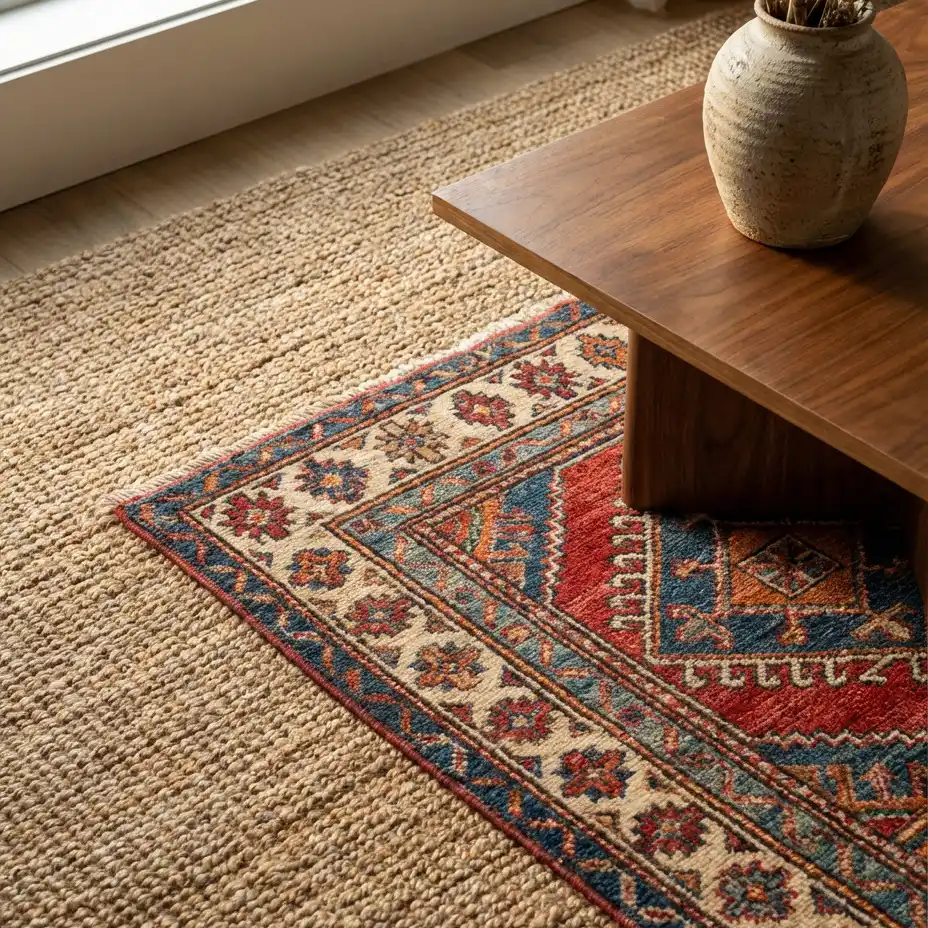
Big rugs get pricey fast. Layering two gets you the same coverage for less money.
Here, a chunky woven rug in sandy tan covers most of the floor. A smaller rug with a red, navy and cream pattern sits on top and pulls in all the color. The plain base does the covering, and the patterned rug on top is the one people notice.
A low, flat top rug like this one is the safest choice. It stays put on the textured weave instead of curling at the corners.
One warning: skip a thick, plush rug for the top layer. Stacked on a chunky base, it can bunch at the edges and turn into a tripping spot.
One warning before you layer: putting a rubber-backed rug on vinyl or hardwood is one of the renter mistakes that cost your deposit.
| 🟫 Base Layer | 🎨 Top Layer | |
|---|---|---|
| Its job | Hides as much floor as possible | Brings color and pattern |
| Size | As big as the room allows | Smaller, centered under the coffee table |
| Look | Plain, textured, neutral | A bold pattern you love |
| Budget | Save here | Spend a little more here |
3. Run a Faded, Vintage-Style Runner Down a Galley Kitchen
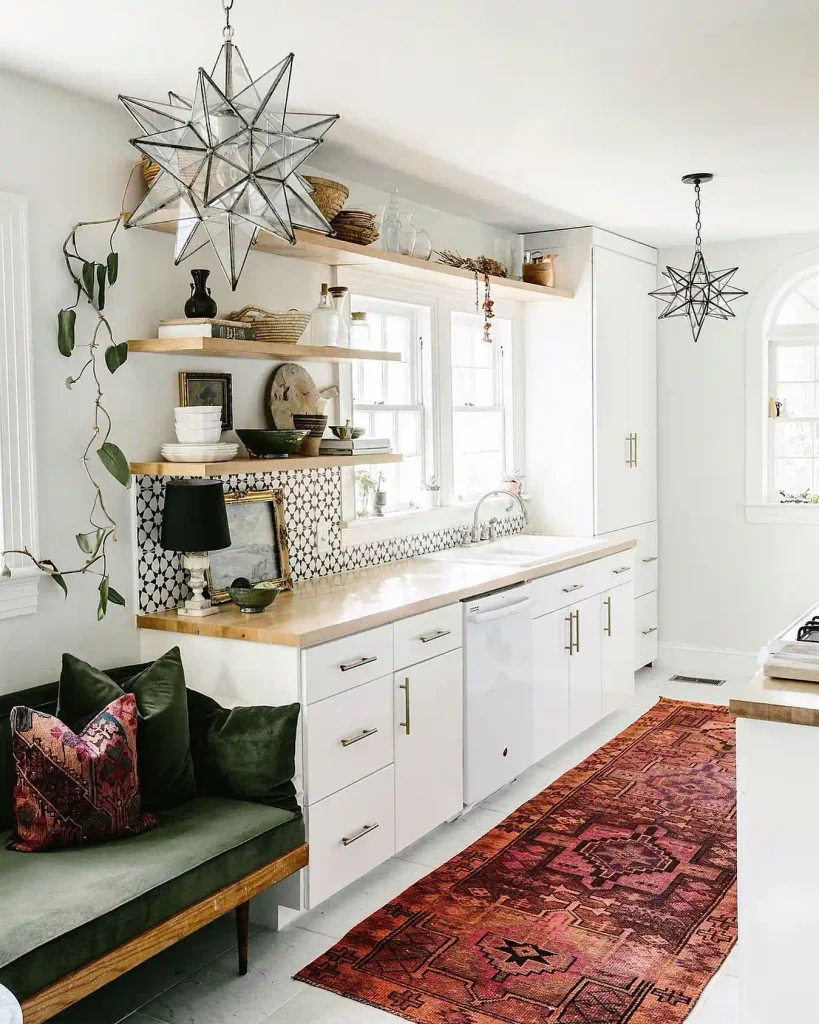
Galley kitchens make the floor hard to ignore. It’s one long, narrow strip that you walk up and down all day.
In this bright white kitchen, a long runner in faded rust, pink and plum covers most of that walkway. The washed-out pattern already looks a little worn in, so a coffee drip or a splash of sauce blends right in instead of standing out.
To pick one for your own kitchen:
- Measure the walkway and leave a little floor showing at each end.
- Choose a low, flat rug so the dishwasher and cabinet doors open freely over it.
- Put a grippy pad underneath, because kitchen floors get slick.
Against all that white, the warm runner is what makes this kitchen feel cozy.
A runner is a great start in a galley kitchen. Pair it with a few more removable kitchen upgrades and the whole room feels new.
4. Put a Washable Rug Where Spills and Paws Land
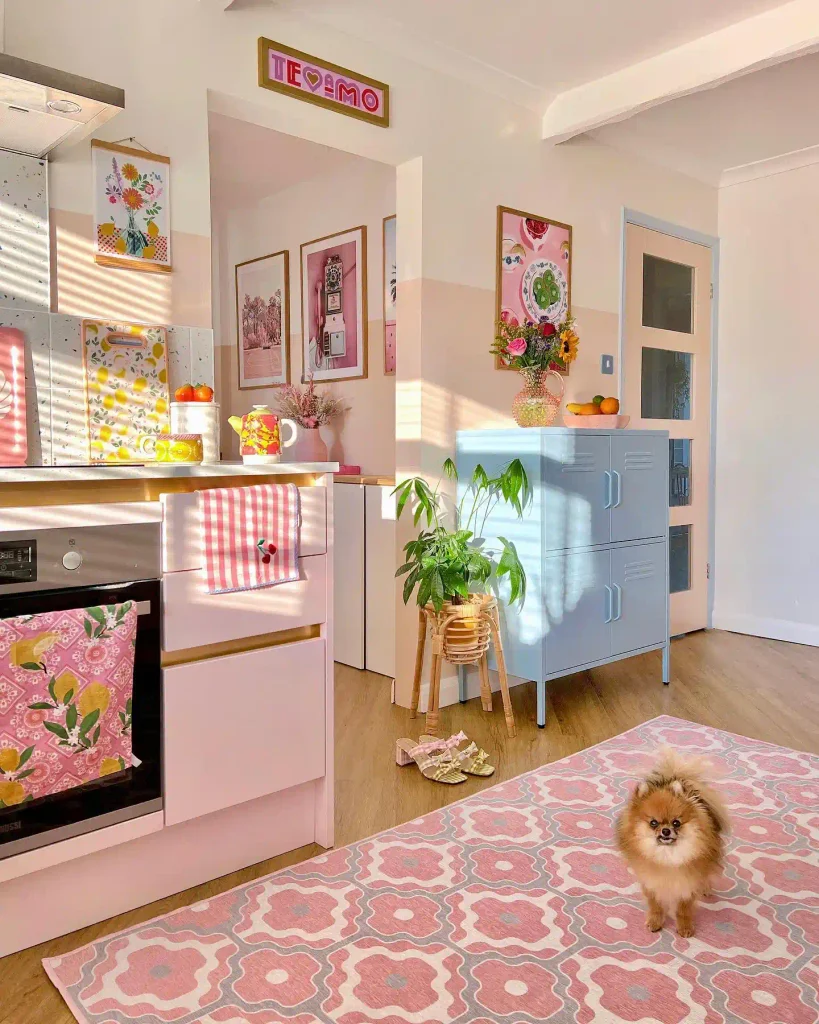
Pets and kitchen rugs usually don’t mix. Paw prints, spills and dropped food pile up fast.
This bright pink kitchen solves that with a washable rug. Its soft pink, grey and white trellis pattern covers a big part of the wood floor, right where the cooking and snacking happen. A fluffy little dog sitting on it shows you exactly who it has to survive.
The rug in this photo is the two-piece kind. A thin patterned cover sits on a non-slip pad, and when it gets dirty, you lift the cover off and put it in the washing machine.
Your old floor stays hidden, and the rug stays clean enough to keep down every day.
Place it in front of the sink and stove, where most spills land.
Shake out pet hair and crumbs before it goes in the wash.
Check that the rug size fits your washing machine before you buy.
Putting the cover back down while it’s still damp.
Washing the pad along with the cover on a two-piece rug.
Waiting weeks to wash it, since stains are easier to remove when they’re fresh.
5. Stick Wood-Look Chevron Tiles Right Over Bathroom Tile
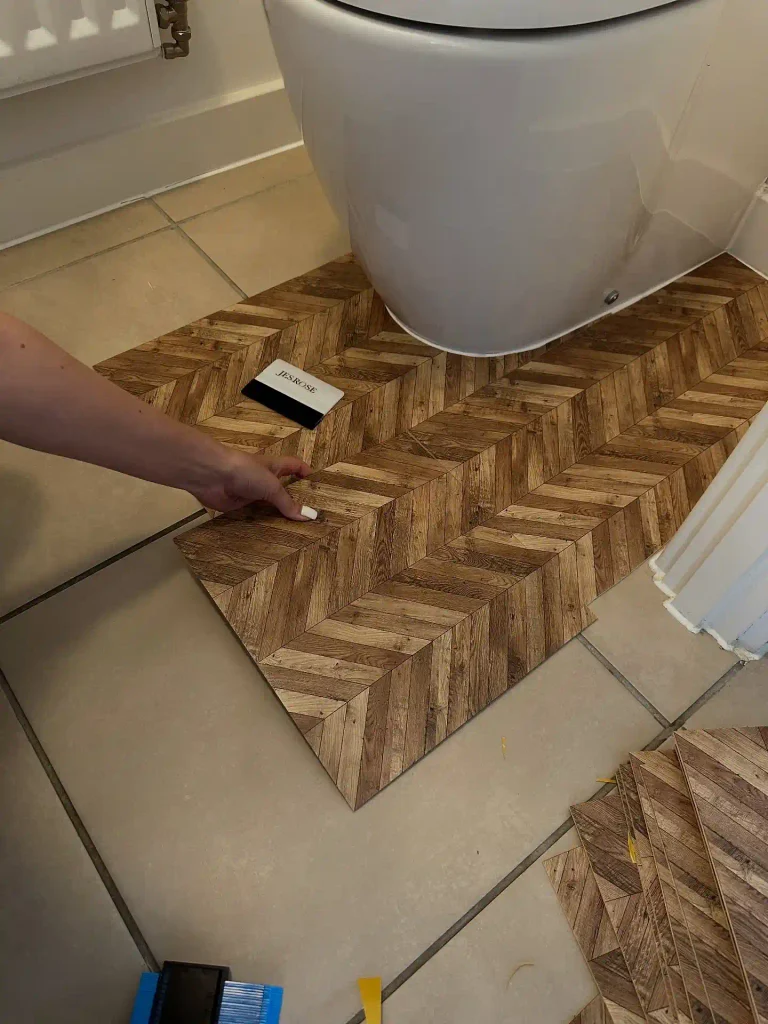
Beige ceramic tile with grey grout lines is one of the most common rental floors there is. In this small bathroom, someone is covering it with thin wood-look tiles in a chevron pattern and pressing each one down by hand. A stack of new tiles sits ready nearby, and scraps of backing paper lie scattered across the floor.
The toilet is the tricky part. Look closely and you’ll see the tiles were cut to follow its curved base.
Two tools in the photo make that easier:
- A flat smoothing card that pushes out air bubbles.
- What looks like a blue contour gauge, a tool that copies a curved shape so you can trace it onto a tile.
Before you do the whole room, stick one tile in a hidden corner as a test. Some adhesives leave sticky residue when you pull them up.
🛠️ How to Lay It
Scrub the old floor and let it dry fully, so the backing grips well.
Lay a row out without peeling anything, so you can see where the cuts will fall.
Trace curves onto the backing paper and cut slowly with a sharp utility knife.
Peel, press, then smooth from the center out to push out any bubbles.
6. Turn Patterned Peel-and-Stick Tiles to Create a Woven Look
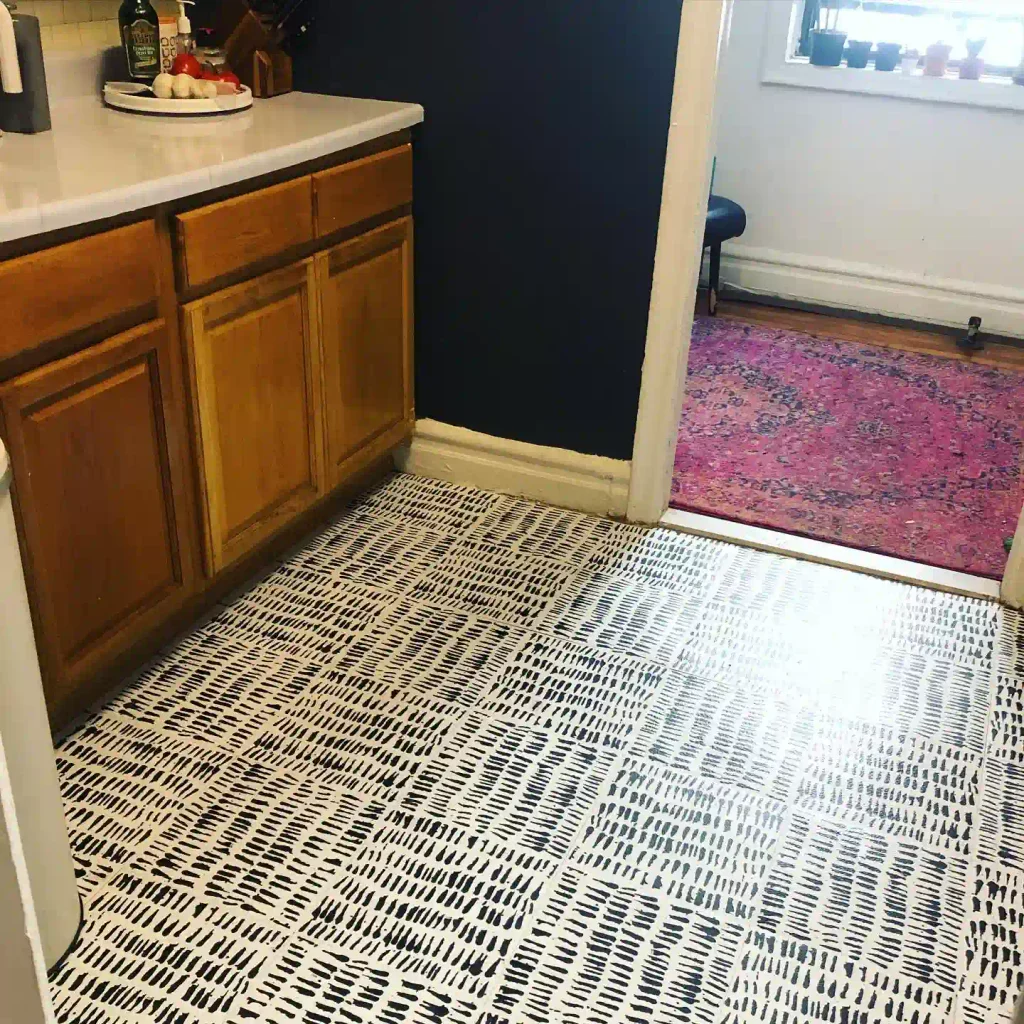
One hour. According to the renter who shared this kitchen, that’s how long the whole floor took to install.
The tiles are white with dark, hand-drawn-looking dashes. Each one is given a quarter turn from the tile next to it, so the dashes switch between running up and down and running side to side. One simple tile ends up looking like a woven pattern.
You have two ways to lay a print like this:
- All facing one way: calmer, and it reads like one big print.
- Every other tile turned: busier and more playful, and the seams are harder to spot.
Next to the deep navy wall, the bold floor makes the warm wood cabinets look like part of the plan.
Pick a pattern that still looks good when it’s turned sideways. Then you can mix directions freely and never worry about lining up a print from tile to tile.
7. Snap Wood Deck Tiles Over a Concrete Balcony

Halfway through the job, this balcony already shows the difference. The finished side is covered in warm wood, and the rest is still plain grey concrete.
The tiles are small squares of wood slats laid in alternating directions, which gives a checkerboard parquet look. Flip one over, like the stack in the photo, and you’ll see an open black plastic grid underneath. Those edges click into the next tile, so there’s no glue and no nails. The open grid also lets rainwater drain through.
That makes them a great fit for renters. When you move out, you unclip them, stack them up and take your balcony floor with you.
As a bonus, the warm slats match the wood railing.
📋 Before You Order
8. Lay a Low Flatweave Rug Over Old Wall-to-Wall Carpet
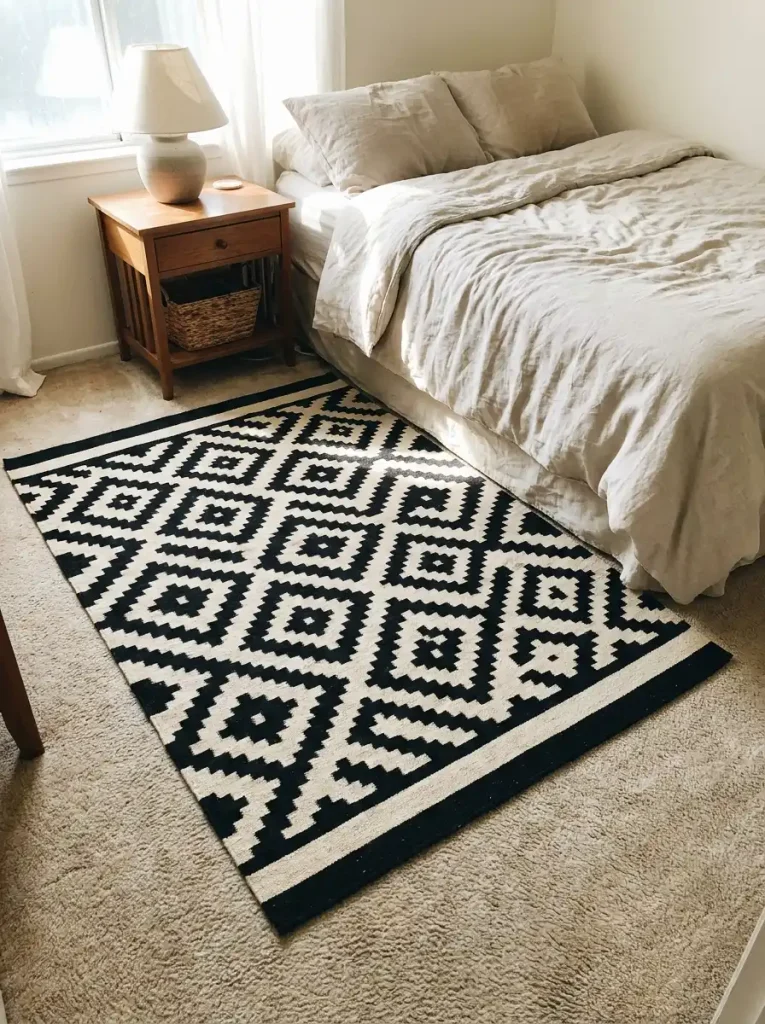
Wall-to-wall carpet is the one floor renters really can’t pull up. Stained, flattened or just a tired shade of beige, it usually comes with the lease.
A rug on top is the easiest fix, but thickness matters. A thin flatweave or low pile rug lies flat and stays put. A shaggy one sinks into the carpet, wobbles under furniture and looks lumpy.
Pick a color or pattern that clearly contrasts with the carpet, like a crisp black and cream design over beige. Then the rug looks like a choice you made on purpose.
Tip: buy a rug pad made for use on carpet. Pads designed for hard floors won’t stop a rug from slowly creeping across the room.
Choose a thin flatweave or low pile rug.
Use a pad or grippers made for rugs on carpet.
Go for a color that clearly stands apart from the carpet.
Shag or thick plush rugs that sink and bunch.
Rug pads made only for hard floors.
A rug so close to the carpet color that it looks like a stain.
9. Swap In Carpet Tiles So One Stain Never Ruins the Whole Floor
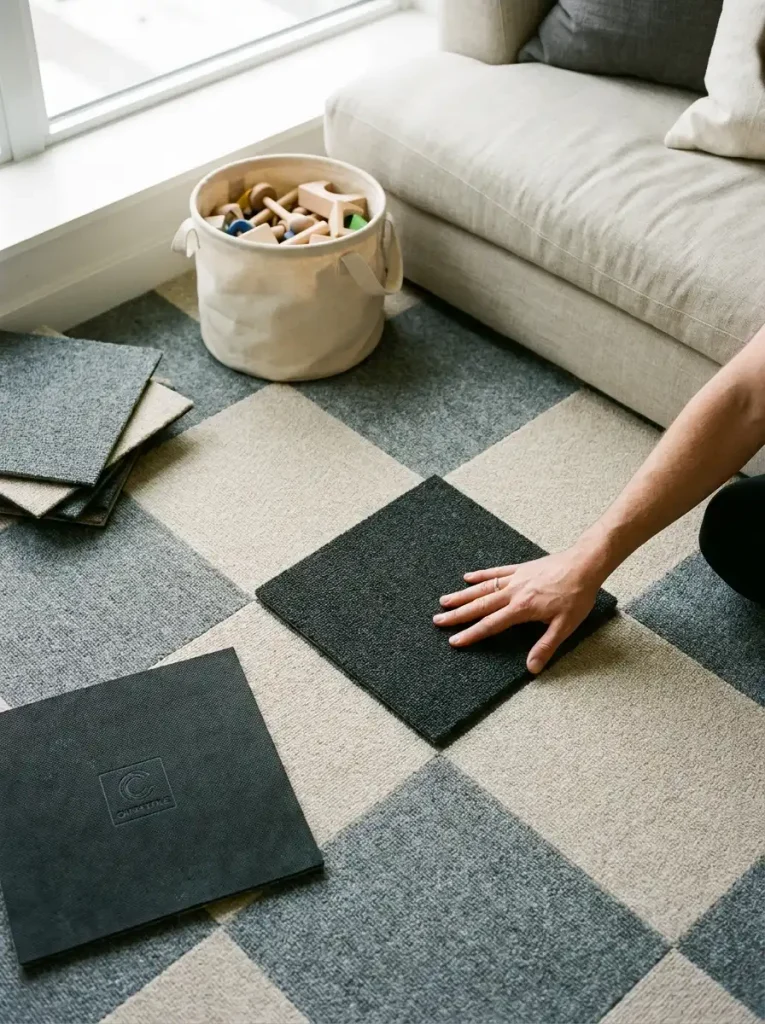
Ever had one spill ruin an entire rug? Carpet tiles solve that.
They’re squares of carpet you lay side by side over the existing floor. Some just sit in place under their own weight. Others use sticky tabs that grip the tiles to each other instead of to your floor. Mix two colors for simple stripes or a checkerboard, or stick to one shade for a calm, solid look.
- Stain on one square? Lift it out, clean it or replace just that one.
- Moving out? Pull them up and stack them in a box.
They hold up well in a den, a kids’ room or any spot that sees lots of foot traffic.
10. Click Together a Floating Vinyl Plank Floor Over the Old One

Peel-and-stick isn’t the only removable floor out there. Floating vinyl planks click together along their edges and rest on top of the old floor with no glue at all.
Since nothing sticks to the floor underneath, the whole thing can come back up when you move out. That makes it one of the strongest options for covering a full room of cracked tile or tired laminate.
It does take more work. You’ll cut planks to length, leave the small gap at the walls that the instructions call for and add a transition strip where the new floor meets the next room.
Check your door height first. A thicker floor can stop a door from swinging open.
| 🧩 Floating Planks | 🏷️ Peel-and-Stick | |
|---|---|---|
| Holds by | Clicking to each other | Adhesive backing |
| Old floor | Nothing stuck to it | May keep some residue |
| Best for | Whole rooms | Small rooms and bathrooms |
| Effort | A weekend | An afternoon |
| Underfoot | Thicker and more solid | Thin |
11. Paint Your Own Canvas Floor Cloth
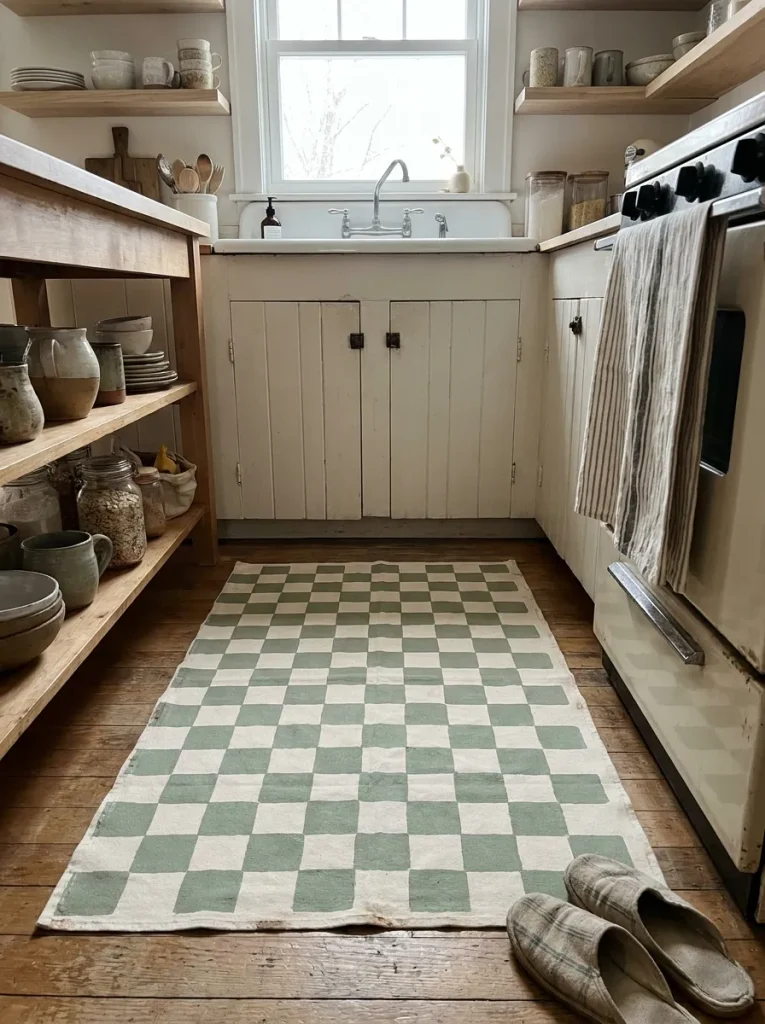
Painted floor cloths are an old idea that still works well in rentals.
A floor cloth is just heavy canvas that’s painted, sealed and laid flat like a rug. The sealed surface wipes clean, which makes it a good match for kitchens and entryways where fabric rugs get grubby fast.
Why renters like them:
- You choose the exact size, even for an odd little nook.
- The pattern can be anything you can paint, such as stripes, checks or simple shapes.
- It lies thin and flat, so doors swing right over it.
A thin rug pad underneath keeps it from sliding.
🎨 Make One in a Weekend
Cut primed heavy canvas a little bigger than you need, then fold and glue the edges under for a clean hem.
Tape off your pattern with painter’s tape and paint it with acrylic or floor paint.
Once it’s dry, roll on several thin coats of clear water-based sealer.
Let the sealer cure fully, following the label, before anyone walks on it.
12. Bring an Outdoor Rug Inside for a Tough, Wipeable Entry

Outdoor rugs belong inside more often than people think. They’re made to handle rain, mud and sun, so a busy entryway is easy work for them.
Most are woven from synthetic fibers that don’t soak up water. Muddy boot prints shake out, and if it gets really dirty, you can carry it outside and hose it off. They’re thin too, so the front door clears it.
The designs have improved a lot. You’ll find stripes, faded vintage-style prints and soft neutrals that don’t look like patio gear at all.
One catch: they feel a little stiffer underfoot than a cotton or wool rug.
Other Indoor Spots It Handles Well
13. Trade the Tiny Bath Mat for a Long Bathroom Runner

Most bath mats are too small to hide anything. They cover one patch of tile and leave the rest of the dated floor on full display.
A long bath runner stretches along the tub or vanity and covers much more. In a narrow bathroom, it can hide almost the entire walking path.
When you shop, look for:
- A washable runner, since bathrooms get damp and steamy.
- A flat or low pile, so the door and the toilet base don’t catch on it.
The room ends up looking finished instead of half done.
A long runner makes a rental bathroom feel finished in about five seconds. For the rest of the room, follow my weekend rental bathroom makeover plan.
⚠️ Watch Out
Rubber or latex backing can stain some vinyl floors over time, and that could cost you at move-out. If your rental bathroom has vinyl, choose a runner without rubber backing and use a pad labeled safe for vinyl.
14. Roll Out a Vinyl Sheet in a Laundry Closet

Laundry closets rarely get any design love, even though you stand in one every week.
A sheet of vinyl flooring is a quick fix. It comes on a roll, often printed to look like tile or wood, and you cut it to fit the space.
- Make a paper template of the floor, corners and all.
- Trace it onto the vinyl and cut with a sharp utility knife.
- Lay it flat and slide the machines back on top.
The weight of the washer and dryer helps hold it in place. If you want tape at the edges, test it in a hidden spot first so it won’t leave residue.
Chipped, dated tile with lint and detergent stuck in the grout lines.
One smooth, patterned surface with no grout, so spills wipe up in one pass.
15. Park Your Furniture Over the Worst Spots
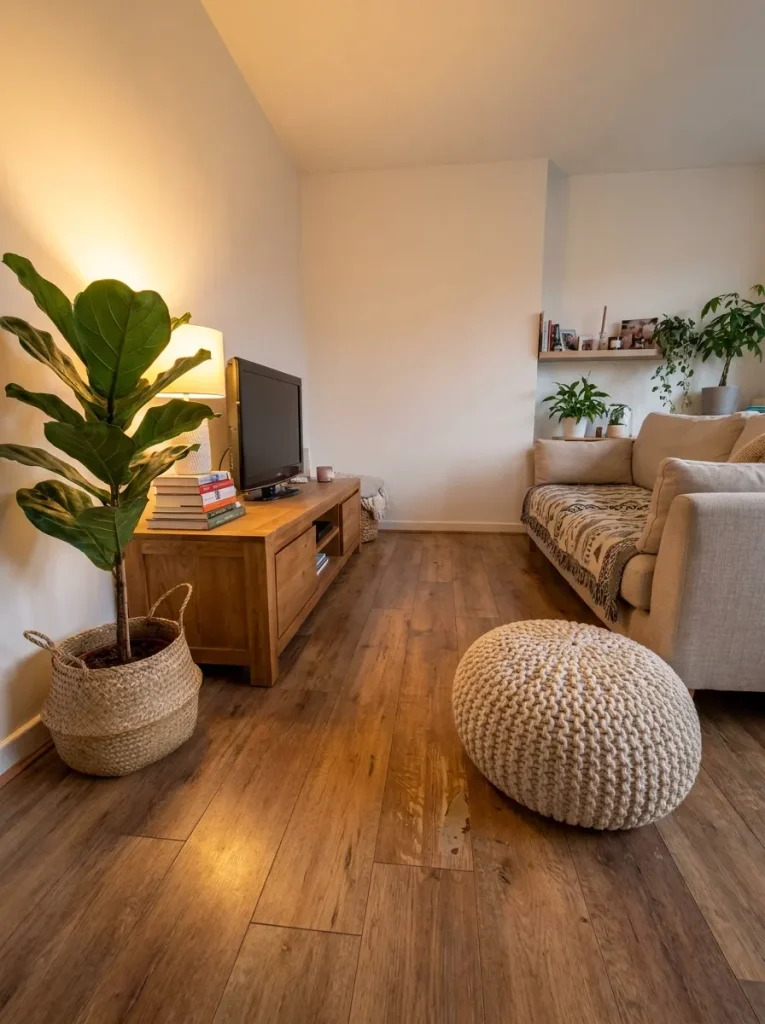
Before you buy anything, rearrange what you already own.
Walk the room and find the ugliest patches. Maybe it’s a burn mark, a deep scratch or a stain that never came out. Then ask which piece of furniture could sit right on top of it.
Heavy, solid pieces that reach the floor hide the most. Leggy chairs and open shelves won’t help much, because you can see right under them. Snap a photo of the bare floor first so you remember where every mark is.
Moving a dresser a little to the left costs nothing.
🧭 Match the Piece to the Problem
- ▸Bed and nightstands: worn patches in the middle of a bedroom.
- ▸Dresser or closed bookcase: stains running along a wall.
- ▸Big floor plant in a wide pot: one burn mark or chip.
- ▸Storage ottoman or floor pouf: a scuff out in an open area.
- ▸Low media console: damage along the TV wall.
16. Line Up Two Matching Runners to Make One Wide Rug
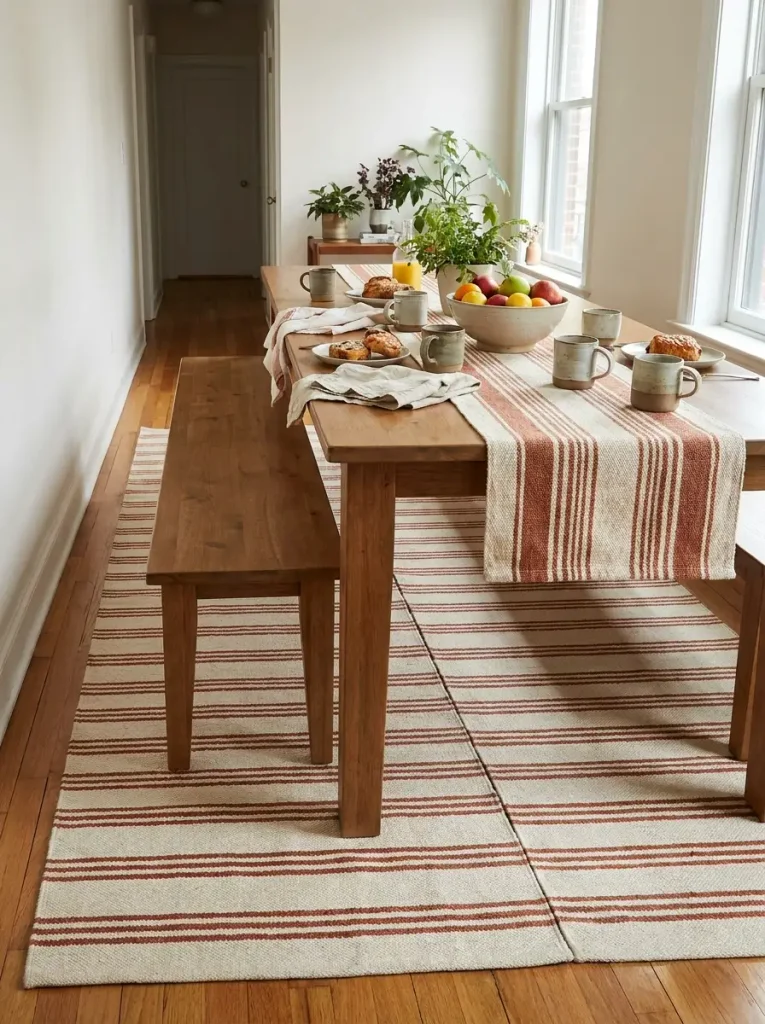
Wide rugs cost a lot. Runners usually don’t.
Buy two identical runners and lay them edge to edge, and you’ve got one long, wide rug, often for less money. This works best in a long, narrow living room or under a dining table, where a standard rug looks short and stubby.
To make them read as one piece:
- Choose a simple stripe or small repeating pattern so the seam down the middle blends in.
- Buy both at the same time so the colors match exactly.
Skip runners with wide borders. Two borders meeting in the middle make the seam obvious.
Put one rug pad under both runners, cut wide enough to span the seam. It holds them together, so a gap doesn’t open up every time someone walks across.
17. Snap Wood-Look Foam Tiles Into a Workout or Play Corner

Rolling out a yoga mat on cold, scratched tile gets old fast.
Interlocking foam tiles fit together like puzzle pieces and can cover a whole corner in minutes. The plain grey gym kind works, but many now come with a printed wood grain, so from a few steps away they blend in with the rest of the room.
They’re soft, too, which makes them a good choice for a kids’ play area. Knees, toys and light hand weights all land a little more gently.
When you move, they pull apart and stack flat in a closet.
📋 Set It Up Right
18. Hide Desk Chair Wear With a Patterned Chair Mat
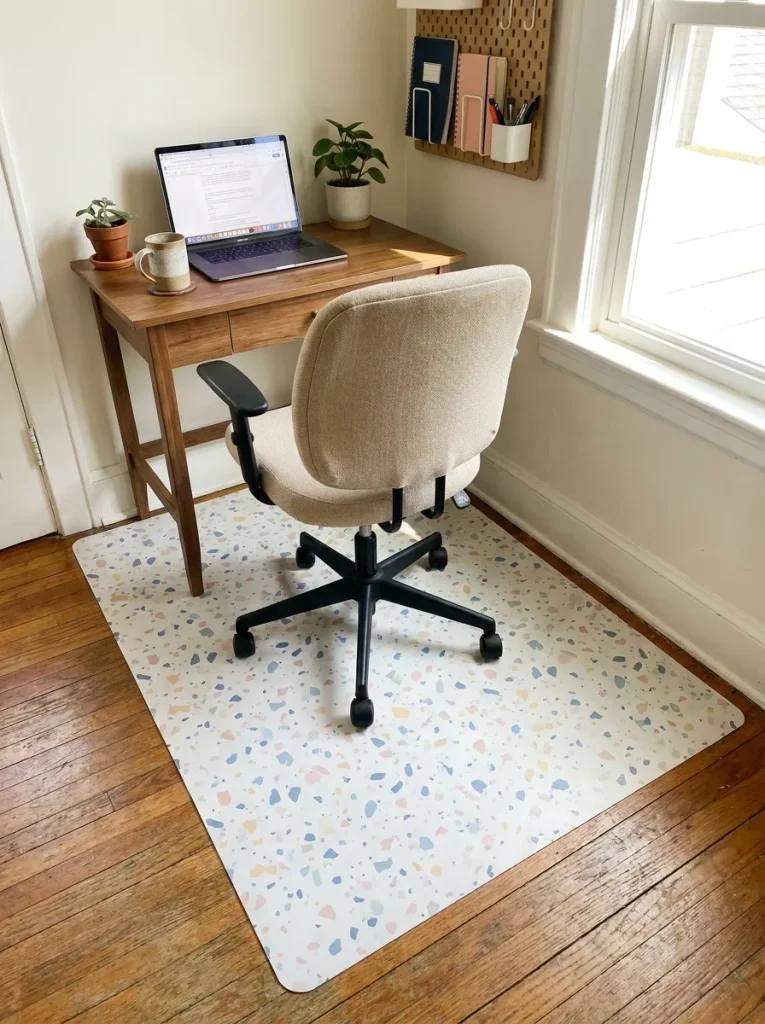
Desk chairs are hard on floors. Rolling back and forth for hours wears a dull patch into wood and crushes carpet flat.
A chair mat covers that spot and keeps it from getting worse. Clear plastic mats do the job but show every flaw underneath. A printed one looks more like a small rug, with designs like faux tile, wood grain or soft abstract shapes.
Measure how far your chair rolls back before you buy, because a mat that’s too small leaves the wheels dropping off the edge. Also check that it’s made for your floor type. Mats for carpet and mats for hard floors are built differently.
Conclusion
Your rental floor doesn’t have to be the first thing people notice. Start with the free fix and rearrange your furniture, then make one bigger change in the room that bothers you most. A washable rug in the kitchen or a few boxes of peel-and-stick tiles in the bathroom can make a bigger difference than you’d expect.
Before you try anything with adhesive, check your lease and test it in a hidden spot. That simple habit is the safest part of learning how to cover rental flooring and keeping your deposit.
Save this pin to your renter decor board so it’s ready for your next move.