

Your bedroom fits a bed, and that’s about it. If you can touch two walls while making the bed, or you’ve ever climbed over the mattress to reach the window, this list is for you.
Rooms under 100 square feet don’t have space for a dresser, two nightstands, and a reading chair. They need smarter moves.
The good news is that small rooms respond fast. One change to where the bed sits, where the light comes from, or what goes on the walls can make the whole space feel calmer and easier to live in.
These 30 small bedroom ideas come from real tiny rooms and practical fixes. You’ll find beds that lift, fold, climb, and sit right on the floor. There’s storage that runs up the walls, hides under the mattress, and hangs on the back of the door, plus lighting that frees up your nightstand. There are bold paint ideas too, because small doesn’t have to mean beige.
Plenty are renter-friendly, and many take an afternoon or less. Pick one or two to start, and save the rest for later.
1. Wrap the Window Behind Your Bed in Built-In Shelves
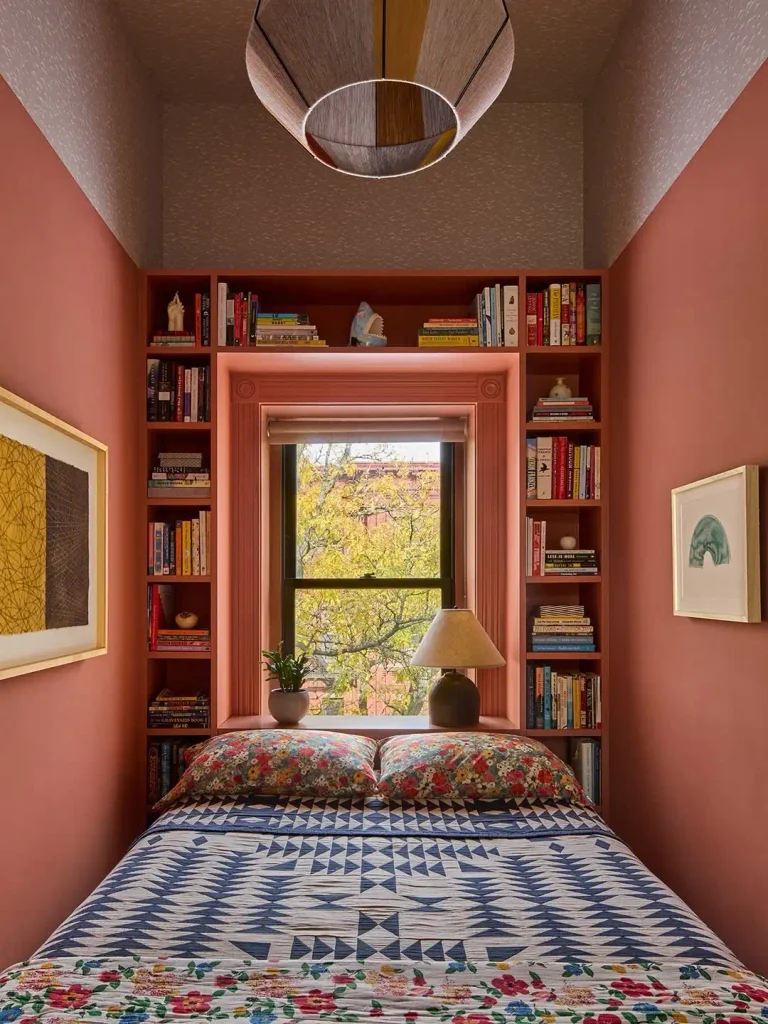
In a room this narrow, the bed takes up the full width, so the wall behind it has to work harder. Here, shelves run up both sides of the window and across the top, forming one deep frame around it.
That frame quietly handles three jobs:
- It holds a whole book collection without a single bookcase on the floor.
- The deep window ledge becomes the nightstand, with room for a lamp and a small plant.
- It acts as the headboard, so you can skip buying one.
The shelves are painted the same dusty pink as the walls, which keeps all that storage from looking bulky. Renting? Two narrow bookcases pushed tight against each side of the window get you surprisingly close.
One wall, three jobs
2. Run Trailing Vines and Fairy Lights Along the Ceiling Line
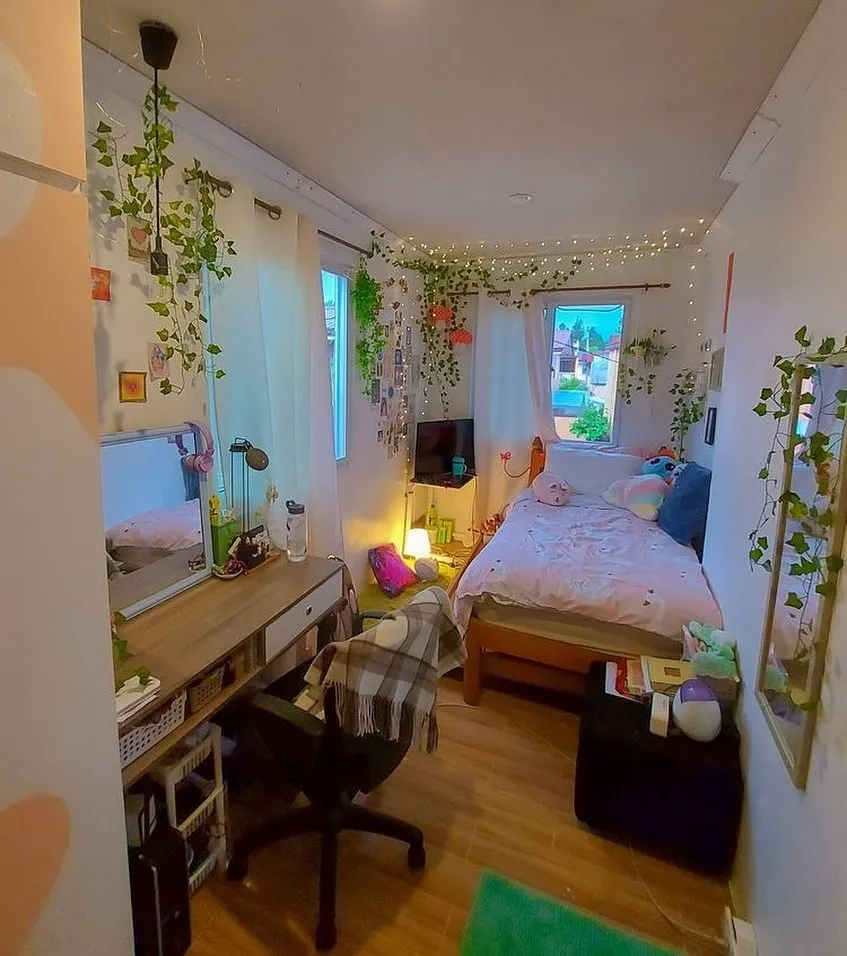
Look up before you buy another shelf. In this long, skinny bedroom, most of the personality lives above eye level, which leaves the desk and floor free for real life.
Trailing vines loop from the curtain rods and spill down the corners. A strand of warm fairy lights follows the edge of the ceiling across the room, and the mirror on the side wall gets its own vine frame, so it reflects more green instead of blank wall.
At night the lights glow through the leaves and the whole room feels warmer and less boxy.
Faux vines look almost the same from bed level and skip the watering.
Hang vines from curtain rods or peel-off adhesive hooks so nothing needs drilling.
Pick warm white LED string lights, which stay much cooler than old bulb strands.
Letting vines dangle low over your pillow, where they gather dust and brush your face.
Piling every vine into one corner. Spread them along the ceiling edge so it reads as one clean line.
3. Keep One Soft Color Family and Let Texture Do the Talking
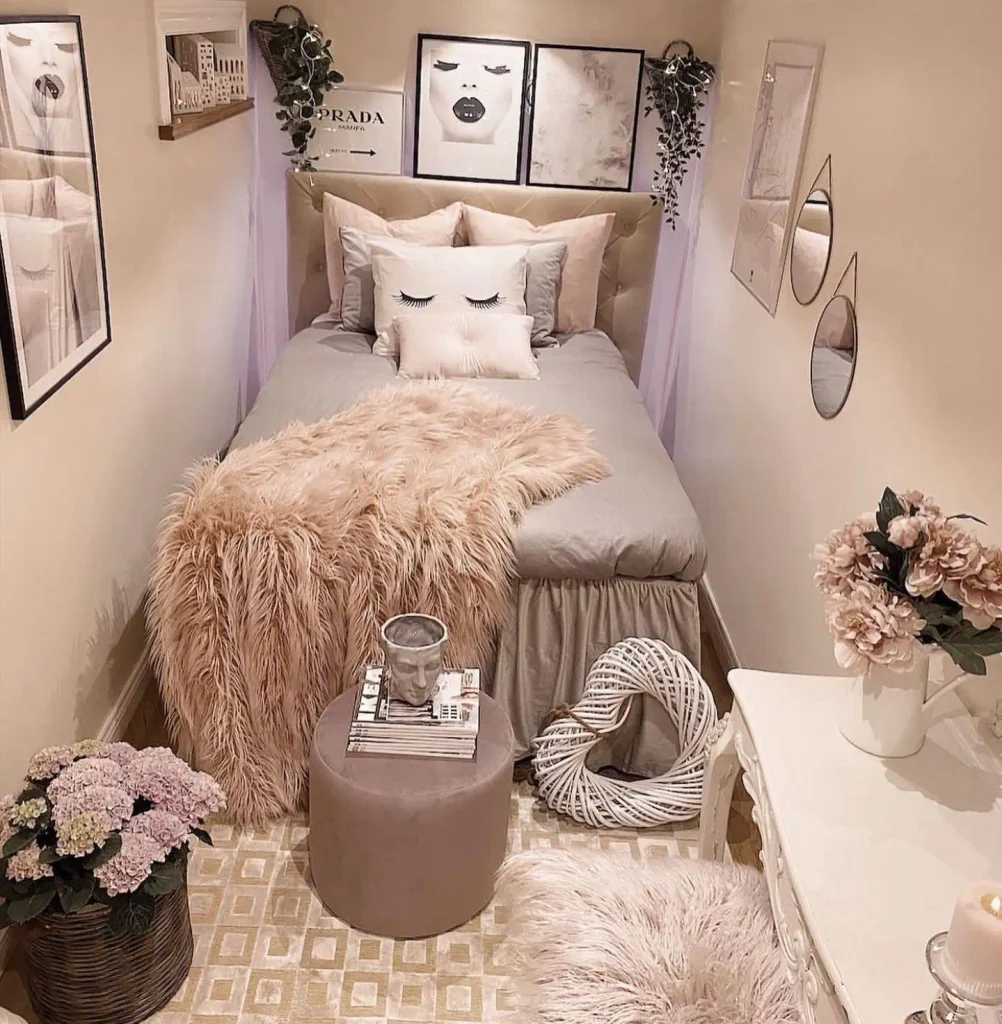
Blush, soft grey, and cream. That’s the entire color story in this bedroom, and almost nothing steps outside it.
Dreaming of a boutique feel? See how to create a hotel style bedroom on a budget in a small space.
Keeping colors this close together stops your eye from jumping around, so a room barely wider than the bed feels calm instead of crammed. The interest comes from texture. A tufted headboard, a shaggy faux fur throw, a velvet pouf at the foot of the bed, and a fluffy rug all sit in the same gentle shades but feel completely different.
Notice the thin black frames on the art. Without a few dark lines, a pale room starts to look blurry, both in photos and in person.
Recreate this soft tonal look
4. Lift Storage Off the Floor With a Wall Cabinet and Basket Cubes
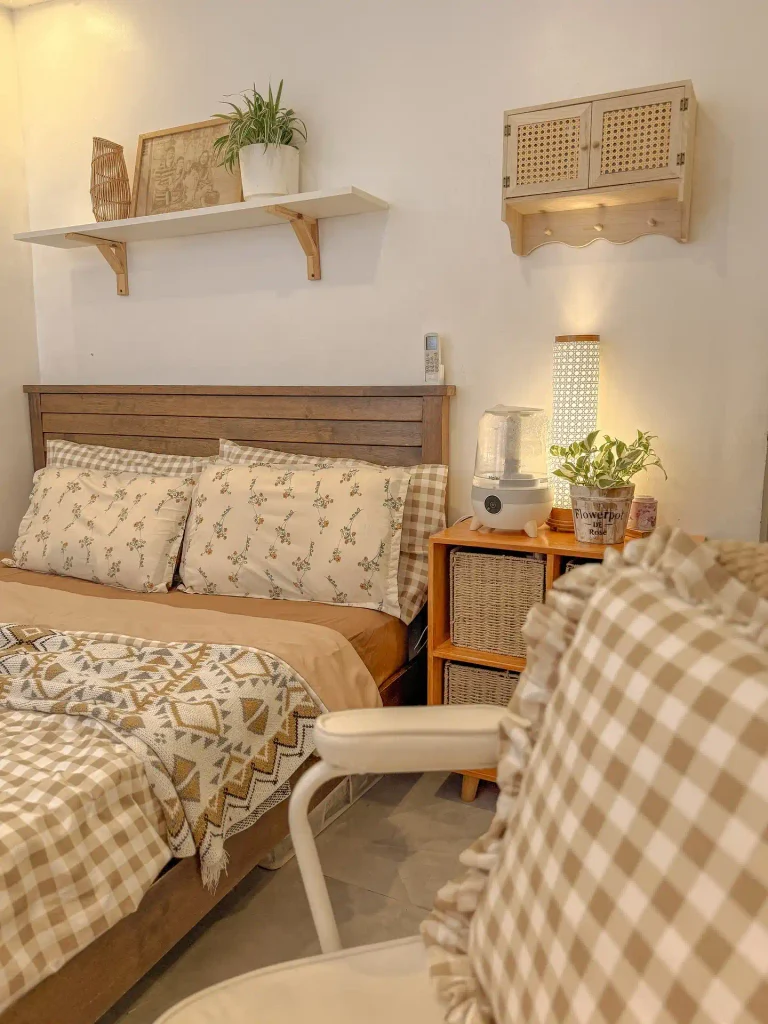
Floor space is the first thing to disappear in a tiny bedroom, so this setup keeps storage up and out of the way.
Above the nightstand, a small wall cabinet with cane doors hides clutter, and a row of wooden pegs underneath catches a bag, a hat, or tomorrow’s outfit. Over the bed, a simple white shelf on wood brackets holds a plant and a framed photo without crowding the headboard.
Down low, the nightstand is just a small cube shelf with woven baskets slid inside. Chargers, books, and lotion go in the baskets, and the top stays clear for a lamp and a plant.
Warm wood, cane, and tan gingham tie it all together.
| Bulky dresser | Wall cabinet + basket cubes |
|---|---|
| Takes a big bite out of a small floor. | Leaves most of the floor open. |
| Deep drawers that turn into junk piles. | Small, sorted spots for daily things. |
| Looks heavy in a narrow room. | Feels lighter and more open. |
| No drilling needed. | Cabinet needs proper wall anchors, so check your lease first. |
5. Raise the Bed to Fit a Desk and Sofa Underneath
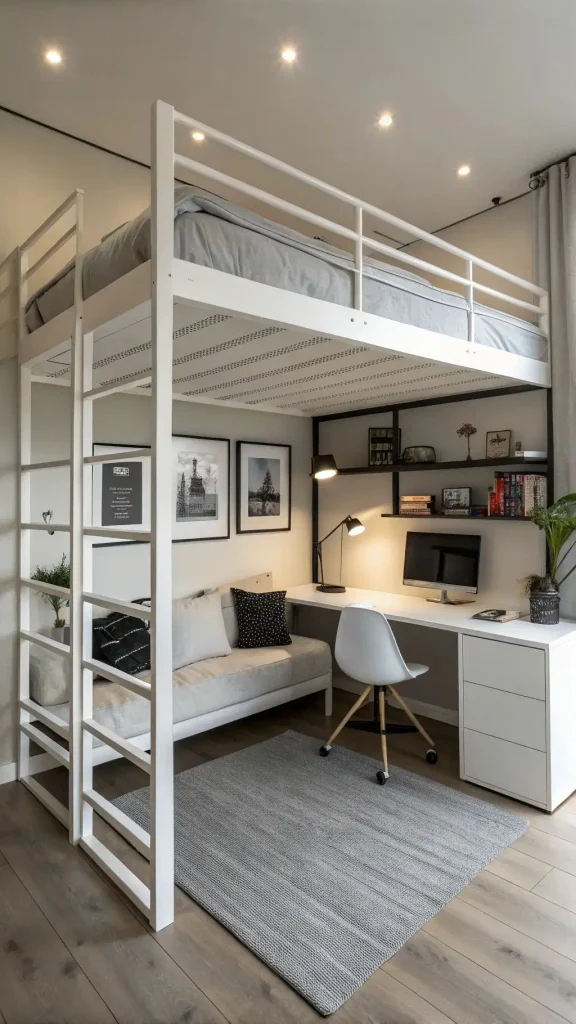
Lift the bed and the same small footprint holds a bedroom, an office, and a spot to sit.
Here, a white metal loft frame raises the mattress high, and the space underneath splits into two zones. On one side, a small cushioned sofa tucks in for reading or a friend who stops by. On the other, a white desk with a drawer unit and open black shelves above handles work, lit by an adjustable desk lamp.
Keeping the frame, desk, and walls in white and soft grey stops the stacked setup from looking top heavy.
Measure your ceiling before you buy. You need room to sit up in bed without bumping your head, plus enough height below to sit comfortably.
The bed sits on the floor and swallows most of the room. A desk won’t fit, and there’s nowhere to sit except the mattress.
The bed moves up. Below it, a small sofa, a full desk with drawers, and wall shelves all share the same floor space.
6. Fold the Bed Into a Wall Cabinet That Opens Sideways
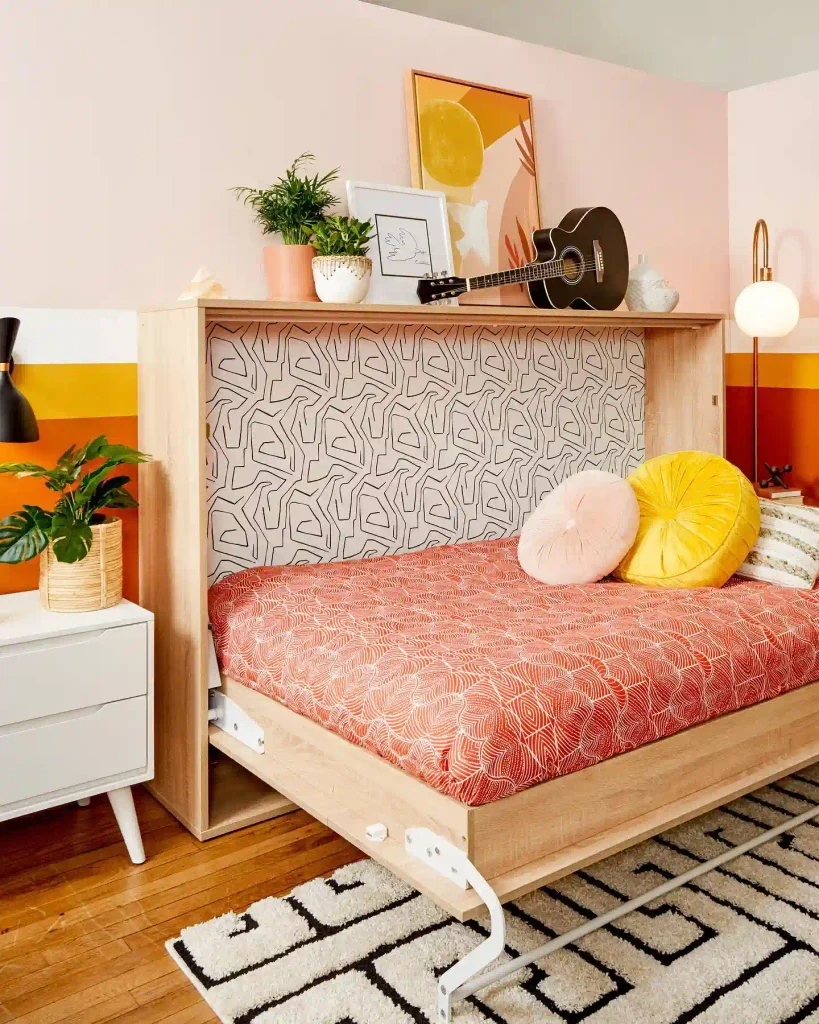
By day, this bed folds up into a light wood cabinet. At night, it swings down and rests on a fold-out leg.
It tilts open sideways instead of dropping down from a tall unit. Side-tilt wall beds sit lower and stick out less from the wall when open, which helps in a narrow room or under a low ceiling. A few details make it feel like real furniture, not a fold-away fix:
- The inside back is lined with a black and white line pattern, so it looks like a headboard when the bed is down.
- The top of the cabinet becomes a display ledge for plants, leaning art, and even a guitar.
- A wall sconce on one side and a slim floor lamp on the other mean no table lamp is needed.
Color-block stripes on the wall pick up the warm orange, yellow, and pink from the bedding.
7. Skip the Frame and Sleep Low on a Floor Bed
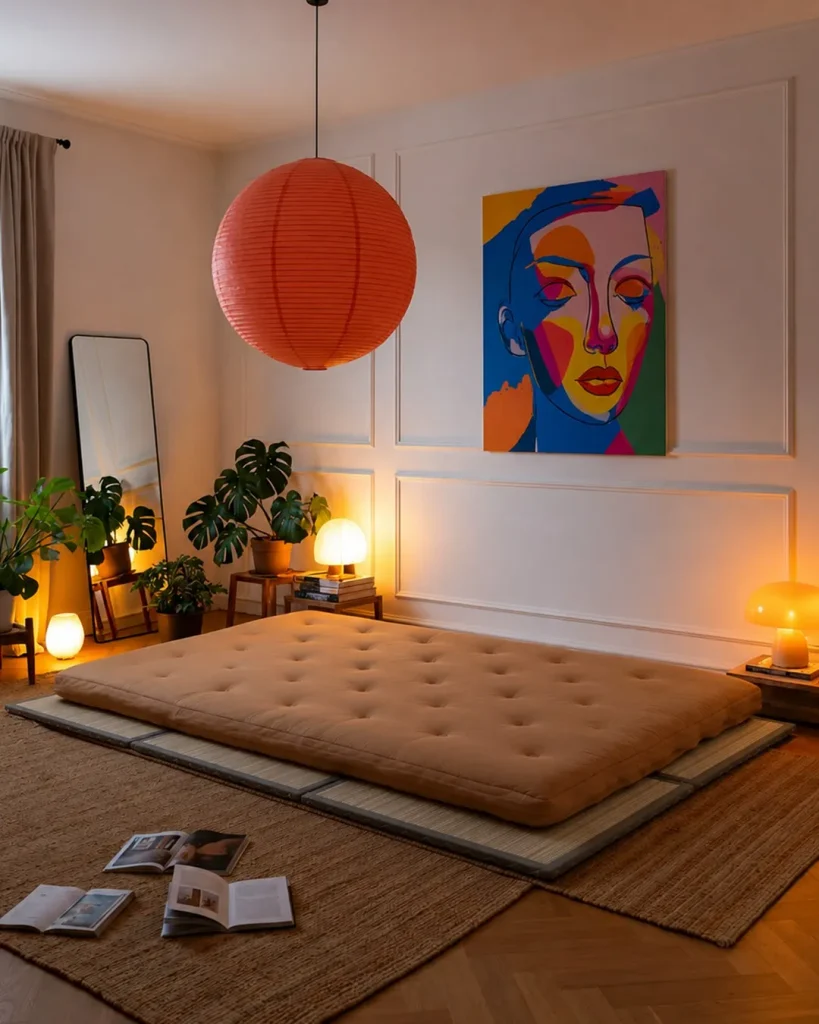
No frame, no headboard, no legs. A thick tufted futon resting on woven mats keeps everything close to the ground, and that low line is the whole trick. With nothing tall in the middle of the room, more of the wall stays open above the bed, so the ceiling feels higher.
Squeeze in a cozy corner with these reading nook ideas for small bedrooms.
The rest of the room stays low to match. Small glowing lamps sit on stacks of books and short stools instead of nightstands, while a big coral paper lantern pulls your eye up. One bold painting handles all the color.
Renting? No frame means nothing to assemble, haul, or store when your lease ends.
Set up your own floor bed
Lay down a breathable base, like woven mats or a low slatted platform, instead of bare floor.
Add a thick futon or folding mattress that’s light enough to lift on your own.
Keep lamps and side surfaces low. A short stool or a stack of books works fine.
Prop the mattress up or air it out every week or so, so moisture can’t build up underneath.
8. Mount a Floating Nightstand With Its Own Light Built In
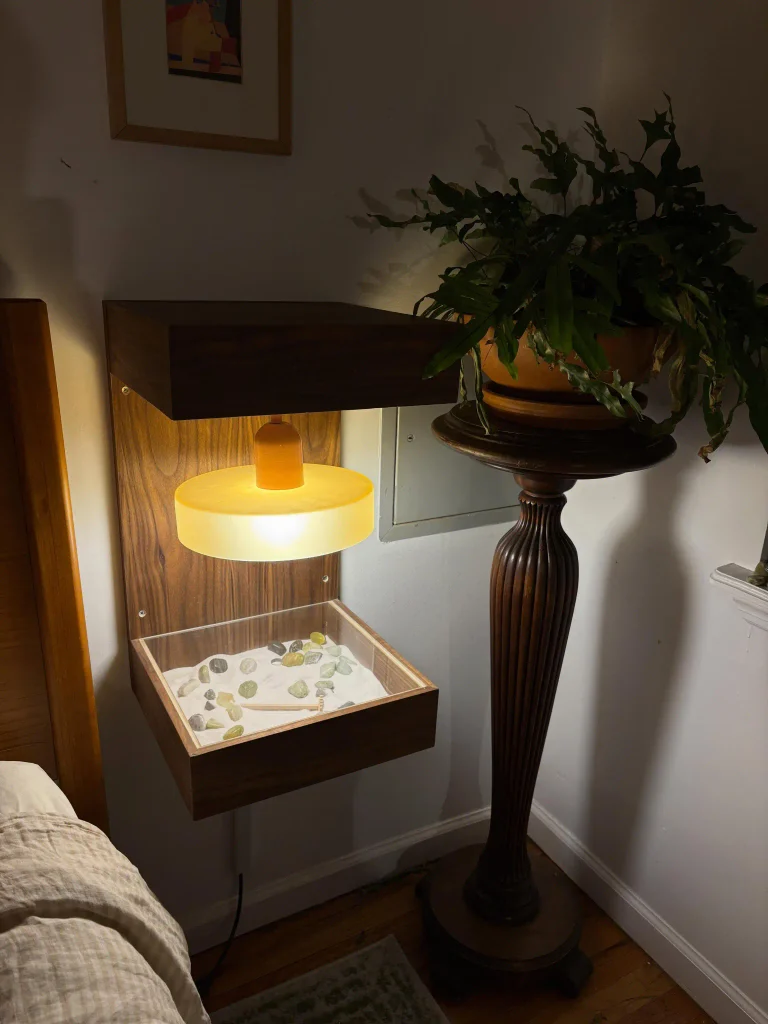
Nightstand, lamp, and display all live in one slim wall unit here, and none of it touches the floor.
It works in three layers:
- A deep top box holds the light fitting and gives you a top surface for small things.
- A pendant with a warm amber shade hangs just under it, low enough to read by.
- Below, a shallow tray with a clear lid holds a tiny sand garden, stones and little rake included.
Right beside it, a tall carved pedestal lifts a big fern off the floor. The corner gets height and greenery without a wide pot crowding your feet when you get out of bed.
📌 Good To Know
A plug-in pendant or sconce runs its cord down the wall to the nearest outlet. Stick on a paintable cord cover, paint it your wall color, and the cord nearly disappears. No electrician needed.
9. Paint One Deep Green Wall and Mix Patterns on Repeat
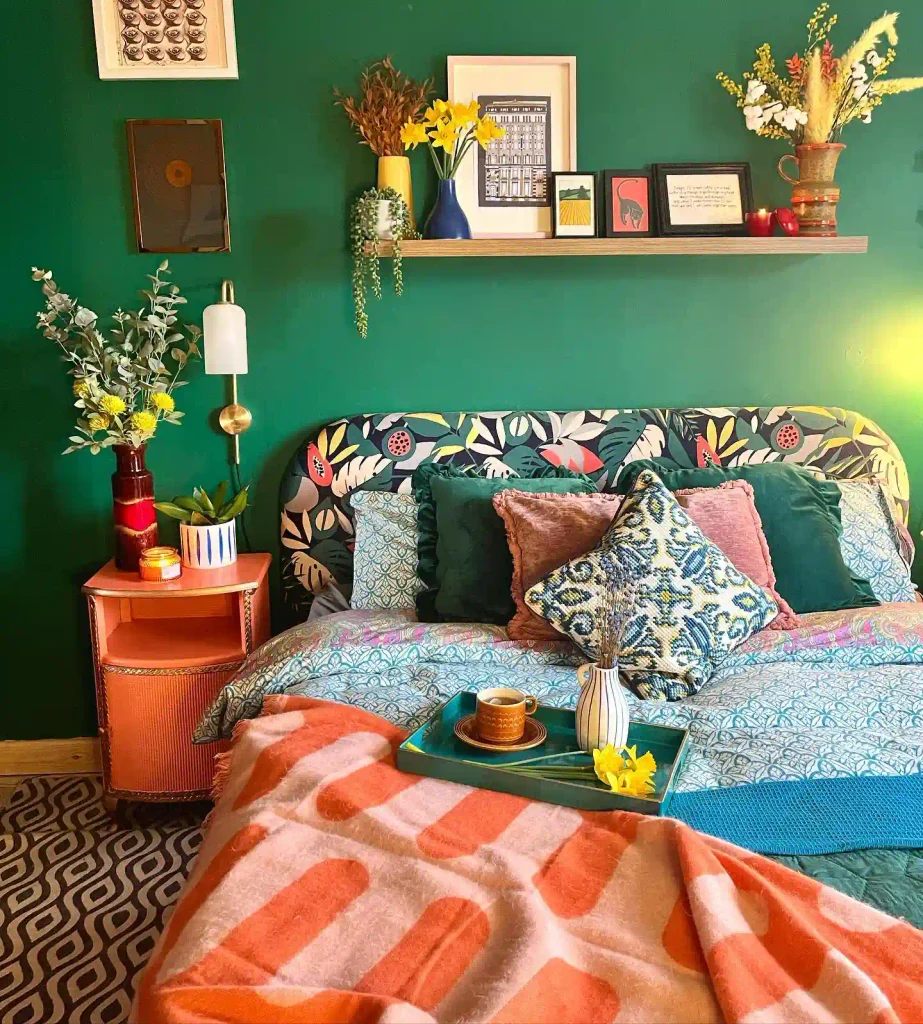
Small rooms don’t have to stay pale. Deep emerald paint covers this wall, and in a tight space it softens the corners so the room feels cozy rather than cramped.
Then comes the brave part. Almost every surface wears a pattern: a tropical fruit print on the curved headboard, a teal geometric duvet, a needlepoint pillow, a checked throw, and a wavy black and cream rug.
It holds together because the same four colors keep showing up in different spots, so your eye finds a rhythm instead of chaos.
One rule if you try this: mix big prints with small ones. Two large prints side by side start to fight.
The four colors on repeat
10. Fill the Gap Under Your Bed With Baskets, Boxes, and Books
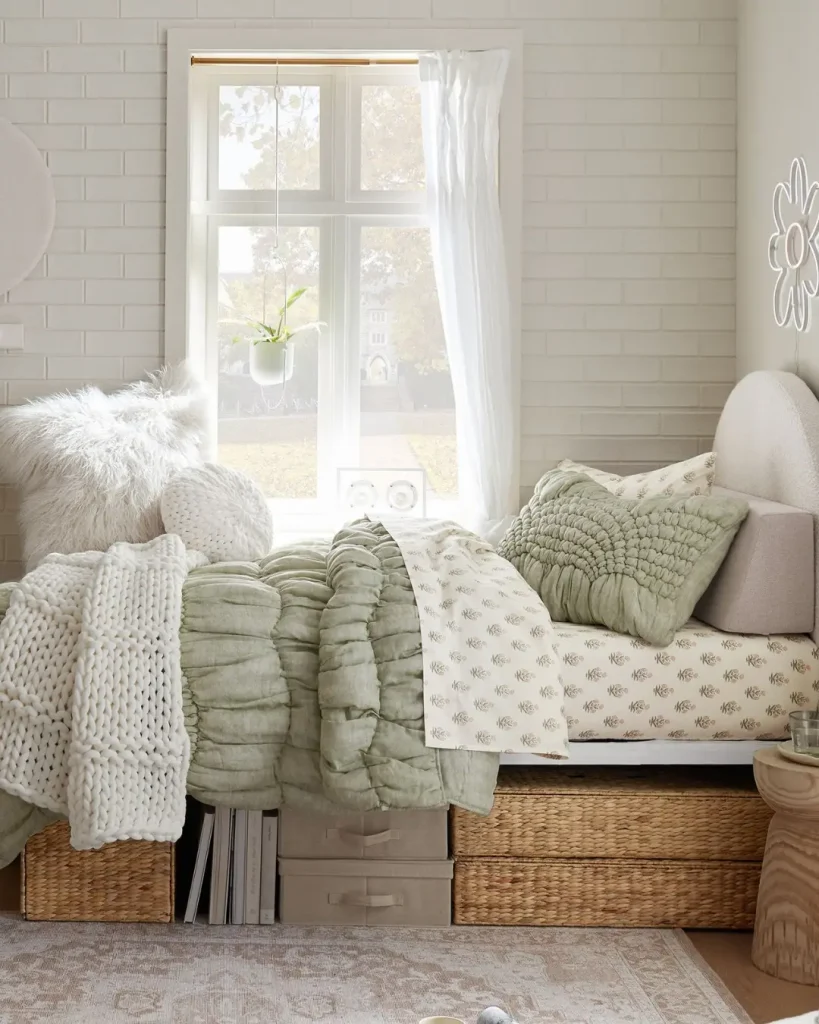
Every inch under this bed is working. Instead of one long plastic bin, the space holds a mix: low woven baskets, stacked fabric boxes with handles, and a row of books standing upright like a bookshelf laid on its side.
Mixing shapes makes it look styled on purpose, not like overflow. The woven texture also echoes the wooden side table and the warm rug, so the baskets feel like part of the decor.
Up top, sage green bedding and a chunky knit throw keep things soft, and the bed sits lengthwise under the window so it doesn’t block the walkway.
Measure the gap under your bed before you shop. Baskets that almost fit are worse than none.
What goes where under the bed
| Container | Best for |
|---|---|
| 🧺 Lidded woven baskets | Off-season clothes and spare blankets |
| 📦 Fabric boxes with handles | Shoes and things you grab every week |
| 📚 Open gap, no container | Books and magazines standing upright |
| 🌙 Small basket near the pillow end | Chargers, an eye mask, tonight’s book |
11. Add Picture Frame Molding and Hang Art Inside the Panels
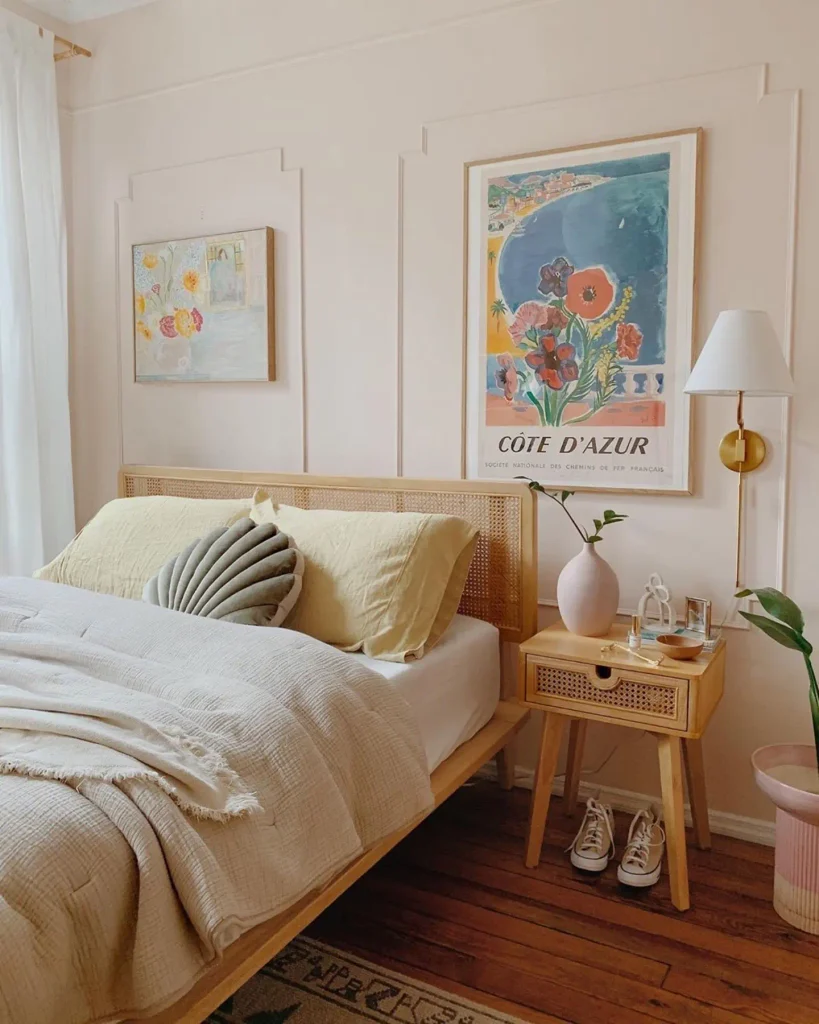
Plain walls can make a small bedroom feel flat, and a little trim fixes that without using an inch of floor.
Thin molding outlines tall panels on this pale blush wall. It’s painted the exact same color as the wall, so it reads as soft texture instead of clutter. Each piece of art then hangs inside its own panel, which makes even a simple print look framed twice.
Want to try it?
- Sketch the panel shapes on the wall with painter’s tape first.
- Cut thin trim to size and attach it with construction adhesive or small finishing nails. Renters can look at lightweight peel-and-stick trim instead.
- Paint the wall and trim in one color.
Underneath, a cane headboard and a leggy little nightstand keep the furniture feeling light.
Tone-on-tone trim gives a small room depth and a finished look without adding one more object to dust, move, or trip over.
12. Use a Slim Three-Drawer Chest as Your Nightstand
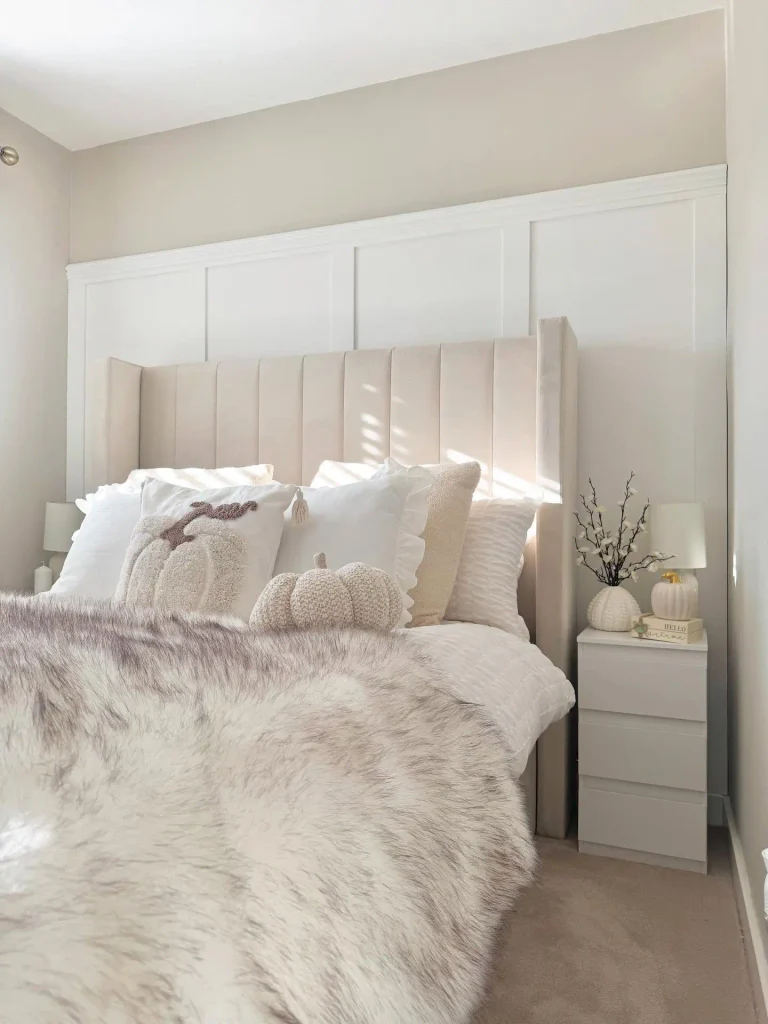
Short on width beside the bed? Look at the white chest next to this one. It’s narrow and tall, with three drawers stacked up instead of one wide drawer spread out.
That shape matters in a tight room. The slim footprint leaves walking space beside the bed, and the extra height adds real storage, like a mini dresser hiding in plain sight. The top still fits a small lamp, a vase of blossom stems, and a ceramic pumpkin.
Behind it, a tall channel-tufted headboard pulls the eye upward and keeps the bed the clear focal point.
For fall, the only changes are pumpkin pillows and a faux fur throw. Easy to swap in, easy to store away.
Give every drawer a job
13. Mount a Swing-Arm Sconce and Keep the Nightstand Bare
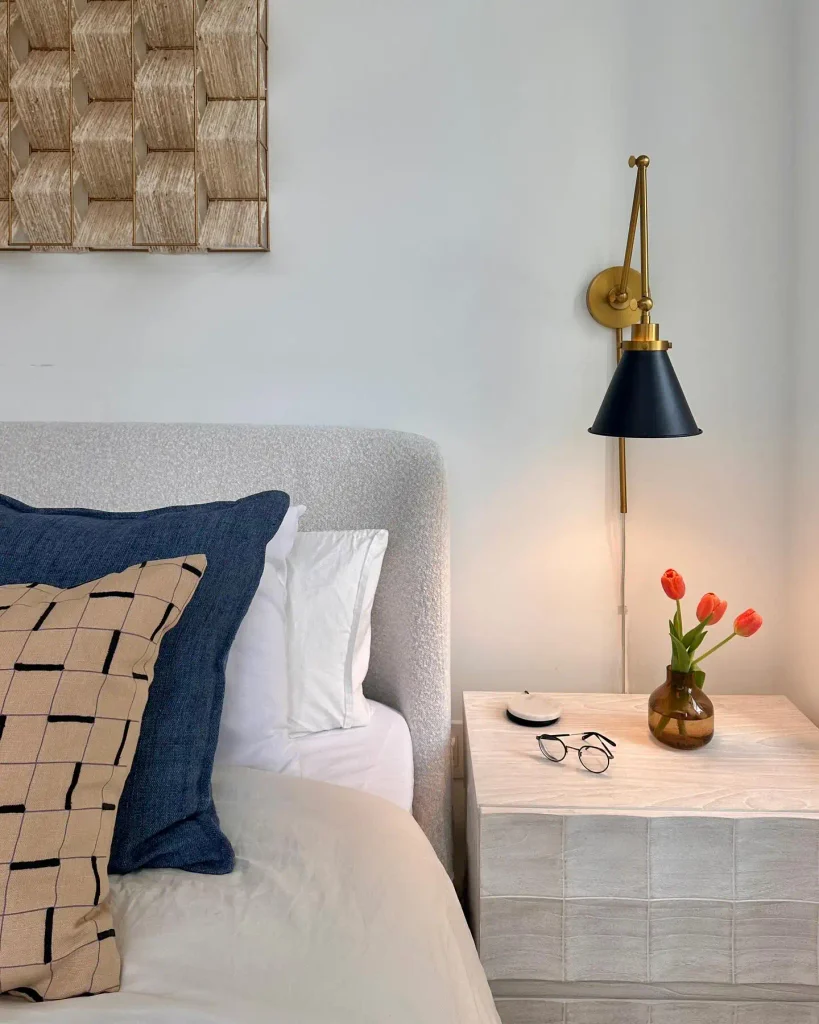
Three things sit on this nightstand: reading glasses, a small round dish, and an amber vase of orange tulips. That’s it.
The lamp is the reason it stays so clear. A brass swing-arm sconce hangs on the wall instead, with a black cone shade you can pull out over the pillow to read, then fold back when you’re done. Its cord runs straight down the wall toward the outlet behind the bed.
In a small bedroom, every object you take off a surface makes the whole room feel calmer.
A soft boucle headboard, a blue linen pillow, and woven wall art bring in texture, so the pared-back setup still feels warm.
| 💡 Table lamp | 🔆 Swing-arm sconce |
|---|---|
| Takes up a big part of the nightstand top. | Uses no surface space at all. |
| Light stays in one spot. | Swings out to aim light right at your book. |
| Easy to knock over reaching for your phone. | Stays put on the wall. |
| Nothing to install. | Plug-in versions need just a couple of screws, no wiring. |
14. Hang a Tall Mirror Beside the Bed on a Dark Wall
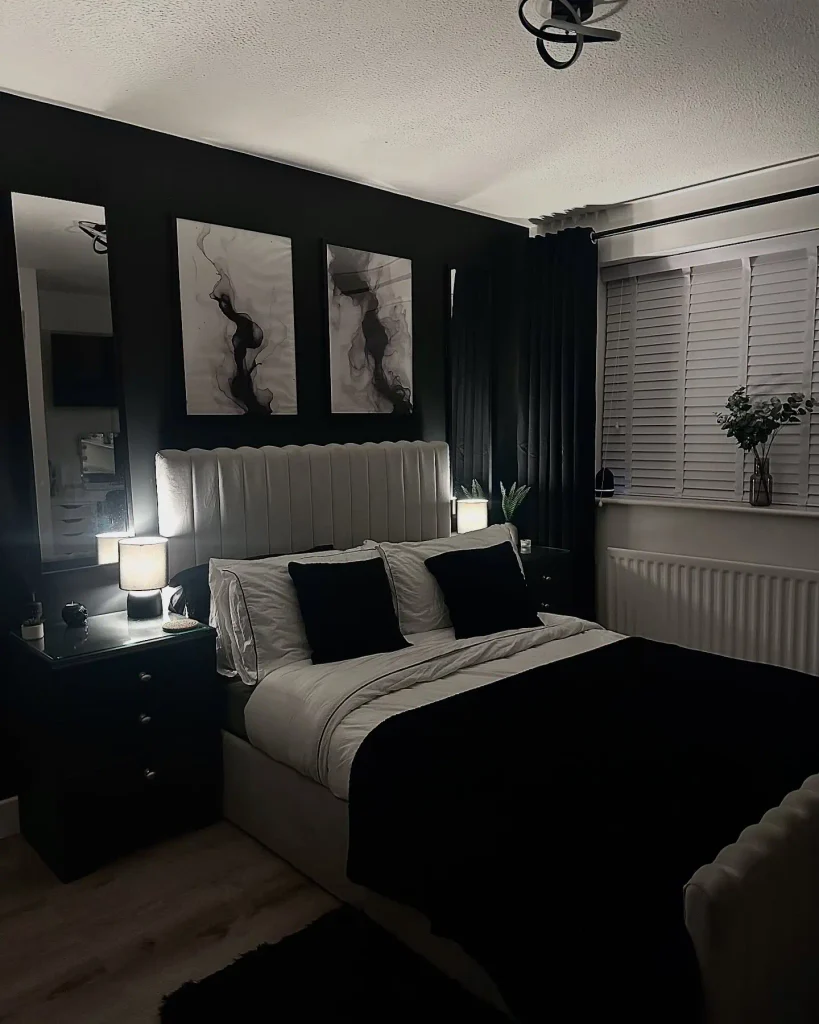
Black walls in a small bedroom sound risky, but this room shows how to keep the dark from closing in.
The trick is a tall, narrow mirror hung beside the bed. It catches the glow from the bedside lamp and reflects the lighter side of the room, so the black wall gets a bright panel of its own.
The rest of the room stays balanced with simple contrast:
- A white channel-tufted headboard and white bedding stand out sharply against the dark paint.
- Black and white ink prints above the bed repeat the color scheme.
- Black pillows, a black throw, and black nightstands pull the wall color down into the room.
Warm lamp light keeps it moody, not gloomy.
Hang the mirror vertically so it stretches the wall and makes the ceiling feel taller.
Place it where it catches a lamp or window, so it bounces light into the dark corners.
Aiming it at your laundry pile or a cluttered desk. A mirror doubles whatever it faces.
Leaning a heavy mirror loose by the bed. Secure it to the wall so it can’t tip.
15. Hang Curtains Just Below the Ceiling and Wider Than the Window
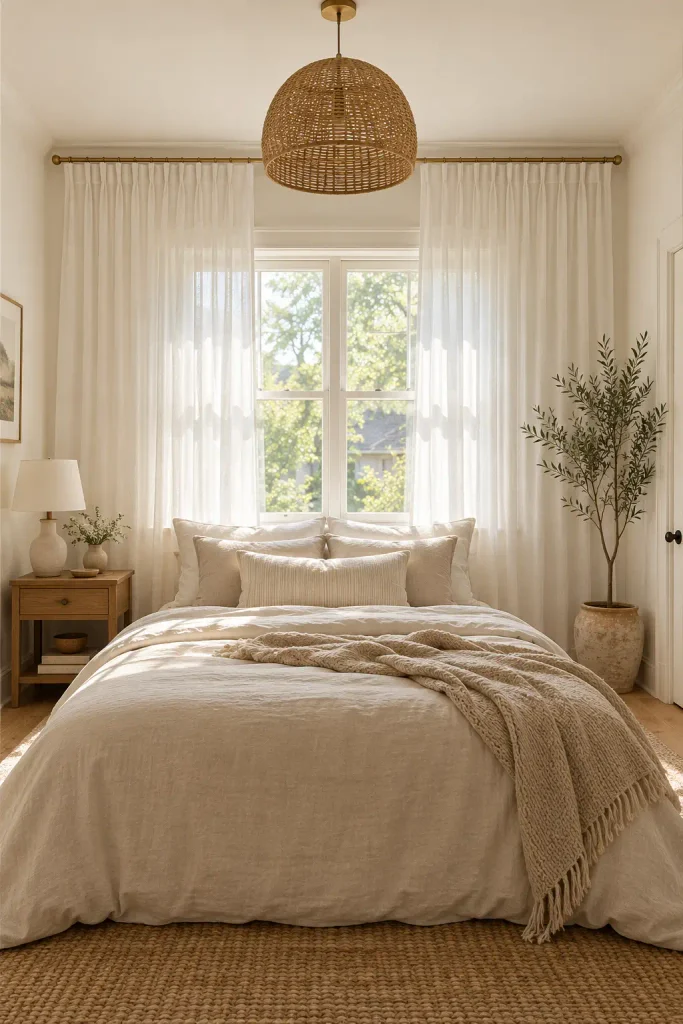
Most curtain rods get mounted right above the window frame, and that one habit makes a low ceiling look even lower.
Move the rod up until it sits just under the ceiling, and let the panels fall all the way to the floor. Your eye follows that long line from top to bottom, so the wall reads taller than it is.
Go wider too. When the rod extends past the frame on both sides, open curtains rest against the wall instead of covering the glass. You keep every bit of daylight, and the window looks bigger.
Light linen in a shade close to your wall color works best. Heavy, dark drapes would cancel out the whole effect.
Get the height right
Measure from the floor to just under the ceiling. That’s your panel length, not the window height.
Shop for extra-long panels if standard ones fall short. They should just touch the floor.
Pick a rod long enough to reach a hand’s width or more past the frame on each side.
Renting? Ask before drilling, or look at tension rods and no-drill brackets made for window frames.
16. Push the Bed Into a Corner and Give the Wall Side a Daybed Back
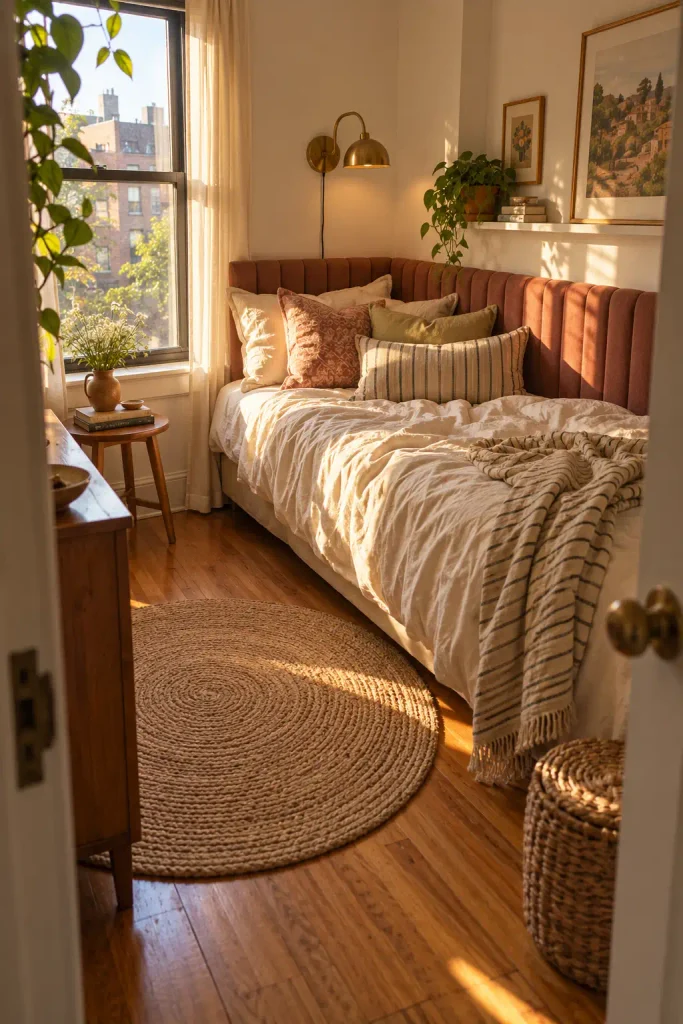
Centering the bed feels like the rule, but in a room under 100 square feet it splits your floor into two skinny strips nobody can use.
Slide the bed into a corner, long side against the wall, and all your open floor lands in one usable piece.
Then make the wall side look intentional:
- Mount a long upholstered panel or line up big cushions along the wall so it works like a daybed back.
- Add a slim ledge or a plug-in light on that wall for your phone and late-night reading.
- Stack a few pillows along the side for lounging during the day.
Fair warning, a corner bed is harder to make. A fitted sheet and a duvet you can shake out beat tucked-in layers.
Bed in the middle of the wall. Two narrow paths on either side, too tight for a chair, a rug, or even getting dressed comfortably.
Bed in the corner. One open patch of floor with room for a small rug, a reading chair, or a yoga mat.
17. Swap the Closet for a Clothing Rail Behind a Curtain
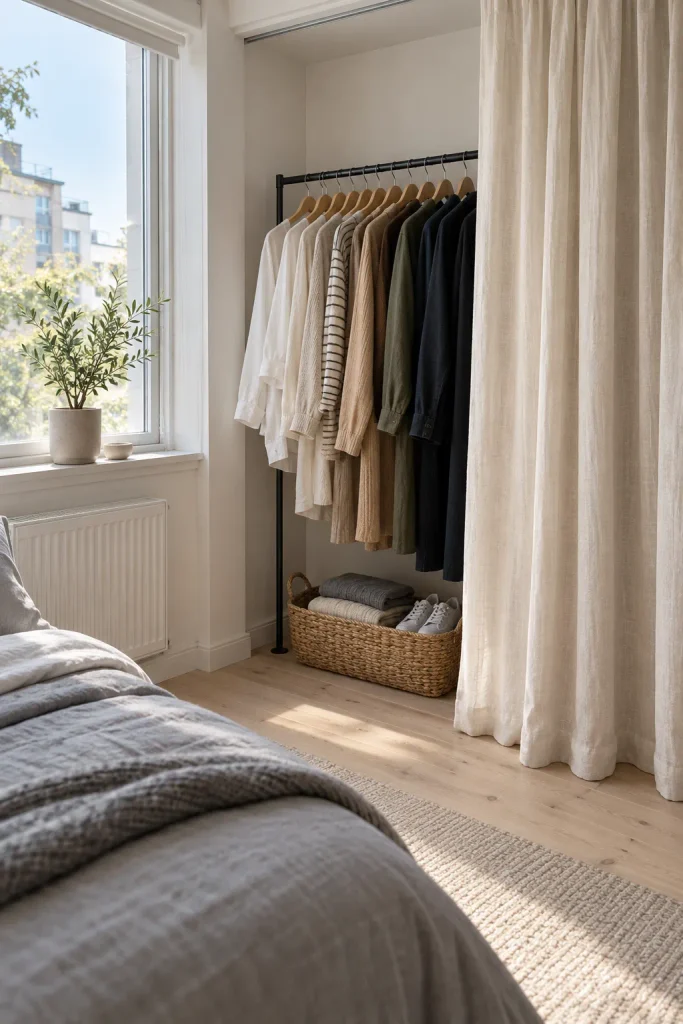
Plenty of small bedrooms come with a tiny closet or none at all. A slim clothing rail along one wall solves it, and a simple curtain makes it look built in.
Here’s the setup:
- Choose a narrow freestanding rail, or a ceiling-mounted rod in a nook or beside the door.
- Hang a ceiling-height curtain track in front of it.
- Pick curtain fabric close to your wall color so it blends in when closed.
Leave it open on days you want to see your clothes, then pull it shut when friends come over. It usually costs less than a wardrobe and takes up less floor, too.
Keep an open rail looking calm
18. Paint an Arch Behind the Bed Instead of Buying a Headboard
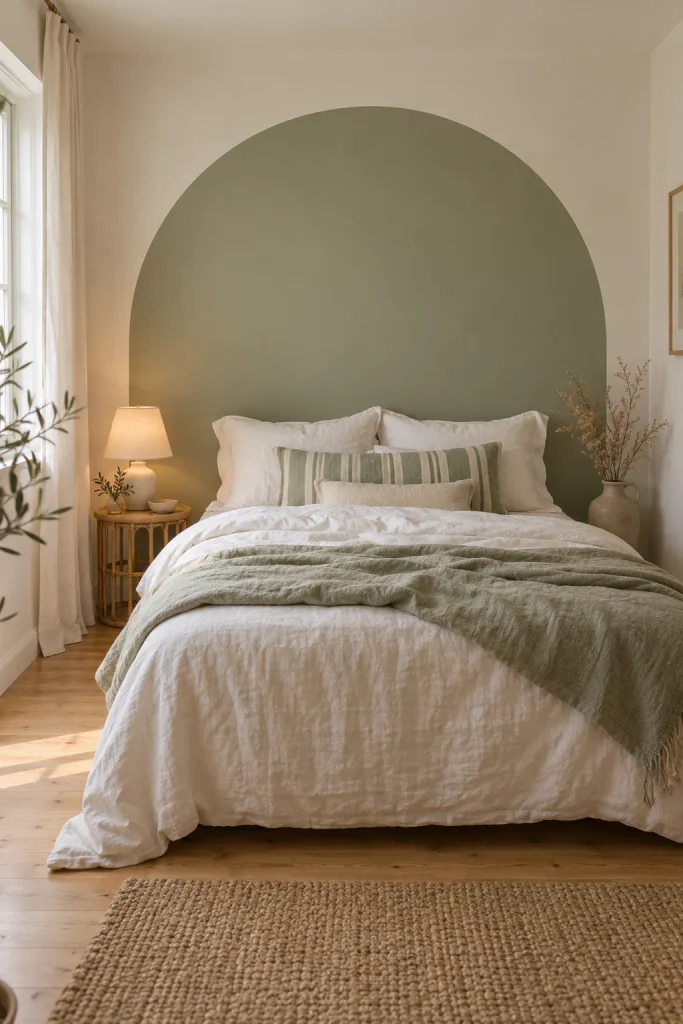
Headboards cost money and steal a few inches of depth, which matters when the bed already nearly touches the walls. A painted arch does the same job with one small can of paint.
Center a tall arch behind the bed, a little wider than the mattress, and run it down to the floor. The curve frames the bed the way a headboard would, and the color gives a plain white wall real personality.
Pick a shade a step or two deeper than the wall, like clay, sage, or dusty blue. Anything too bright starts to shout in a small room.
Moving out later? A coat or two of the original wall color covers it, but check your lease before you start.
19. Turn the Back of the Door Into Storage
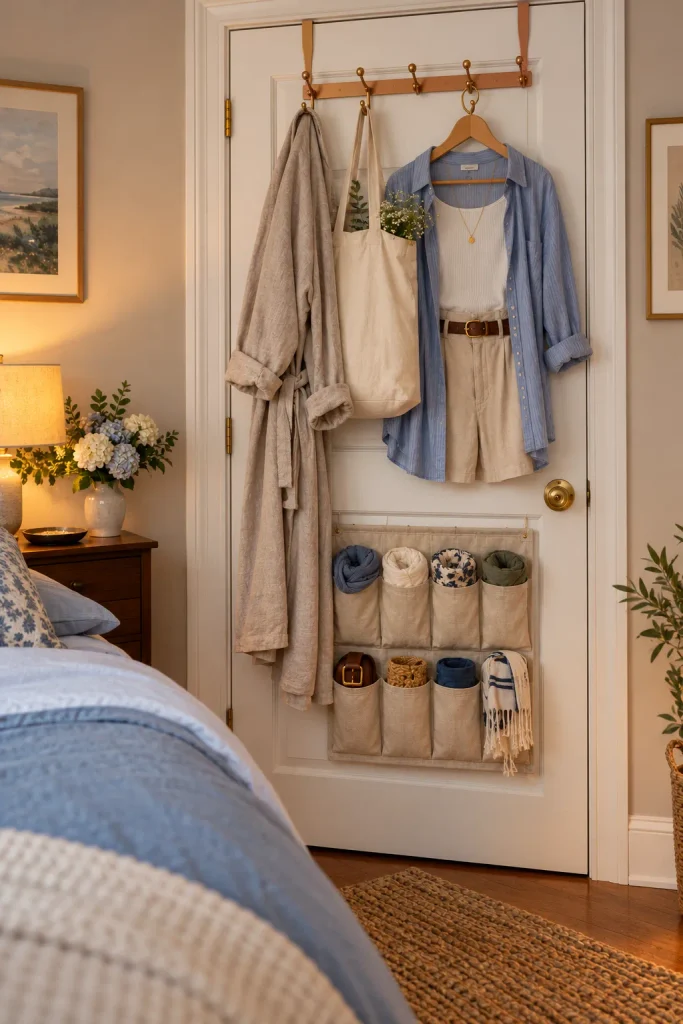
Most bedroom doors hide a full panel of storage that nobody touches. In a room this small, that’s too much space to waste.
Over-the-door hooks and organizers go up without tools, so they’re easy for renters. A few ways to put the door to work:
- A slim pocket organizer for scarves, belts, and small accessories.
- A row of hooks for tomorrow’s outfit, a robe, and your bag.
- A full-length mirror that hooks over the top, so you don’t need wall space for one.
Keep the load light enough that the door still swings and closes smoothly. If it starts to stick or sag, you’ve hung too much.
📌 Good To Know
Check your door’s thickness before you buy. Many over-door hooks only fit standard doors. A small strip of felt under each hook keeps the paint and frame from getting scratched.
20. Wallpaper the Ceiling Instead of the Walls
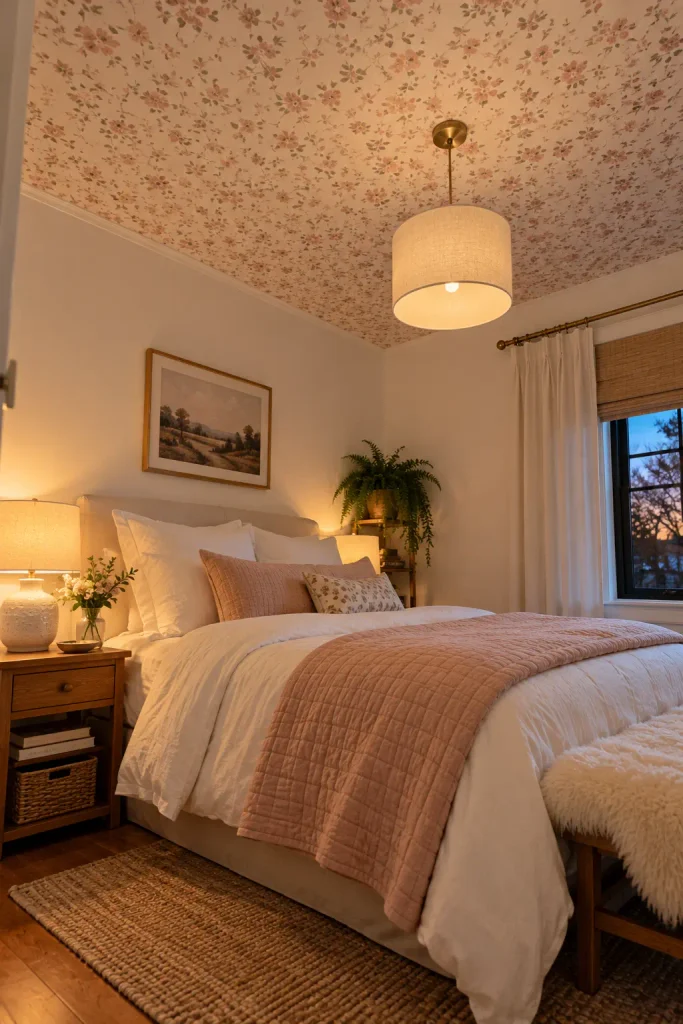
The ceiling is the biggest blank surface in a tiny bedroom, and almost nobody decorates it. Wallpaper up there adds pattern and charm without taking an inch from the walls or floor.
A soft, small-scale print works best, like tiny florals, delicate stars, or a faint grid. Paired with plain walls, it feels cozy rather than busy, a bit like sleeping under a canopy.
How to tackle it:
- Choose peel-and-stick paper if you rent, and test a small piece first.
- Mark a straight line down the center of the ceiling and work outward from it.
- Get a helper. Holding paper overhead alone is a fast way to lose your patience.
Pick a light background with a small, soft pattern.
Keep the walls plain so the ceiling is the one special moment.
Dark, oversized prints on a low ceiling. They can make it feel like it’s pressing down.
Peel-and-stick on a bumpy textured ceiling. It won’t grip well and may peel off.
21. Choose a Lift-Up Storage Bed Instead of One With Drawers
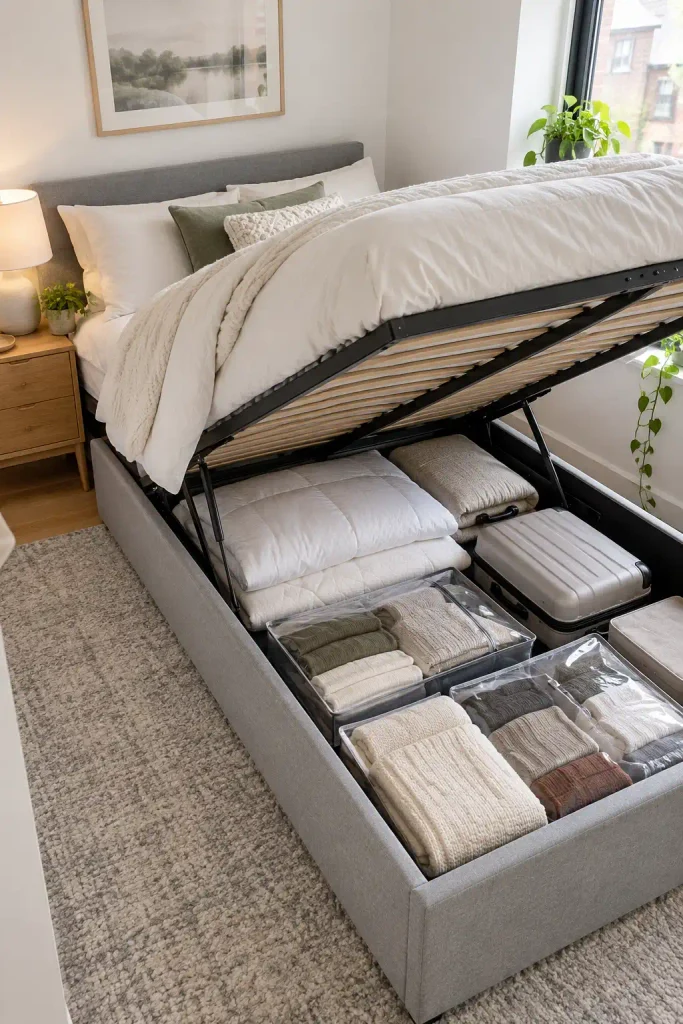
Drawers under a bed need floor space to pull out, and in a tight room there often isn’t any. A lift-up storage bed skips that problem. The whole mattress base rises on gas lifts, a bit like the hood of a car, and opens onto one big storage well.
Pair a lift-up bed with furniture that doubles as storage and you gain even more hidden space.
What fits inside:
- Spare duvets and pillows with nowhere else to go.
- Suitcases and travel bags between trips.
- Off-season clothes packed in flat zip bags.
It works best for things you need every few weeks, not every morning, since you’ll lift the mattress each time.
Test the lift in a store if you can. It should rise smoothly with one hand.
| 🗄️ Drawer bed | ⬆️ Lift-up bed | |
|---|---|---|
| Floor needed | Clear space to pull drawers out | None beside the bed |
| Storage | A few separate drawers | The full space under the mattress |
| Daily access | Quick | Slower, you lift the mattress |
| Best for | Everyday clothes | Bulky things you use now and then |
22. Pick Clear Acrylic Furniture That Almost Disappears
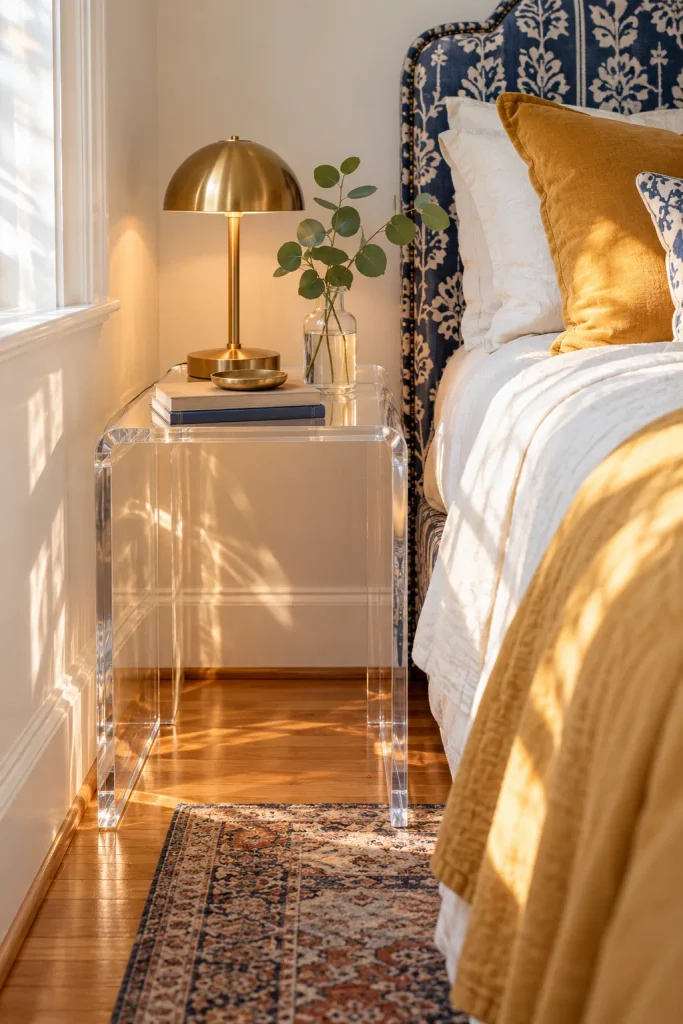
Clear furniture has one big advantage in a tiny room: you can see straight through it. An acrylic nightstand or a glass-topped side table does its job without blocking the floor or the wall behind it, so the room looks less full than it really is.
It helps most in the busiest spots. Next to a patterned headboard, under a window, or in the narrow gap between the bed and the wall, a clear piece keeps things from feeling crowded.
The catch is that clear surfaces show fingerprints and dust fast. Keep a soft cloth nearby, and limit the top to two or three items so it stays light.
Where clear pieces help most
23. Mount a Fold-Down Desk That Closes Into a Slim Cabinet
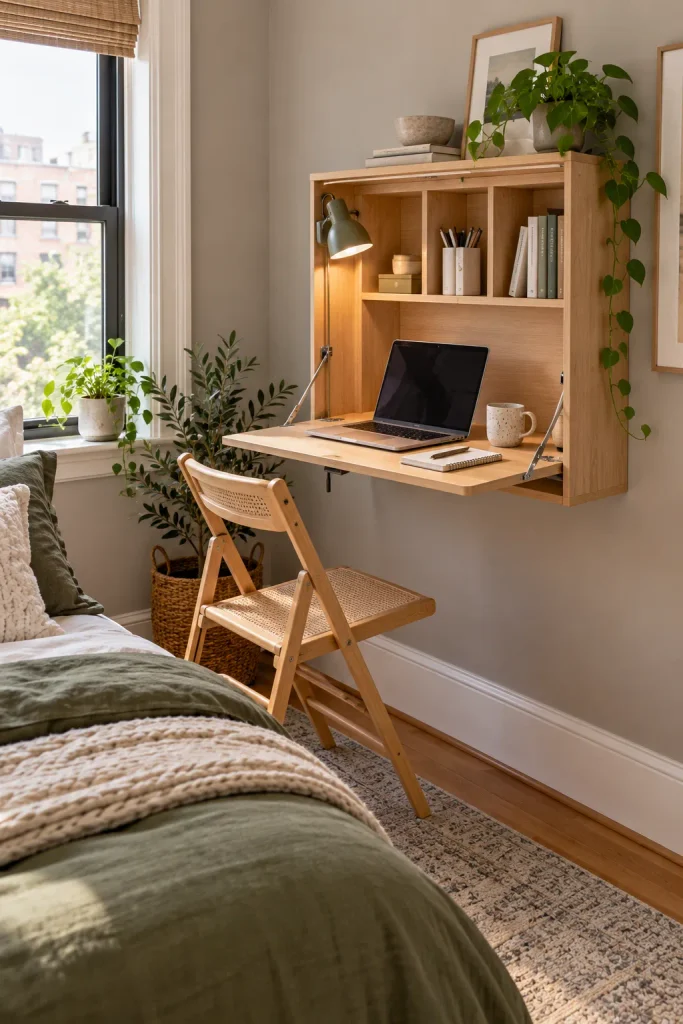
A full desk rarely fits in a bedroom under 100 square feet. A wall-mounted fold-down desk does, because it sits barely deeper than a shelf until you need it.
Open, the front panel drops into a work surface for a laptop and a mug. Closed, it’s a slim cabinet hiding notebooks, chargers, and pens, and the floor in front goes back to being floor.
Before you buy:
- Measure the wall and make sure the open desk won’t block the door or the bed.
- Plan to anchor it into wall studs, since it carries weight when open.
- Choose a stool or folding chair that tucks under or hangs on a hook.
- Renters, get your landlord’s okay first.
A slim cabinet on the wall. The floor stays clear, and the room feels like a bedroom again, not an office.
A ready desk with room for a laptop, plus little cubbies inside that keep pens and chargers within reach.
24. Hang a Sheer Canopy or Ceiling Curtain to Make a Bed Nook
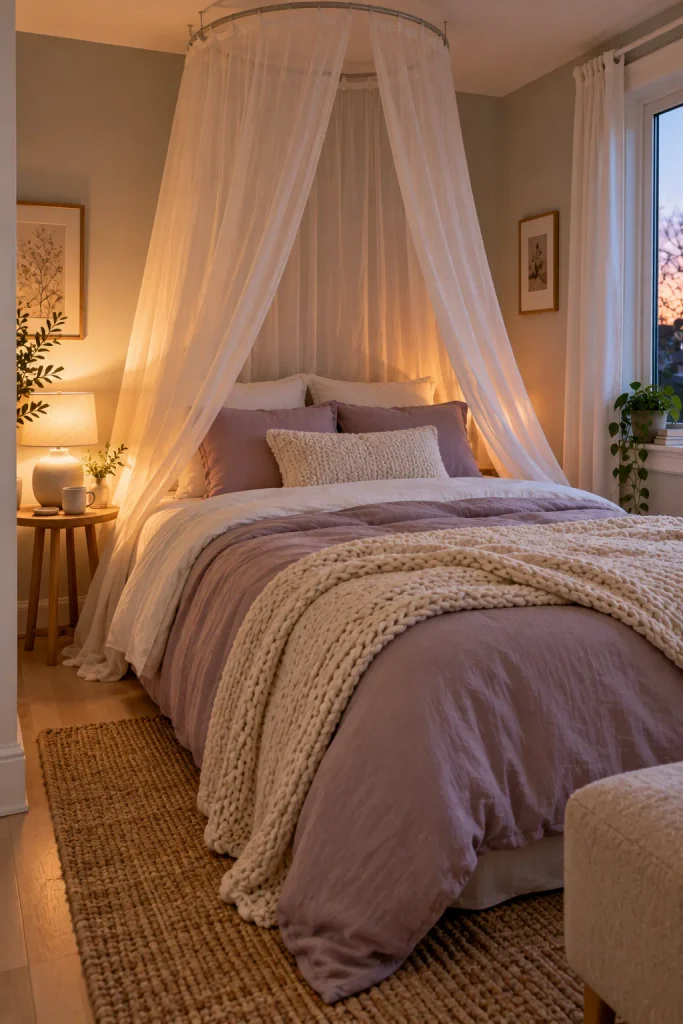
Fabric hung from the ceiling can turn a plain bed into a cozy little nook, and it takes up zero floor.
There are two easy ways to do it. A ceiling hoop hangs above the pillows and drapes sheer fabric down around the head of the bed, which feels soft and dreamy. A ceiling curtain track running alongside the bed works more like a room divider, handy in a studio where the bed shares space with a sofa or desk.
Either way, the bed feels tucked away from the rest of the room, and that sense of being wrapped in is surprisingly calming at night.
Ceiling hooks and tracks need secure fixings, so use anchors made for your ceiling type.
Fabric that works
- ▸Sheer voile for a light, airy canopy that lets daylight through.
- ▸Linen gauze for a softer, more relaxed look.
- ▸Heavier cotton only for a studio divider where you want real privacy.
- ▸Keep all fabric well away from candles and hot bulbs.
25. Run a High Shelf Around the Room Above Door Height
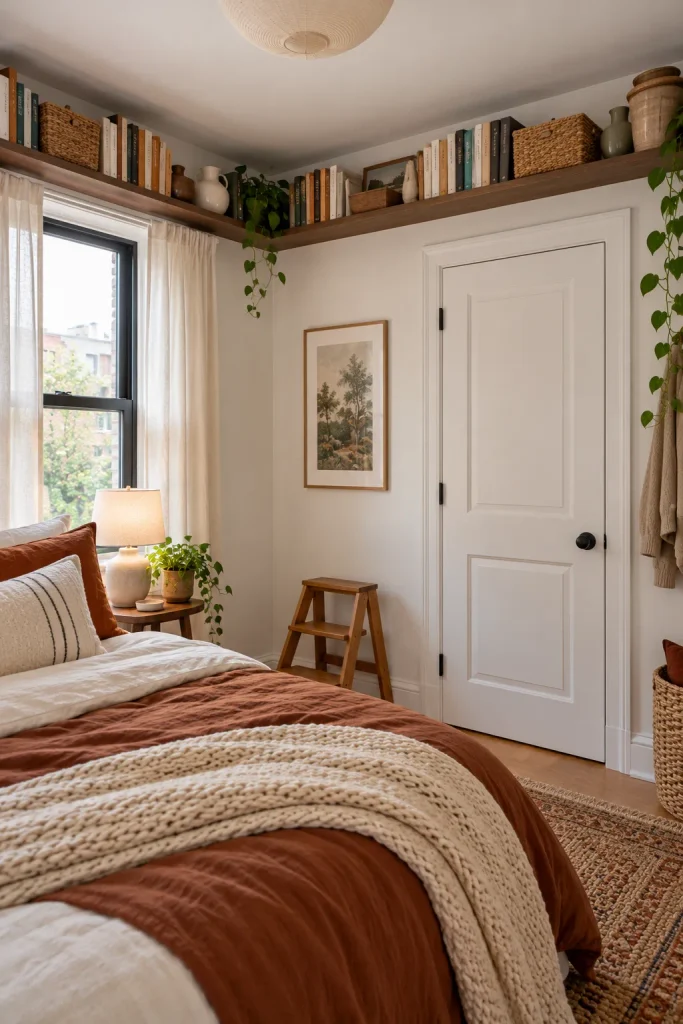
What’s sitting above your door frame right now? Probably nothing. A long shelf running around the top of the room, just above door height, turns that dead zone into a home for things you own but rarely reach for.
What belongs up there:
- Books you’ve finished and want to keep.
- Lidded baskets of off-season accessories.
- A few favorite objects that give the room character.
Because it sits so high, it doesn’t crowd anything at eye level. Your eye reads it as one clean line circling the room.
Keep a small step stool nearby. You’ll need it.
The strip between your door frame and the ceiling sits empty in most bedrooms. A high shelf puts it to work without taking a single step of floor.
26. Clip a Bedside Caddy to the Mattress When a Nightstand Won’t Fit
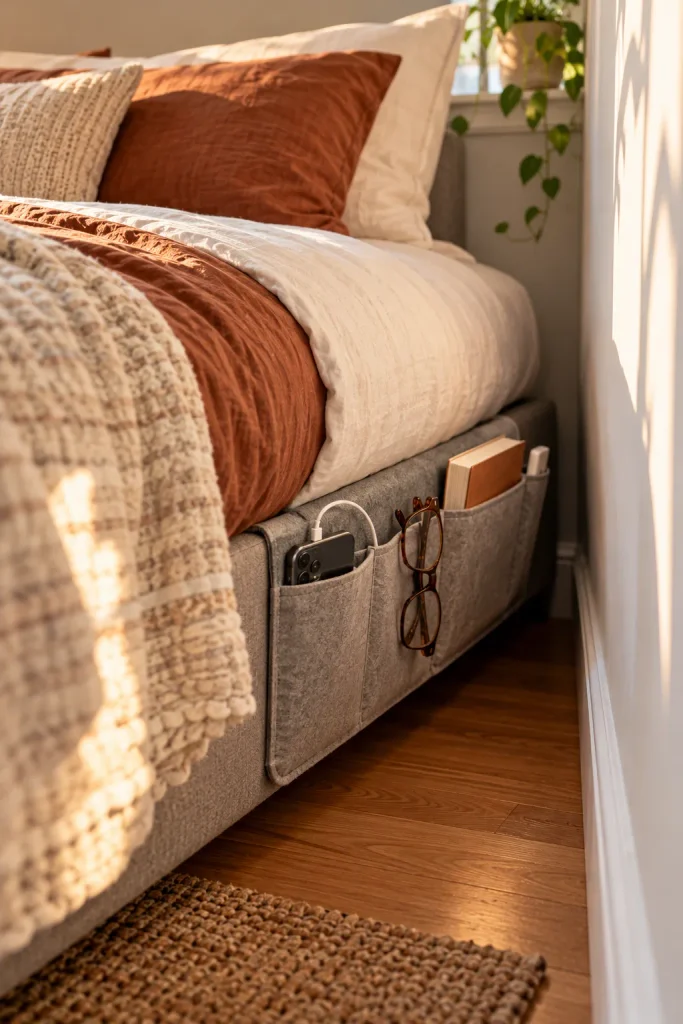
Some beds sit so tight against the wall that even a slim nightstand won’t fit. A bedside caddy fixes it. A flat panel slides between the mattress and the bed base, and the pockets hang down the side of the bed, right where your hand lands at night.
Phone, charger, glasses, remote, a paperback. Everything stays within reach, and nothing ends up on the floor.
Felt and canvas caddies look calmer than shiny plastic ones, and a color close to your bedding helps them blend in.
Small fix, no tools, done in a minute.
27. Hang One Large Piece of Art Instead of a Gallery Wall
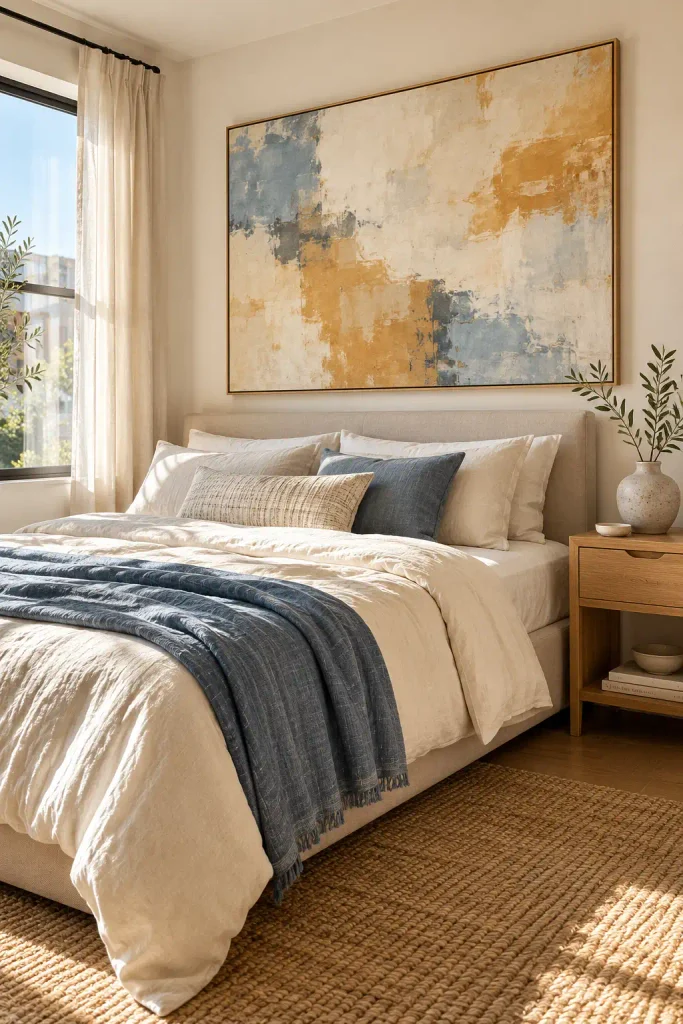
Six small frames on a tiny wall can look busy fast. One big piece usually looks calmer, and it makes a small bedroom feel more grown-up.
Hang a single large print or canvas above the bed, close to the width of the mattress or a little narrower. Why it works:
- Your eye rests on one thing instead of hopping between many.
- Fewer nail holes, which your landlord will appreciate.
- A big piece makes a small room feel confident rather than cramped.
Pick something that repeats a color from your bedding, and hang it a hand’s width or so above the headboard so it feels connected to the bed.
Choose a lightweight canvas or a frame with acrylic instead of glass, since it hangs over your head.
Can’t drill? Lean it on a sturdy picture ledge behind the bed.
Hanging it so high it floats near the ceiling, cut off from the bed.
Relying on a single sticky strip for anything heavy. Use proper hooks rated for the weight.
28. Size Up Your Rug So It Tucks Under the Bed
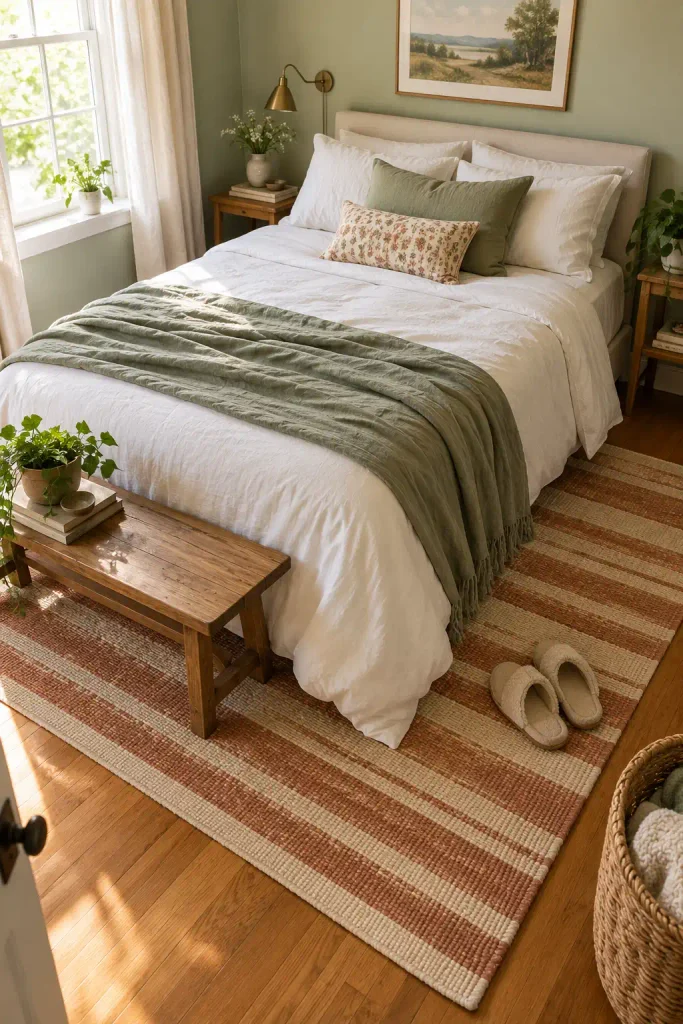
A rug that’s too small is an easy mistake in a tiny bedroom. A little mat floating in the middle of the floor chops the room into pieces and makes it look smaller.
Go bigger than feels natural. Tuck the rug partly under the bed so it peeks out on the open sides, or run a long narrow runner along the one side you actually walk on. Your feet land somewhere soft in the morning, and the floor reads as one connected space.
Low-pile and flatweave rugs are easiest here. They won’t catch on a door that swings over them.
Place it right
Measure the open floor around the bed, not the whole room.
Slide the rug under the lower part of the bed, leaving the nightstand legs on the bare floor.
If your bed sits against a wall, skip the big rug and use one long runner on the open side.
Check that the door clears the rug before you buy, and add a non-slip pad underneath.
29. Layer Three Kinds of Warm Light Instead of One Overhead
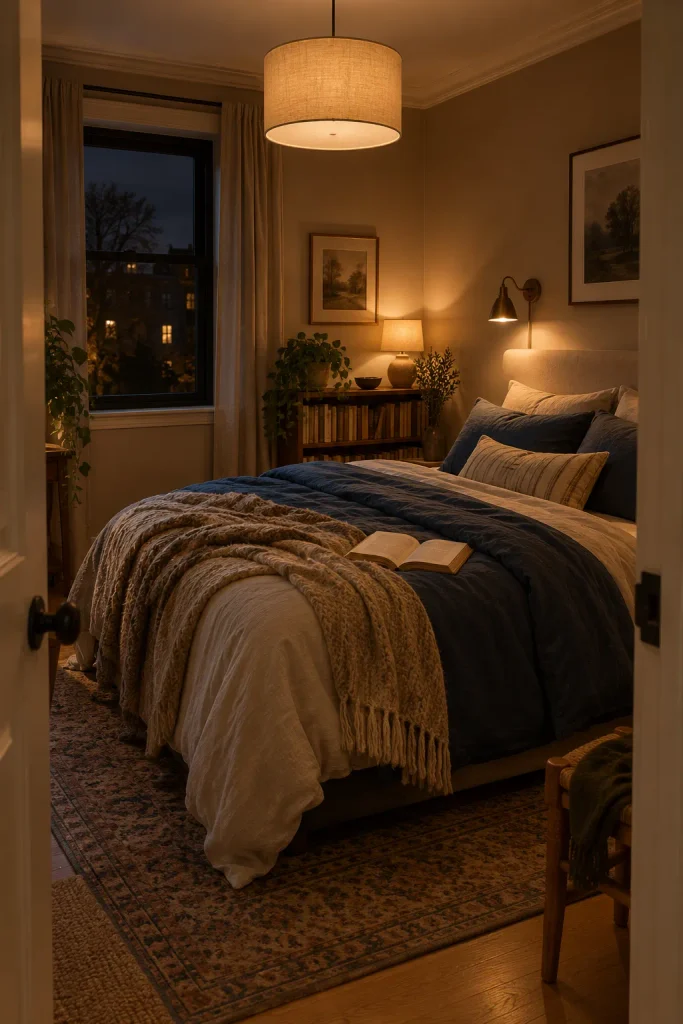
Does your bedroom rely on one bright light in the middle of the ceiling? That single glare flattens a small room and makes every corner feel tight.
Pair them with bedroom lighting ideas that make a small apartment feel cozy.
Layering three kinds of light fixes it. A soft overhead for getting dressed and cleaning, a reading light near the pillow, and one low glow somewhere else, like a small lamp on a shelf or the floor. Switch the overhead off at night and the room suddenly has depth and gentle shadows.
Use warm white bulbs everywhere. Smart bulbs or plug-in dimmers let you turn things down in the evening without rewiring anything.
Your three layers
30. Size Down the Bed and Pick a Slimmer Frame
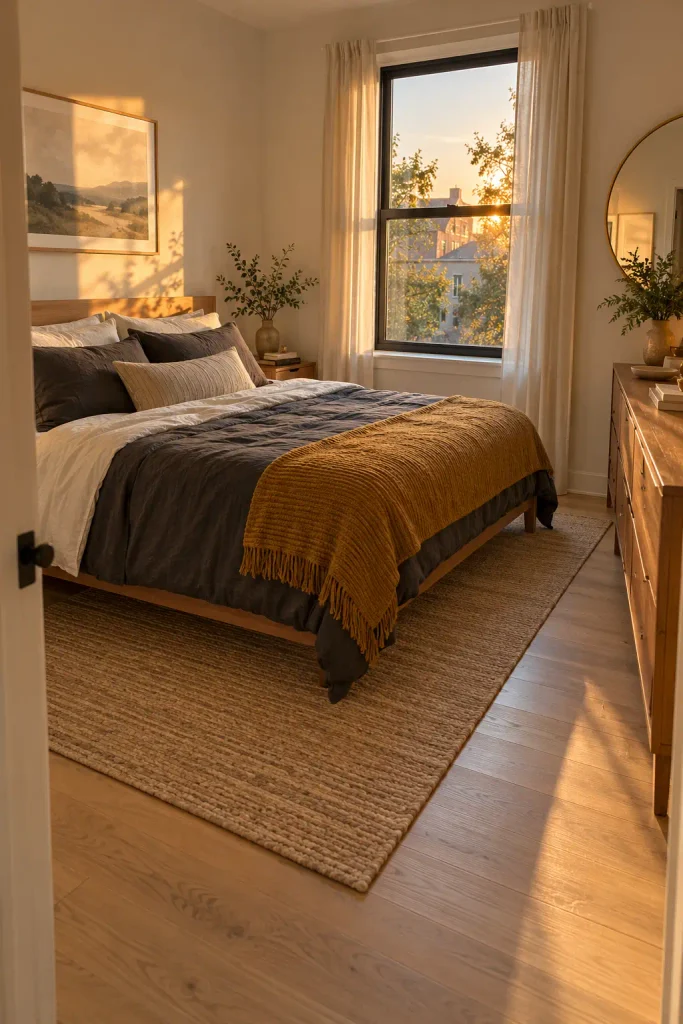
The bed is the biggest thing in a small bedroom, so its size decides how everything else works. Before buying more storage, ask whether you really need the bed you have.
Going from a queen to a full gives back about six inches across the room, which can be the difference between squeezing past the bed and walking past it. For one sleeper, a twin frees up even more.
The frame matters as much as the mattress:
- Skip footboards, which add length you’ll bump your shins on.
- Choose a slim headboard over a deep, heavily padded one.
- Look for a frame that sits flush with the mattress, not one with a wide wooden ledge around it.
Which bed fits your room? (standard US sizes)
| Bed | Mattress width | Best for |
|---|---|---|
| 🛏️ Twin | About 38 in | One sleeper who wants the most floor |
| 🛏️ Full | About 54 in | One sleeper who likes room to sprawl |
| 🛏️ Queen | About 60 in | Couples, if the room can spare the width |
Conclusion
A tiny bedroom asks you to be choosy, and that’s not a bad thing. When every piece has to earn its spot, the room ends up feeling more like you.
Start with the change that fixes your biggest daily annoyance. Maybe it’s the lamp crowding your nightstand, the clothes with nowhere to go, or the bed blocking the walkway. Fix that first, then layer in the fun parts like paint, art, and a cozy canopy.
Small steps add up fast in a small room.
Found an idea you want to try? Save this post to your small space board on Pinterest so it’s ready when you start.
Easy weekend starts from this list